
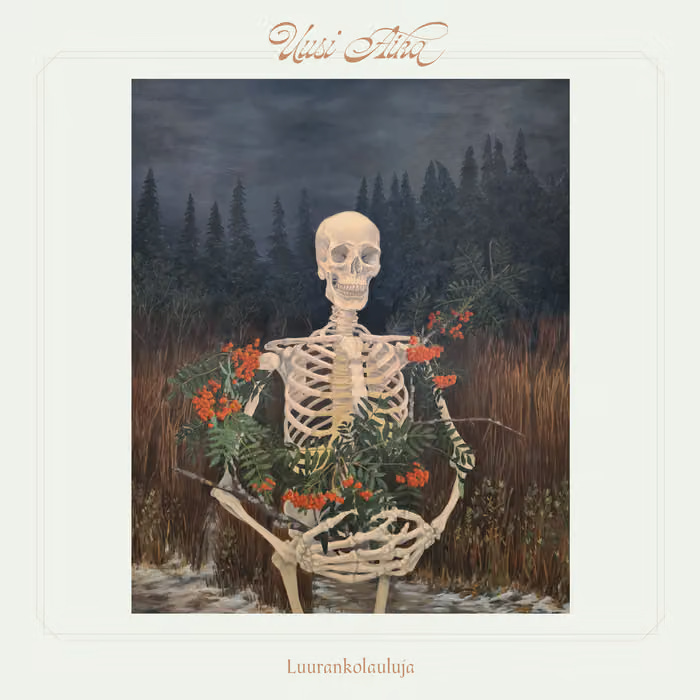
A few years ago, the Finnish ensemble Uusi Aika released their self-titled album, which left a very strong impression on me with its introspective take on spiritual jazz, enriched by elements of Indian music and a touch of Japanese ambient sound through the use of the shakuhachi. It was a cohesive record—at once highly melodic and free—featuring a particularly striking, almost epic culmination in the composition “Henget.”
Somehow, I missed that they released a new album last November, so this review arrives four months “late.” Since I closely follow new releases from We Jazz Records, I didn’t notice that the new album, Luurankolauluja, came out on a different label, Puro Recordings, which I wasn’t familiar with until now. A great opportunity to explore their catalog as well.
Luurankolauluja, the second album by Uusi Aika, opens with Luurankouni, a shakuhachi kata rooted in ancient tradition and named after a poem by the 15th-century Japanese Zen poet Ikkyū.
This is a quote from the album’s Bandcamp description. Based on such an introduction, one might assume that Uusi Aika continue in the same vein as their debut. The core lineup remains largely the same: Amanda Blomqvist (drums, percussion, vocals), Otto Eskelinen (wind instruments, synths), Antero Mentu (guitar, sitar), and Tapani Varis (double bass). Compared to the debut, Johannes Sarjasto (piano, synth, accordion, vocals) is no longer present, while Antero Mentu has expanded his role on guitar. The guest musicians include Natalia Castrillón (harp), Pauliina Koivusaari (violin, vocals), Sirja Puurtinen (violin), Sakari Heikka (viola), Senni Eskelinen (piano), and Teemu Into (synthesizers).
Already on the second track, “Vattnet,” we hear a clear evolution: the band leans more strongly into female vocals that bring an indie/alternative/folk sensibility—at once intimate and restrained, yet also elevated and lush. Some albums are defined by their overall sensibility and sense of wholeness; others by standout tracks—the ones you want to add to a playlist, send to friends, or share online. Uusi Aika possess both qualities, though on this new album they seem even more attuned to crafting memorable singles. This is evident in the following “Ikipetäjä”, with its echoes of folk sensibility and background vocals, and especially in “Sammaltukka”, where the sitar—one of the band’s trademarks—enters into a playful dialogue with vocalizations framing the central improvisation.
And just as I thought, “okay, this is their direction on the new album”, in comes, of all things, the surf-jazz miniature “Tanssivat käärmeet”, and suddenly the entire record takes on a distinctly playful character. Not that it wasn’t playful before—depending on how loosely you interpret that term—but now the band gives a clearer wink, inviting us to relax and come back down to earth from the heights they had taken us to with their spiritual-folk vignettes.
At the very end, Uusi Aika treat us once again to an extended, almost cinematic piece “Turyasangitananda”, with lush strings and arrangements that evoke an almost symphonic sensibility, combined with the sitar and the band’s spiritual jazz core.
In the 21st century, jazz eclecticism has evolved to the point where describing any band as a “mixture of styles” feels almost worn out. I’ve gotten used to it. It’s increasingly rare for a band to genuinely surprise me with its stylistic combinations while still keeping them coherent and accessible - opening up a new emotional space while maintaining a musical anchor we can hold onto, throughout an engaging listening journey. In that sense, Uusi Aika are a true gem - a band capable of bringing both tears and a smile. Well done.
If you enjoyed this article, here are some recent Eurojazzist reviews: