


Ever since I first visited the Jazzfestival Saalfelden, I have been fond of the Austrian jazz scene—whether we are talking about festivals, clubs, or ultimately the bands coming from that country. The Institute of Jazz at the University of Music and Performing Arts Graz has for decades been particularly important in Serbia, as a place where many Serbian jazz musicians were educated, thanks to a combination of geographical proximity and a high-quality study program.
I began paying special attention to Austrian jazz and improvised music around the time when I curated the music program of the Nova Festival in Pančevo (2015–2018). During those years we had excellent cooperation with the Austrian Cultural Forum Belgrade, which financially supported the visits of its musicians to our festival. Today that musical collaboration continues through support for concerts at Radio Belgrade’s Studio 6—but more about that on another occasion.
For financial reasons, we mostly opted for duo or trio formations. Still, it was during that time that I first heard about Shake Stew and later continued to follow their work. They were one of those “fun” jazz bands: the kind you can dance and bounce to at a concert, recommend to friends who are not particularly fond of the genre—or of the idea of jazz as music full of complicated improvisations and rhythmic detours. Shake Stew definitely have a stable rhythm and drive, and that is one of their main strengths. They also have catchy themes. They are very enjoyable to listen to. But none of this means their music is trivial or emotionally limited. I would even say it is quite complex in terms of arrangement, even though it rests on seemingly simple premises.
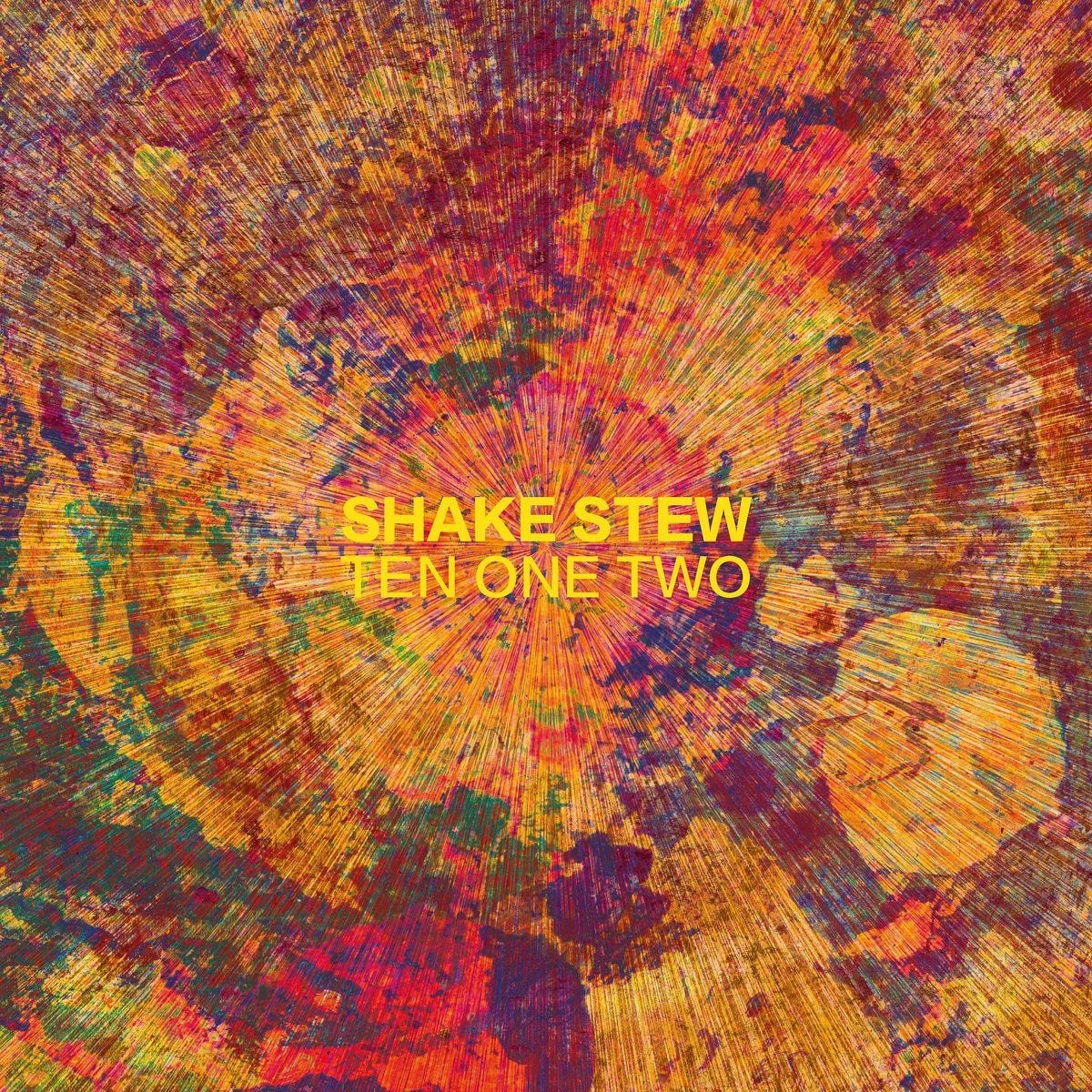
This year’s album TEN ONE TWO, with which they begin marking the band’s tenth anniversary (a third album is also expected by the end of 2026), can be seen as the culmination of their still relatively young career. It is a double album with very carefully measured dramaturgy, which proves to be especially important for such an extensive release. Seven permanent and two guest musicians perform on the album (we will list them at the end of the text), while bandleader Lukas Kranzelbinder plays double bass, e-bass, guembri, kalimba, log drums, mellotron, and tambourine.
The fact that Kranzelbinder and his crew command such a rich palette of instruments makes it easier for them to sound lush and diverse. But that is only the starting point, and Shake Stew do not play all their cards at once.
A good example is the opening track Wood, which lasts nine minutes and develops very slowly. The piece opens with a repetitive melody on the kalimba. Their recognizable trance/groove rhythm is present here, already labeled as kraut-jazz in reference to German krautrock legends Can. Over it unfold melodious horn lines; solo sections alternate with orchestrated passages, and the collective climax arrives only near the very end—but even then it does not explode excessively. Then Tristan Junk throws us into a whirlwind of ethio-jazz and melodies reminiscent of Mulatu Astatke and Getatchew Mekurya. This track has all the qualities of a hit single, yet we still sense that Shake Stew have plenty more up their sleeves.
The focus is on collective playing and fine-grained nuance in arrangements and solos. Within songs that have a clear direction, many interesting things happen on a micro level—from raising and lowering dynamics, to subtle interactions between the horn section and the rhythm section, and ultimately simply good improvisations. Somewhere around the fifth track Ascendance, it feels as if Shake Stew shift into fourth gear—at least in terms of tempo—only to continue the seesaw of slower and faster tracks throughout the rest of the album.
So when I mentioned “measured dynamics”, I was referring precisely to this very skillful sequencing of tracks, which made me think that Shake Stew approach music also from the perspective of listening logic. If you have a double album, you do not want the listener to grow tired or saturated after 30–40 minutes; instead, the entire work must feel complete and rounded. You want the listener to reach the very end—and for the final tracks to be just as engaging as the first ones.
The second part of this release was produced with a more pronounced live vibe and therefore offers a somewhat different listening experience, which justifies the division into two formal parts. At the same time, this is still the same band with its recognizable qualities: a very refined and organic sense of blending modern American and European jazz, African musical traditions, soul and funk sensibilities, and an underground rock drive.
The fact that I didn’t feel the need to single out any individual in this review doesn’t diminish their excellence, nor does it suggest the album lacks outstanding solos. Rather, I simply wanted to highlight this “band” nature of Shake Stew and the mutual understanding that comes from a decade of working together.
Happy anniversary - with the hope that many more will follow.
Shake Stew are:
Lukas Kranzelbinder – Double Bass, E-Bass, Guembri, Kalimba, Log Drums, Mellotron, Tambourine
Yvonne Moriel – Alto Sax, Flute, FX
Mario Rom – Trumpet
Johannes Schleiermacher – Tenor Sax, Flute, FX
Oliver Potratz – E-Bass, Fender Bass VI, FX
Nikolaus Dolp – Drums, Percussion
Herbert Pirker – Drums, Percussion, Log Drums, Tambourine, Shaker
Special Guests:
JJ Whitefield – Electric Guitar (on “Tristan Junk”)
Pablo Herrasti-Fajardo – Modular Synthesizer (on “Tiger”)
Great band.
Can't wait to listen to the album.
That first video was amazing, by the way.