


The way we listen to music—and the horizon of expectations we bring to it—is partly shaped by our perception of genre. If we are listening to classic jazz, we look for memorable themes and virtuosic soloists. If we know it is free jazz, we may hope for extended playing techniques or perhaps particularly energetic saxophone playing. In ambient music we look for something else—an emphasis on sound texture rather than on the harmonic or improvisational development of compositions. If you have been in love with music your whole life, you will probably approach it with an open and curious spirit; but your past experience will also draw you toward something familiar in new music as well, an anchor that helps you place it somewhere within your own system of values and emotions.
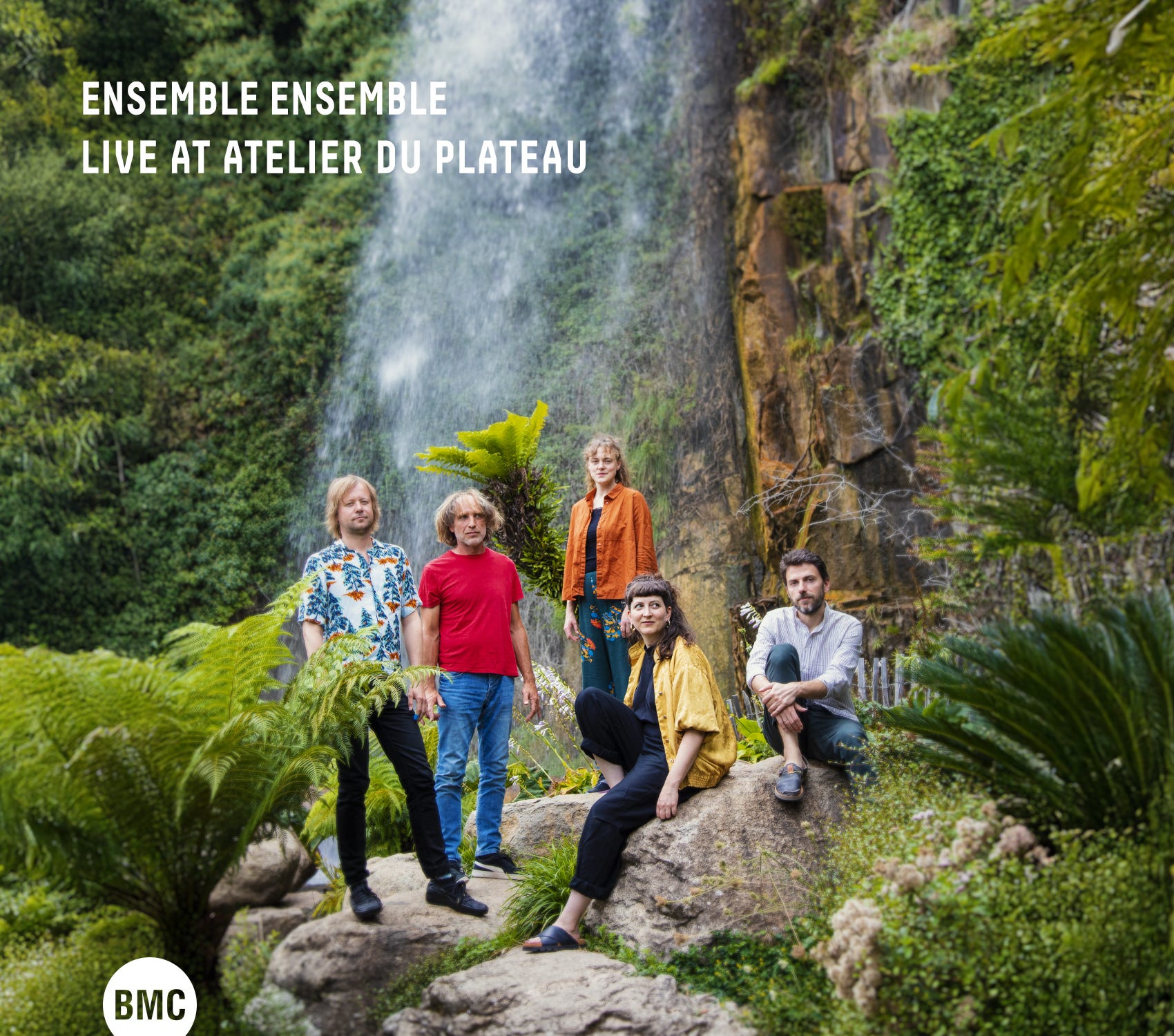
Sometimes we encounter music that catches us unprepared. Yet it also seduces us with something unfamiliar—something difficult to define and to explain to ourselves using the usual, established ways. I encountered this phenomenon while listening to the album Live at Atelier du Plateau by a lineup called Ensemble Ensemble, consisting of Mari Kvien Brunvoll (voice, electronics), George Dumitriu (violin, viola), Eve Risser (piano, prepared piano, alto flute), Kim Myhr (guitar), and Toma Gouband (drums, percussion).
I had already heard some of these musicians in different contexts before—I loved Eve Risser in the famous avant-garde jazz trio En Corps with Benjamin Duboc and Edward Perraud, and Mari Kvien Brunvoll in a duo format with guitarist Stein Urheim. I was also fairly familiar with Kim Myhr’s body of work. But the wonderful thing about experimental and improvised music is that it is not simply the sum of the individual characteristics of the musicians playing together in a concert or studio. Or at least it should not be, in its finest moments.
Which brings us to the next challenge: how do we write about music that does not follow any conventions—music for which the language of references is not particularly suitable, because at its core lies an anti-referential impulse, a step away from what we have learned to describe in certain familiar ways? I do not have a good or precise answer to that.
For me, the starting point was Eve Risser’s piano—her minimalist, repetitive playing style interwoven with avant-garde excursions. Then there is the sonic layer added by Mari Kvien Brunvoll: a dreamy kind of singing that carries the magic of an ancient folk song, something you imagine like a spell from a fairy tale. Around these anchors unfolds a whole web of sounds, melodic branches, and small gestures across different instruments. Rustles, chirps, breezes.
Once you are sufficiently immersed in the experience of this music, a kind of synesthesia occurs and you begin to perceive it visually: depending on your sensibility, it may feel like entering a deep forest, or witnessing the flourishing of non-human life along the banks of a mountain river. Perhaps it is a descent into the unconscious, into the territory of reverie and dreams. And yet it is not really about Ensemble Ensemble achieving the specific formal qualities of “ambient” or “cinematic” music. Rather, the music transgresses from what we consider the “experience of music” toward something not necessarily “deeper,” but certainly different and more challenging—art in its abstract form, freed from self-imposed definitions.
At this point, we might imagine this to be some kind of demanding music that must be listened to with the greatest possible concentration and without external distractions—certainly not something that “plays in the background.” My own experience was quite the opposite: I listened to Ensemble Ensemble while doing my day job, while driving long distances, while preparing lunch—and of course also while “listening for the sake of listening.” In all of these situations, the only thing that mattered was turning the volume up enough to hear every possible rustle and sound the quintet might produce. I enjoyed the counterpoint between music that radiates pure beauty and a kind of magical rapture on the one hand, and formal abstraction on the other.
All of this may have little to do with “jazz” in its historical or formal musicological sense. But it has everything to do with its essential qualities: freedom, the creation of music in the moment, and the venture into the unknown. The search for challenge in music—whether you approach it as a trained musical professional or as a curious music lover.
Appreciate your point about how our "horizon of expectations" is shaped by genre. We often look for an anchor in the familiar before we allow ourselves to get lost in the new.
The most rewarding music isn't always the easiest to label. That search for challenge you mentioned is exactly what keeps music—and our relationship to it—alive and evolving.