


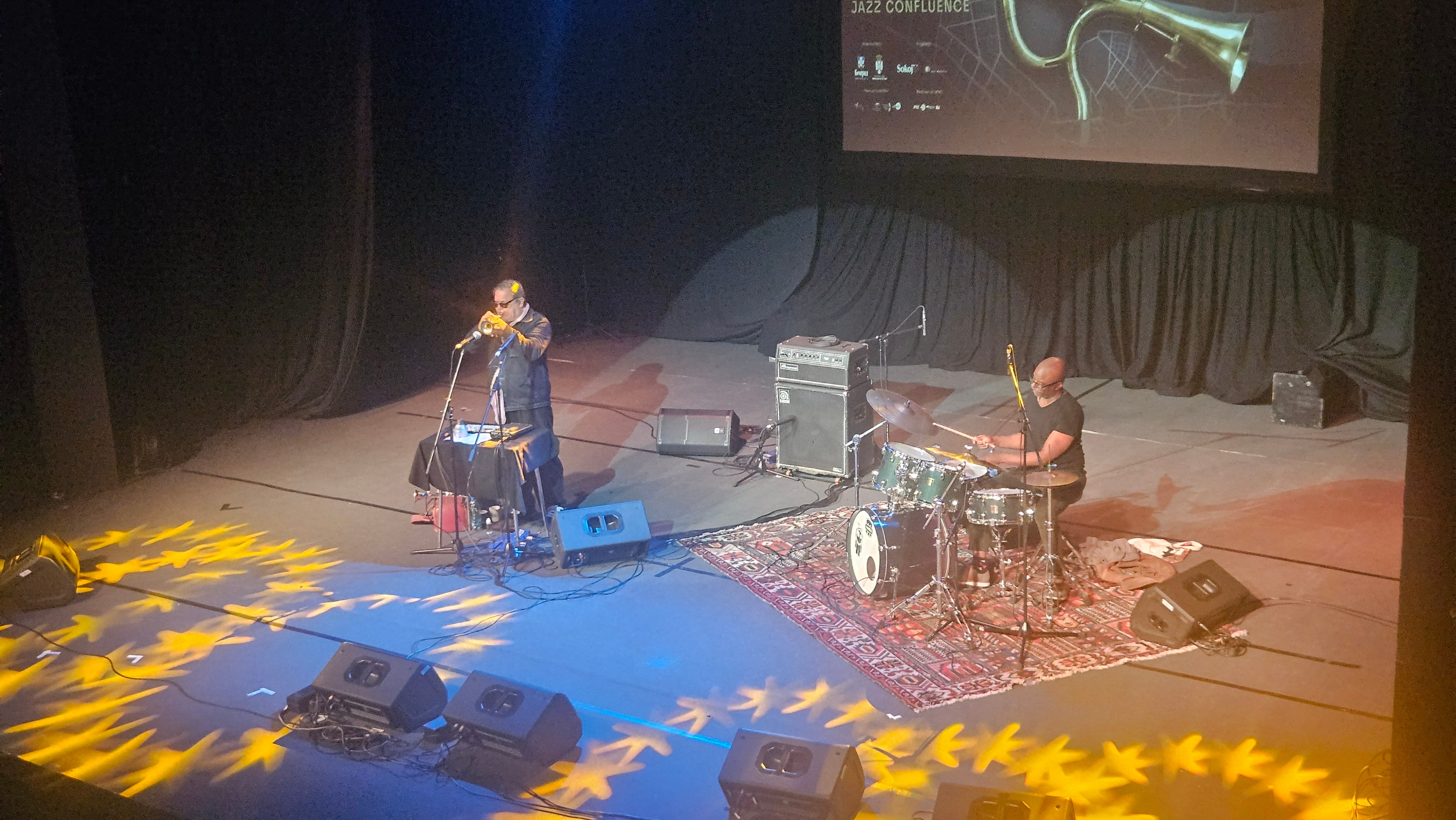
At the time of writing, the Belgrade Jazz Festival is underway, by all valid measures the most important jazz event in Serbia. Over the years, the festival has had its ups and downs, and I’ve had numerous debates about the selection with its artistic director and fellow journalist Vojislav Pantić. Why wasn’t this or that included, when are you going to bring this or that band or musician, and so on.
There has, of course, been plenty of praise too. Sometimes I had the impression that the best lineups came in years when budgets were tighter, making it harder to cater to the “general taste”. Which doesn’t mean I support or welcome years with reduced budgets, like this one.
So far, I’ve seen several very good concerts: Vladimir Nikolov Nonet, Chicago Underground Duo, and Arun Ramamurthy Trio. By the time you read this, The Messthetics and James Brandon Lewis will have played their concert too, which I’m particularly looking forward to. A roundup of all the concerts will probably be published on Tuesday, and until then I’m posting Reels and Stories on Eurojazzist’s Instagram page.
Upcoming interviews
During my stay in the Czech Republic a couple of weeks ago, at the excellent Jazz Goes To Town festival (reports are here and here), I managed to record two interviews that I’ll publish over the next few weeks.
The first is with Berlin-based Czech accordionist Vojta Drnek, whose debut solo album Lost Wisdom I mentioned in one of the earlier Randomizers. It’s great to interview “jazz celebrities”, but sometimes it’s even nicer to devote time and attention to those who are just stepping onto the “big stage” and to be part of their journey. The shortage of adventurous jazz accordionists on the scene certainly works in Vojta’s favour, but I think his talent lies less in finding a “niche market” and more in having a healthy and creative way of thinking about his own art.
The second interview was certainly fun in many ways. With the excellent pianist Eve Risser, whom I consider a true star of the European avant-garde jazz scene, there were first a few misunderstandings involving emails that ended up in spam and unsuccessful digital communication, so we only arranged our in-person interview late in the evening before the day she was due to return home. The only time we had left was early in the morning, around 7:30, when we set off in light rain towards one of the fantastic coffee shops in Hradec Králové, got takeaway cappuccino and chai latte, and made it back in time for her van to the airport. We set up our microphones and recorded our entire conversation while walking through the streets of Hradec and back, which was also my first-ever “interview on the move”. There will be a lot of editing and technical polishing to do because of the “dynamic environment” (lol), but I’m looking forward to spending time working on this material.
Today I’m also meeting double bassist Nenad Vasilić, whom I mentioned in the most-read article ever on Eurojazzist as a musician with an exceptional talent for audiophile sound. Of course, that’s only part of his artistic authority, which rests above all on his original and meaningful interpretation of what we call Balkan musical heritage, in the context of contemporary jazz. Vasilić has been living and working in Austria for almost 30 years, and his entire career is connected to the country, while he also regularly visits Serbia and maintains relationships and projects with local musicians. This will be another audio interview with short video clips for Instagram, and it should be published by the end of the year.
Other gigs
After quite some time, I’ve received another commission from the Croatian website Glazba.hr to write a review, which I’ll be working on over the next few days. It’s for the album Zimtserla! by Truth ≠ Tribe, which Google’s AI Overview describes as an “instrumental alternative band from Zagreb, Croatia, that blends contemporary jazz, rock, electronics, and African and Balkan rhythms”.
For the background of the story, it’s important to highlight bandleader and saxophonist Mak Murtić, who started his career in London before returning to his home country, and who developed as a composer during the rise of the “new British scene” and musicians such as Shabaka Hutchings and other now-recognised stars.
Murtić’s Mimika Orchestra originally emerged in England, a spectacular band regarded in the region as his main project — a large orchestra that combines the aesthetics of contemporary big bands with “pan-Slavic” musical heritage, or rather a very specific vision of “invented ethnic music”. Let me try to explain it this way: Murtić doesn’t so much reinterpret existing traditions as imagine traditional music that might have existed in the Balkans, and particularly in the Istrian region, and then throws it into a blender with hard-boiled jazz, post-jazz, rock, and who knows what else.
When it comes to Truth ≠ Tribe, however, this is a stripped-down, compact lineup with a strong alternative rock drive, but also jazz competence. It’s no coincidence that I mentioned Shabaka, as the use of tuba in this setting partly reminds me of Sons of Kemet, although Murtić is an original artist who knows how to shape his own ideas in this context too. Highly recommended.
A few days ago, I also finished several articles for the November issue of Hi-Files magazine, where another Serbian, or rather regional, project got two full pages. I wrote about the old Yugoslav group Meta-Sekcija, which existed in the late 1970s before its members began new careers and went their separate ways. Their “lost tapes” had been sitting in the Radio Novi Sad archives for 48 years before David Blažević, founder of the new record label Non Aligned Records, brought them out of oblivion and, with the musicians’ blessing, prepared a new, improved master and vinyl release.
Among these musicians, the most significant international career was achieved by saxophonist, clarinetist and composer Boris Kovač, who travelled the world in the early 2000s with his “world music” projects, while also leading several interesting projects in avant-garde jazz and the improvisation scene. Their Meta-Sekcija project, however, was mostly influenced by the jazz-funk of the time and, in that sense, represents a “hidden gem” for “crate diggers”, while Non Aligned Records is trying to position itself in that particular niche of lost ex-Yu retro-funk and related records, for which there is collector interest in this region (and beyond).
I also have room for four mini-reviews in the Hi-Files review section, and most of the albums I’m writing about there have already passed through the Eurojazzist Randomizer filter.
And then there’s good old Radio Belgrade’s Third Programme, which this month has been largely devoted to John Coltrane’s centenary, followed by the Belgrade Jazz Festival. Serbia is a small country and there aren’t many truly dedicated jazz fans, while my show airs late at night, so I sometimes worry whether anyone still listens to it at all. That’s why I’m always happy to get some feedback in person, like when I met drummer Aleksandar Škorić at an event a couple of weeks ago.
He turned towards me and shouted, “Interstellar Space!” It took me a few seconds to get my sh.t together and realise what he was telling me — that he was sharing his excitement about catching my show featuring that album on the radio. Aleksandar is in his mid-thirties, and we could say he belongs to a younger generation that we associate with different listening habits. So it’s interesting when someone “his age” listens to live radio too, and not just old-timers who grew up with the format.