


In one of my previous columns, I mentioned that I used to work for a company that served as the Serbian importer and distributor for releases from ECM Records, ACT Music, Enja, Harmonia Mundi, CAM Jazz, and many other labels. That was my specific domain, while the colleague I shared an office with handled top hi-fi brands like Rega, Naim, Harbeth, Sonus Faber, Accuphase, Devialet, ProAc, Clearaudio, and others. We had a showroom where people would come to see and hear the gear they were interested in. Given that these speakers, amplifiers, turntables, and CD players were often very expensive—even for well-off customers—selling this kind of equipment was a process. Many visitors would come several times and spend hours in the showroom, talking with us and listening carefully before deciding to spend several thousand euros.
When I started working at the company, I wasn’t very familiar with this kind of clientele. I was interested exclusively in the music itself, and I didn’t have the money for serious equipment anyway. Still, from time to time I had to step in for my colleague and host hi-fi customers. Until I got the hang of it, there were moments when I felt confused and out of my depth. Years later, I would often retell one anecdote: a potential customer once asked me what we were listening to in the showroom. Naively, I started explaining which track it was, the artist, and the album. The man interrupted me and clarified the question—he meant which cables we were listening to. He had noticed some new interconnect cables and wanted to know the brand, technical specs, and so on. We weren’t listening to music—we were listening to cables.
Of course, this comical situation doesn’t represent the entire world of audiophiles. To be fair, most people simply want to hear music on the best possible system. As a kid, I grew up on small cassette players and later on mediocre mini hi-fi systems. I first heard a CD when I was around 15 or 16, and I bought my first decent second-hand hi-fi system at 21. Each step brought a noticeable improvement in sound—the nuances became clearer, warmer, more detailed. Even people who aren’t particularly obsessed with music can hear the difference between low-budget and top-tier headphones. Anyone can appreciate the richness of sound that reveals itself in a proper audiophile listening room. Everything starts from this simple fact—but how far an individual audiophile will go in their technical fascination depends on personal preferences and budget. And it’s not a cheap hobby.
When it comes to playlists designed for listening in showrooms, hi-fi shows and presentations, we can roughly say that the most common choices are classic rock, classical music, and jazz, along with various singer-songwriter styles (blues, country, americana), often with an emphasis on specialized audiophile labels like Stockfisch Records or Master Music. If we zoom in on jazz playlists, vocal tracks—especially female vocals—are very common. Of course, jazz standards were always present.
Dave Brubeck’s “Take Five” is probably the track I’ve heard most often at such events. Chuck Mangione’s “Children of Sanchez” was another staple. Miles Davis’s Kind of Blue was never far away. The most frequently selected tracks tend to showcase a wide dynamic range—from deep bass to shimmering cymbals—or highlight the acoustic qualities of instruments: the touch of fingers on an acoustic guitar, the knock against the wood of a double bass, or a saxophone placed very close in the sound image. If all of that appears in a single track—even better.
Speaking of our own presentations, I was particularly amused by the fact that the former company owner was (and still is) a big fan of the ECM sound. As a result, our playlists often included pieces that weren’t typical for hi-fi demonstrations. For example, we would play The Köln Concert, which was a rare choice. Or Tomasz Stanko, whom no one else seemed to play. Also some of Jan Garbarek’s 2000s albums, Enrico Rava, Charles Lloyd, and so on. Of course, the usual audiophile favorites were always there too, so the playlists struck a good balance between genuinely great music and tracks that were often produced specifically for these kinds of listening situations.
It’s easy to hear the difference between cheap headphones and top-tier audiophile gear when playing the same music. But what exactly is audiophile music? How do we distinguish a well-produced album from a poorly produced one? Why is ECM founder Manfred Eicher considered a legendary producer, while others are not? I won’t go into technical deep dives here; instead, I’ll rely on personal experience and impressions. While I’m generally wary of the idea that production matters more than the musical substance, I certainly appreciate a well-produced album. It’s just that the meaning of “well-produced” can vary from listener to listener.
Let’s start with a basic principle of modern production. Depending on the target audience—especially if the goal is to reach as many listeners as possible—music is often “flattened” so that the difference between listening on basic headphones and on a sophisticated system is minimized. If the target is audiophiles, the recording, production, and mastering will emphasize a wide dynamic range—both the bass and the cymbals, so to speak. Of course, this assumes that the music itself lends itself to such treatment.
When I started working at One-HiFi, one of my tasks was to prepare 90-second audio samples for our website, showcasing the albums we imported and sold. I did this in Audacity, where each track has a visual representation of its frequency range. In a screenshot presented here, I placed a blues-rock track next to an ECM recording (removing the names to avoid bias).
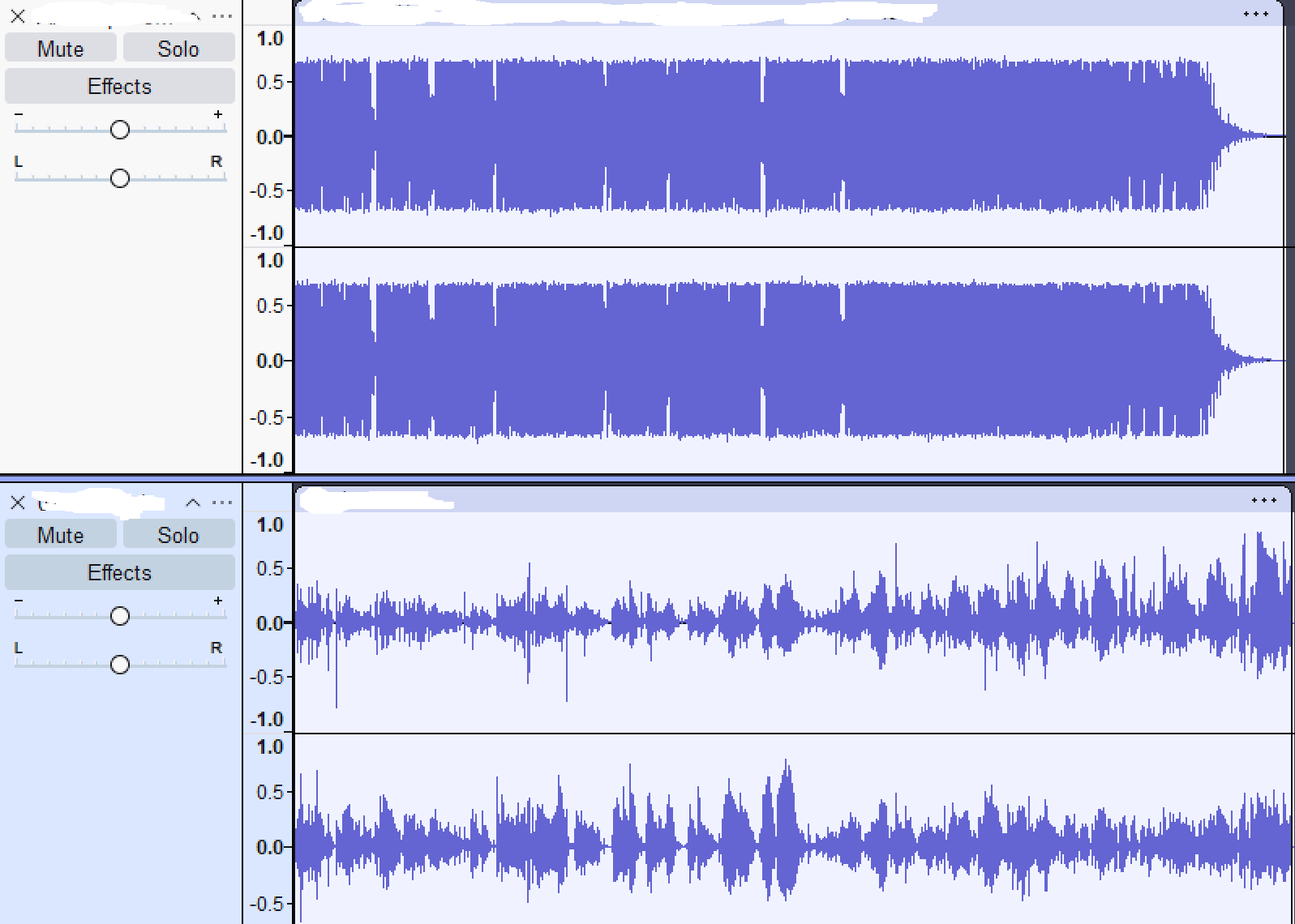
In the first track, everything is pushed to the maximum—because it needs to sound good on headphones in noisy environments. The second track, however, requires better listening conditions. It won’t sound great on public transport, but on a home system it becomes clear why it’s considered audiophile while the first one isn’t. Regardless of personal taste, under the right conditions an entire world of sound unfolds. This depends primarily on the musicians and their arrangements—but in the final result we also hear many other things: the acoustics of the recording space, the distance of instruments from the microphones, post-production choices that either enhance or preserve natural sound, and so on.
In 2015, my former boss moved to Australia and started the new company, while I continued running the business in Serbia for a few more years before we eventually shut it down. During those years, we had a new space organized differently, so I had both a desk and a hi-fi setup in my office. In my case, this was usually a combination of Rega amplification, streamer, and turntable, paired with Harbeth speakers (we also had the fancy Devialet Phantom there, though I preferred the more standard setup).
This meant I had considerable freedom in choosing playlists for myself and the visitors. During those years, my go-to audiophile choice was often Jakob Bro’s album Gefion. The subtle interplay between Bro, Joey Baron, and Thomas Morgan was musically outstanding, while also beautifully revealing sonic nuances—Baron’s cymbals, Morgan’s warm bass, Bro’s guitar, which completely avoided the “guitar hero” aesthetic. As for vocal albums, Tord Gustavsen’s What Was Said, featuring Simin Tander, was another favorite. Not a typical vocal jazz album, but a beautiful blend of Gustavsen’s spirituality and Tander’s clear voice. What I always appreciated about ECM was that sense of “space”—a feeling that the music was as natural as possible, not artificially brought closer just to highlight every tiny detail.
That said, even hyper-detailed sound can be appealing. Take the double bass, for instance. It’s a beautiful instrument, and it sounds wonderful when its “wooden” quality is captured—the resonance of the strings, the tapping on the body, the sharpness of the bow, the subtle noise of fingers on the strings. Serbian double bassist Nenad Vasilic, based in Vienna, recorded an intriguing solo album, The Art of the Balkan Bass, which later became quite well-known in audiophile circles. Tracks from this album started appearing in equipment reviews in prestigious hi-fi magazines, often used to describe how speakers or amplifiers were tested.
For this piece, I tried to dig up some of the playlists I created for hi-fi events. I found one I made for Aleksandar for a hi-fi event in Melbourne, where I combined classical music, vocal and instrumental jazz, along with some rock classics. Alongside staples like Patricia Barber, Diana Krall, and Melody Gardot, I included Youn Sun Nah—specifically the track “Momento Magico.” Not a typical choice, but she strikes a good balance between artistic authority and audiophile appeal. Knowing Aleksandar’s affinity for ECM, I also included Matthias Eick, Giovanni Guidi (his trio works particularly well in this context), Jakob Bro, Tomasz Stańko, and others.
I don’t have a grand conclusion to tie all of this together. Instead, I’ll invite you—if you’ve made it this far—to share your own audiophile experiences and thoughts. How important is it for you to listen to music on high-quality equipment? How much attention do you pay to production? Do you prefer listening to jazz loudly or quietly? At home or live? And what are your favorite “audiophile” jazz albums and tracks?
Interesting article. Thanks so much for sharing.
My stereo journey began with an 8-track tape player my parents bought me for Christmas. Coming from a middle-class home, I had to get a job to support my burgeoning audio habit.
Akai cassette deck, JVC turntable, Kenwood integrated, and Advent speakers eventually became Nakamichi cassette, B&O turntable, Yamaha receiver, and B&W speakers, are now Clearaudio turntable, PS Audio DAC, PS Audio SACD, PS Audio preamp and monoblocks, and Devore Fidelity speakers.
Yes, there is a difference between people who love stereo equipment and people who love music. Cables and interconnects make a huge difference, but the obsession needs to be getting closer to the music — a recorded snare drum that has the pop, weight, and dynamics of a live band snare drum.
When a hobby turns into an audio arms race to massively outspend everyone else for a subjective 0.1% improvement in sound, that’s when it’s time to tap the brakes and get a life.
Best albums to test an audio system: Van Morrison “Astral Weeks” (is actually a jazz album), John Coltrane “A Love Supreme,” Sonny Rollins “The Bridge,” Cannonball Adderly “Somethin’ Else,” and Miles Davis “‘Round About Midnight.”
I don't consider myself an audiophile but I like having a decent quality stereo system. I still buy everything on CD then rip it to lossless audio formats.
My albums of choice for testing out the [few] systems I've bought are anything by the Keith Jarret trio, Bill Evans "Live at the Village Vanguard" for exactly the reasons you mention- I want to hear the wood of the bass, definition of the drum set, and the full dynamic range of the piano. Throw in "A Love Supreme" for the same reasons plus the check on Coltrane's Sound.
Most of my life I've paid limited attention to the stereo field, due at least in part because I didn't really have a good setup that accentuated it. But a couple of years ago a bought a nice pair of Klipsch speakers and they happened to be set up the perfect distance from the couch where I listen. I've really been enjoying listening to how the engineers placed the different instruments in the mix.