
Ever since I first heard Daniel Erdmann in concert with Das Kapital in 2011, I’ve been in love with the way he plays the saxophone. I experienced him as one of those musicians who bring humor into jazz in a lucid, effortless way. Like, for example, John Lurie in his The Lounge Lizards, or Steven Bernstein in SexMob. With all of them, there’s a kind of special magic: the ability to sound at once like the most virtuosic jazz musicians in the history of this music, while also infusing their expression with a love for popular music in the broadest sense—from cabaret and chanson, to film music, rock, punk, and beyond. The end result often feels uncanny, to the point where you wonder whether you’re hearing postmodern jazz, an arrangement-based deconstruction in an ironic key, or a sincere homage to “beautiful music” that contrasts with the complexity of their artistic identities. Or all of the above. It’s precisely in that listener’s sense of disorientation—the loss of firm ground—that their magic and allure reside, as much as in everything they are capable of when playing the music they love.
What I came to love in Erdmann is his specific, instantly recognizable sound—a combination of classical jazz saxophone virtuosity and something that evokes early rock and soul, or the kind of reeds sound one might imagine in a television late-night show band. This was striking in all the bands of his that I’ve heard, from the aforementioned Das Kapital, to Velvet Revolution, with whom he also performed in Pančevo (the city where I live today), or his current Thérapie de Couple, which I saw three years ago at the jazzahead! festival in Bremen.
At that concert, he presented a “conceptual” band built around French-German relations, where half of the ensemble came from France (Hélène Duret – clarinet, bass clarinet; Théo Ceccaldi – violin; Vincent Courtois – cello) and the other half from Germany (Daniel Erdmann – saxophone; Robert Lucaciu – double bass; Eva Klesse – drums). Even the band’s name, Thérapie de Couple—again, a reference to the relationship between two neighboring countries—highlights Erdmann’s playful artistic vision, further developed through the choice of compositions and their titles, all engaging with this complex historical relationship.
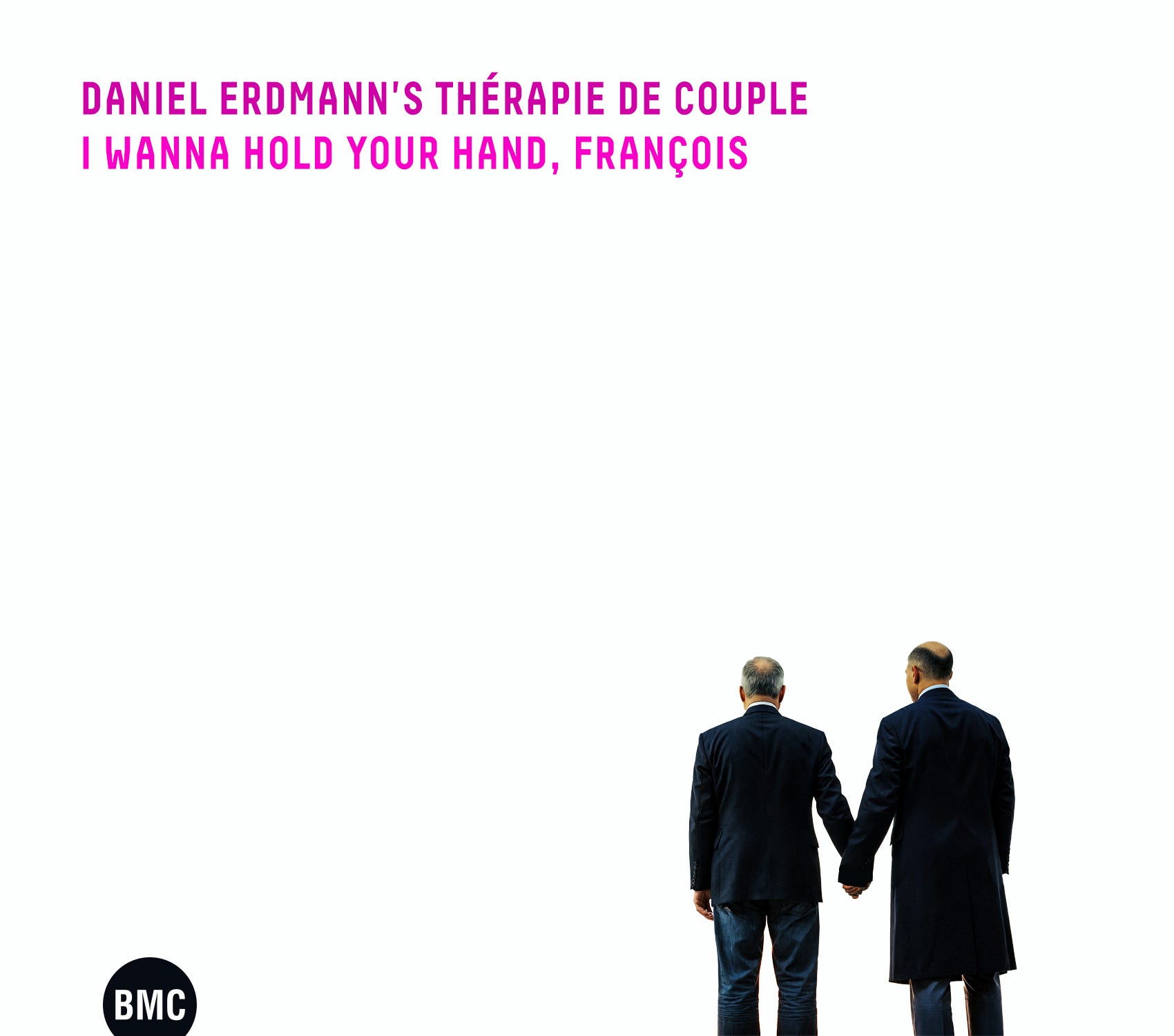
Three years later came the album „I Wanna Hold Your Hand, François“, released by BMC Records, which sounds just as rich as the concert I saw back then. But that richness doesn’t reveal itself immediately—it unfolds through repeated listening, gradually exposing both the layered nature of the ensemble and arrangements, and Erdmann’s desire to allow each musician to shine in the best possible way.
OK, but what does this mean in practice?
The shortest track lasts two and a half minutes, the longest just over seven. By jazz standards, these aren’t particularly extended forms, so one might assume they are compact and “catchy” for potential listeners. Some certainly are—but many unfold quite gradually, almost unhurriedly, as if Erdmann has all the time in the world to win over the listener. We hear this in the opening “Fattal Attraction,” with its long intro, or in “Muskatnuss, Herr Müller,” patiently opened by a double bass solo. Elsewhere, there are compositions whose full melodic potential only reveals itself toward the end, as in the beautiful “Romy.” And then there are miniatures like “On the Road to Werdun” or “Eva in Paris,” which feel like parts of a larger suite while still retaining their own autonomy. Their brevity doesn’t give them the feel of radio singles; rather, they come across as pieces of a more intricate puzzle.
When I mentioned that “each musician is given space,” I was referring to a certain democratic distribution of solo sections, as well as the impression that Erdmann himself doesn’t feel the need to foreground his own playing. As a long-time fan of Théo Ceccaldi, I was, of course, most thrilled by his solos—but everyone has at least a few memorable moments. Take Hélène Duret, who is an absolute star in “Zwei Seelen wohnen ach in meiner Brust”, where she seamlessly move from relaxed swing into free improvisation, while elsewhere she makes other outstanding contributions on clarinet and bass clarinet.
Finally, there are those “simple beautiful songs” such as “Göttingen,” a composition with a particularly telling historical context—performed originaly by singer Barbara in both French and German, and described as “a hymn to Franco-German reconciliation”—or the more recent “Je ne parle pas Français,” originally sung by Namika. In Thérapie de Couple’s interpretations, both carry a strong cabaret-chanson character and a certain patina—another of Erdmann’s recognizable signatures.
Does this combination—on the one hand complex, on the other deeply emotional music—consciously evoke the intricate relationships of couples in therapy, as the album title suggests? A situation that is anything but black and white, instead winding through a web of emotions, thoughts, relationships, passions, and intellectual clashes? If Erdmann intended to convey this complexity—human, historical, and beyond—through the music on this album, he has, at least for me, completely succeeded.
More album reviews on Eurojazzist: