


This summer, Pat Metheny toured several European cities with his Side-Eye lineup, prompting numerous social media posts, videos, and reflections on his work in general. One of my Facebook friends published a post asking people to recommend albums by this legendary guitarist, hoping to explore his music in greater depth.
I cannot say that I am a great admirer of Pat Metheny’s body of work, but I immediately remembered an album I first heard more than twenty years ago, when an acquaintance gave me a pile of fusion CDs in the hope of converting me from the camp of traditionalists into a lover of electric jazz. Among them were all kinds of recordings from the seventies and eighties, from which I came to appreciate a couple of John McLaughlin’s early albums and one release simply titled Jaco.
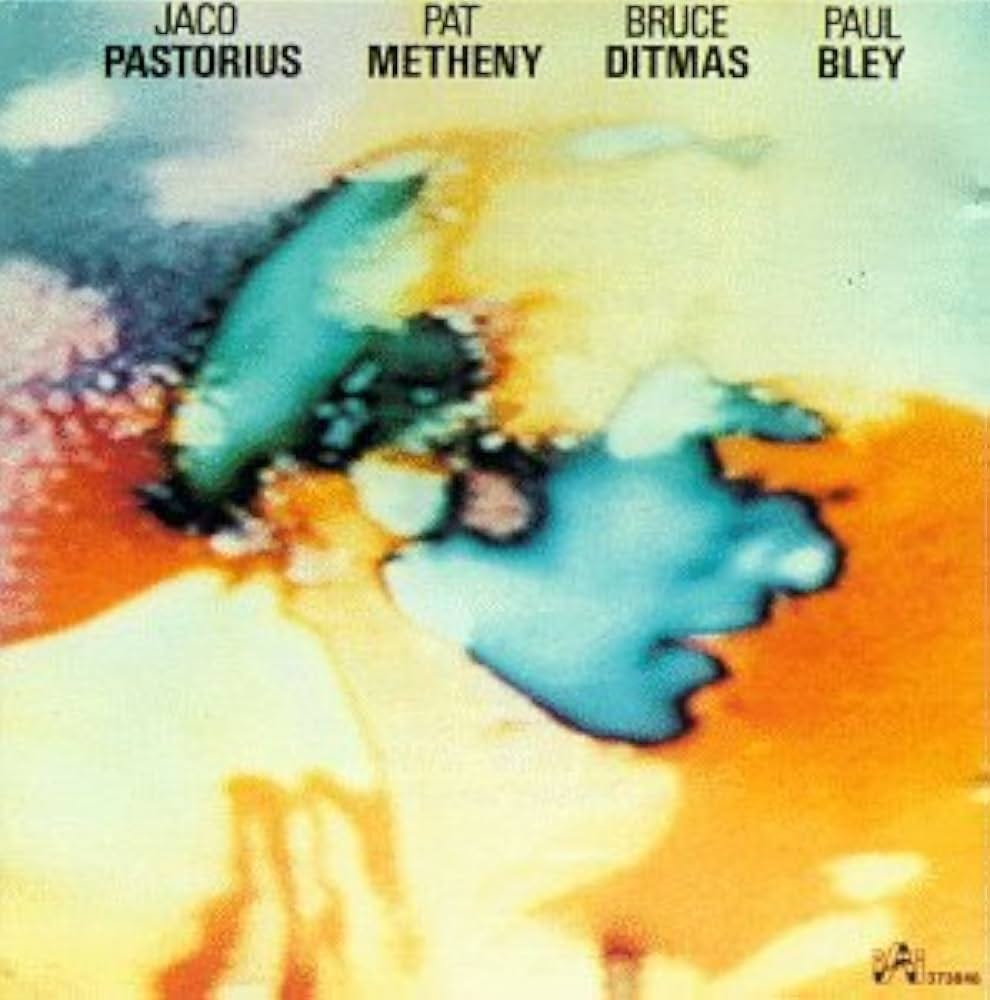
Of course, this was the album recorded by Jaco Pastorius, Pat Metheny, Bruce Ditmas & Paul Bley. According to the information available online, it was the first studio recording for both Jaco Pastorius and Pat Metheny, which alone makes it an interesting curiosity and a valuable historical document. I posted my recommendation and immediately knew that I would also play the album on Radio Belgrade, in my own radio programme, as part of a regular series dedicated to promoting precisely this kind of hidden gem from jazz history.
I began writing the introductory text for the broadcast, which eventually became considerably longer than my usual opening remarks, yet I still felt there were things I would have liked to add. So I decided to publish a slightly expanded version here, drawing on and further developing that original radio text.
Jaco was recorded in June 1974. At the time of the session, Pastorius and Metheny were highly talented, but still young and largely unknown musicians on the jazz scene. They were brought together by the much more established pianist Paul Bley for a studio session, joined by Bruce Ditmas on drums. They performed five compositions by Carla Bley and three by Paul Bley. The album was originally released on Bley’s own label, Improvising Artists.
While searching for historical sources that might tell me something more about the album itself, I came across a fascinating Pat Metheny interview from 2001, which can still be read on his website. The legendary guitarist explains that, in fact, none of them even knew they were recording an album.
“...that record with Paul, Jaco, Bruce and myself came about kind of uniquely. I didn’t know that it was to become an album – none of us did. I showed up to this place that I thought was a rehearsal hall and it turned out to be a recording studio. Paul had rented this stack of Marshalls and a wah-wah pedal, because he had just heard this rock band and knew he had an electric guitar player coming, and wanted me to play like that. I had never even seen this kind of wah-wah pedal before...”
This is the first part of the interview referring to this particular recording session. Metheny then explains that it was a Morley Wah-Wah pedal.
“I asked, “Do you really want me to play through this? And with this stack of Marshall amps with my 175?” I didn’t even know how it would sound, but that’s what Paul wanted, so I tried it. I spent the day with this pedal trying things and again, I didn’t even know it was a recording date. I think Jaco felt more like he was on his own turf – at least he got to use his own amp! – and he certainly did better than me on that date”.
As a listener, I have no objections whatsoever to Metheny’s sound on this album. After reading what he wrote, I immediately thought of The Köln Concert and the whole context surrounding that performance—the fact that Keith Jarrett performed on a faulty piano, that he wanted to cancel the concert, and agreed to play only after being persuaded with great difficulty. Sleep-deprived, in pain, after eleven o’clock at night. One of the dominant narratives is that precisely because of these difficult circumstances he adapted his playing style, ultimately resulting in the best-selling solo piano album in history, the album that marked Jarrett’s career.

Of course, as we know, Jarrett himself was never particularly enthusiastic about the attention this album received, nor did he regard the Cologne concert as his masterpiece. Yet the fact remains that adapting to certain technical circumstances contributed to the uniqueness of what we hear as listeners. When artists of the highest calibre are involved, such adaptation can manifest itself in highly creative ways, as demonstrated both by Jarrett’s famous album and by Metheny’s recording debut.
The album opens with Carla Bley’s composition “Vashkar.” It is a striking and beautiful theme whose introductory exposition sounds remarkably accessible here, somewhat reminiscent of Miles Davis’s In a Silent Way, largely owing to Paul Bley and his electric piano. As the piece develops, however, it gradually changes its rhythmic flow, while the focus shifts to Pat Metheny’s highly psychedelic improvisational deconstruction, from which Pastorius’s bass theme emerges to dominate the remainder of the track.
What follows is a furious improvisation, a tour de force, a fusion that evokes the atmosphere of Miles’s albums from the early seventies, yet also possesses something of its own, something authentic. Two young musicians on stringed instruments weaving a spider’s web, constructing new sonic structures and layers, and hinting at a new musical world. They sound completely relaxed, as though they were simply playing at an informal jam session (which, apparently, is exactly what they thought they were doing), without worrying too much about how coherent or fully shaped the final result would be.

Although the album could certainly be described as fusion jazz, it is far from a conventional release. One could equally describe it as highly psychedelic, particularly with the interplay between Bley’s electric piano and Metheny’s guitar in mind. Within this musical context, Pastorius’s bass stands out with its full and precise tone, foreshadowing the unfortunately short but epochal career of perhaps the most celebrated bass guitarist in the history of jazz.
“Donkey” begins with a conventional bop structure in the drums and bass. When the musicians begin tearing it apart into tiny fragments, the effect is even stronger than it would have been had they started directly from Miles-inspired fusion, precisely because the contrast is greater. At the same time, we hear musicians who master that tradition at the highest level. Once they begin deconstructing it, we approach them with even greater confidence, instinctively understanding that they are doing so from a position of profound knowledge of jazz.
“Vampira” is perhaps my favourite composition on the album. It begins in medias res. There is Pastorius’s powerful bass phrase that carries the listener forward, with Ditmas following closely behind, and a clear musical development built upon those foundations. Although the composition itself follows a more straightforward fusion structure than the previous pieces, it arrives only after the listener has already been thoroughly unsettled and led into unfamiliar territory. “Vampira” does not emerge out of nowhere; rather, it comes across as a kind of resolution—or perhaps a culmination—a logical narrative conclusion to everything that has been played up to that point.
A little later, when Pastorius truly begins to display his virtuosity in “Batterie,” it does not come across as a misplaced demonstration of technical brilliance. Instead, it arrives at precisely the right dramatic moment. Whether this was intentional or not is ultimately of little importance. As listeners, we can simply be grateful that the album was assembled in exactly this sequence before its final release.
Pat Metheny points out that this is, above all, Paul Bley’s album. On the original release, all four musicians received equal billing, but only a few years later the album was reissued under the title Jaco, following Pastorius’s meteoric rise on the jazz scene.
He discusses this in the same interview, not without his characteristic sense of humour:
“This was 1974, so it was two years before Jaco had joined Weather Report and become well known. So, when he got famous, Paul put the record out again with a new cover and called it “Jaco.” Then about three years later I began to get pretty well known myself with my own band, the Pat Metheny Group, and Paul put the record out again, plugging it this time as “Pat Metheny’s first recording.” I am sure he will put it out again. And again. And again. (LAUGHTER)”
In the end, however, the album never attained legendary status, and critical responses to it were somewhat mixed. For example, in his three-star review for AllMusic, Scott Yanow writes:
“Pastorius sounds quite powerful, but Metheny’s tone is kind of bizarre, very distorted, and not at all distinctive at this point. The recording quality is a bit shaky throughout the electronic set, and the group does not quite live up to its potential, but Pastorius shows that he was already an innovative player, making this an LP of historic interest.”
While it is true that we do not hear Metheny here in the style that would later become his trademark, and although the album remains something of a studio and publishing curiosity, it nevertheless offers a fascinating musical sensibility and exciting music at the crossroads of two eras: the early fusion shaped by Miles’s psychedelic explorations, and the more clearly structured fusion that would later be most famously represented by bands such as Weather Report.
I have always been drawn to precisely these kinds of transitional albums, especially those recorded during that period that nevertheless depart from the dominant fusion aesthetic. It may not be a legendary album, but that only makes it all the more rewarding to rediscover it fifty years later and listen to it from a new perspective.