


This year, on the Third Program of Radio Belgrade, we launched a new series within my show Jazz, in which we aim to present not necessarily avant-garde, but perhaps unusual, atypical albums from the history of the genre—records that stand out for their originality, yet were not cornerstones of jazz nor did they reshape it in revolutionary ways. OK, this concept isn’t easy to sum up in a few words, but that’s not so important. In fact, the first idea that came to mind for opening the series was „On the Corner“ by Miles Davis. Then I thought we should play “those kinds of albums” on the radio—whatever that might mean. My radio editor Ksenija agreed, and that’s how we got started.
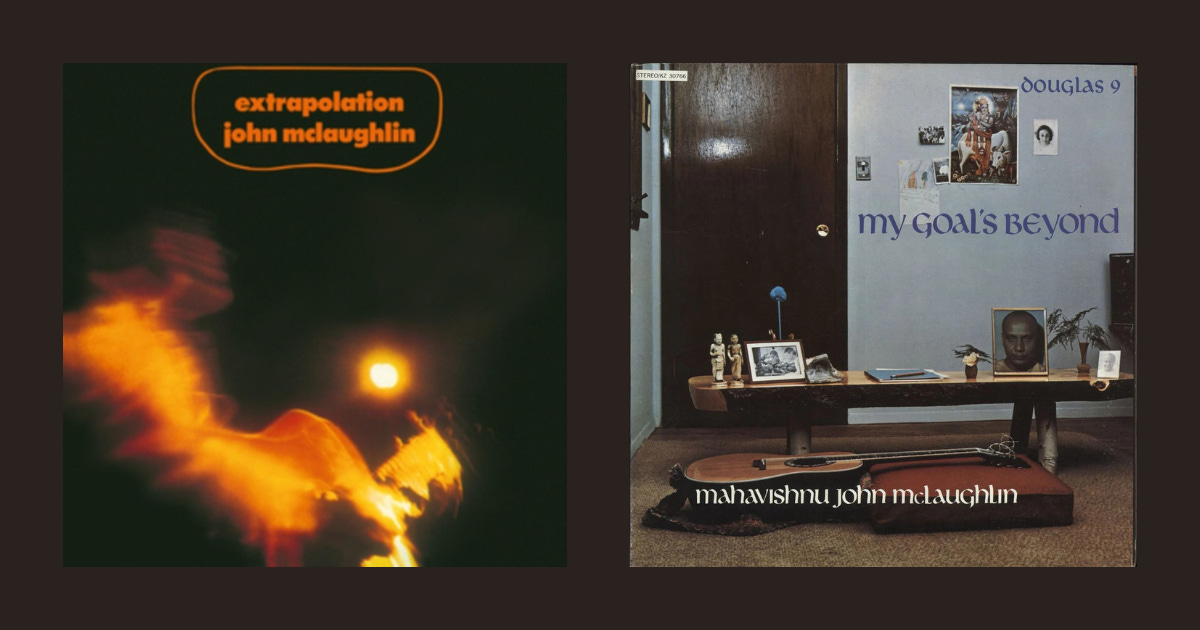
The following month, we had a special broadcast marking the passing of Michel Portal, so we postponed the next installment of the series until March. I began thinking about albums from the 1960s and 1970s that had left a strong personal impression on me, and the first that came to mind was „Extrapolation“ by John McLaughlin.
I wrote the radio introduction in one breath; it follows in the next four paragraphs.
John McLaughlin seemed destined for great things from the very start of his career. Already by the late 1960s, he was participating in the creation of key fusion jazz albums—Miles Davis’s In a Silent Way and then the epochal Bitches Brew. During the 1970s, he became one of the most important musicians of the fusion era, as well as a pioneer of the world music scene through his work with Shakti, where he explored the connections between jazz and Indian traditional music. To this day, he retains the status of one of the greatest living legends of jazz.
Before refining his recognizable style in the realm of jazz crossover, he recorded his debut as a bandleader as early as the beginning of 1969: „Extrapolation“ with his quartet. In this pivotal year for the development of fusion jazz, the genre’s postulates had not yet been clearly established, and experimentation and the free exploration of common ground between jazz and rock took precedence over the commercial shaping of a new musical direction. It is precisely in that spirit that we can view „Extrapolation“—as an expression of unrestrained musical ideas and an album ahead of its time.
Alongside John McLaughlin, the key musician on the album is baritone saxophonist John Surman, who would himself go on to become one of the central figures of European jazz and the ECM aesthetic. A particular curiosity is that bassist Dave Holland was originally scheduled to appear on the album; however, he had to withdraw after receiving a call from Miles Davis to come to the United States, and was replaced by the now lesser-known Brian Odgers. The quartet is completed by drummer Tony Oxley, who would go on to have a very successful career on the European jazz scene.
On this album, neither John McLaughlin nor John Surman sound as we know them today; at this stage of their careers, their playing is urgent but also somewhat raw, unpolished. This impression is reinforced by the natural production, which captures the spirit and imperfections of live performance. Their music, in that sense, also embodies the spirit of alternative rock and the New York jazz eclecticism that would only fully emerge decades later. Although the album was well received by critics, circumstances prevented the quartet from continuing its work, and John McLaughlin himself developed his music in a different direction. Still, „Extrapolation“ secured an important place in jazz history as a document of the birth of a new music that would define the genre in the decades to come.
For the purposes of this text, I revisited some factual details. It turns out the album was recorded in January 1969. „In a Silent Way“, which marks Miles Davis’s definitive step into fusion, was recorded on February 18 of the same year. Of course, neither Miles Davis nor John McLaughlin were the only musicians exploring the intersections of jazz and rock in the late 1960s. It is impossible to determine with factual precision “who was first,” nor is it a competition. But what struck me were John McLaughlin’s musical ideas, which were undoubtedly authentic—especially his approach to melodies that were accessible, while the playing itself remained “dirty.” It feels almost like an alternative band from the late 1980s, or one of the New York jazz postmodernists, or even a band from the neo–jazz-rock wave that gained momentum in the 2000s—as a departure from the virtuosity of classic fusion.
On this occasion, I’m skipping his next album „Devotion“, which didn’t resonate with me as much, and moving straight to „My Goal’s Beyond“. It’s incredible how quickly things were happening in music at the time! Only a few years had passed since the idea of jazz fusion had taken hold among musicians, and the range of albums released—for example, by 1973—presented a fantastic richness of new and interesting musical ideas. If I try to reflect on what happened in jazz between, say, 2018 and 2023, I can’t draw any grand conclusions. A lot of good music was recorded, but within already established stylistic idioms.
Already on the album cover, we see that the bandleader is now called Mahavishnu John McLaughlin. Among the instruments featured on the album are the tanpura and tabla. McLaughlin plays acoustic guitar. There is also violin, as well as percussion. And there is an all-star jazz lineup—the full list of musicians can be found on the album’s Wikipedia page.
The album is divided into two parts, or vinyl sides: one featuring this fantastic band, and the other consisting of solo guitar by John McLaughlin. Although this part of the album is also interesting, the two pieces titled “Peace 1” and “Peace 2” represent the essence of the album and its core.
A few years later, John McLaughlin would perform with Shakti, marking a clearly defined fusion of jazz and Indian music. But here, he was only beginning to flirt with the Indian sound, and it had not yet taken precedence. At the same time, it cannot be said to be merely decorative—a superficial flourish or a trick picked up along the way. John McLaughlin played on the famous „Bitches Brew“ and contributed decisively to its identity, yet he chose not to directly capitalize on that for his own career. At this point, we have many conclusions about what this album is not—but not necessarily what it is. Which is precisely its strength; avoiding obvious genre classifications and labels.
„My Goal’s Beyond“ is an incredibly meticulous and detailed album, very precise and thoughtful even when the musicians are improvising. The production is very smart, and the instruments are carefully placed within the sound image, so that everything is clearly audible. The early 1970s were a time of increasing studio manipulation, and in that sense, John McLaughlin succeeded in recording an album with solid audiophile qualities—but above all, musical ones.
There are a few more albums from John McLaughlin’s later career that I have enjoyed listening to. But these two have stayed closest to my heart. They were created in exciting times, when the world of traditional jazz was struggling for market survival, and the brave new world of fusion had not yet established its definitive identity. They may not have decisively changed the course of jazz, but „Extrapolation“ and „My Goal’s Beyond“ still sound fresh and relevant after several decades of the genre’s (completed?) evolution.
Luckily, McLaughlin, Surman, and Holland were able to record Where Fortune Smiles in 1971 for Dawn/Pye... an incredible offering of creative music.
The best two McLaughlin discs of all time! Extrapolation is great, on My Goal’s Beyond I’ll take just side two consisting of Peace One and Peace Two. The unique instruments really make it go: violin, tablas, soprano , acoustic guitar etc. My only problem with the lp is McLaughlin plays an Ovation guitar and it sounds like absolute shit. On the early discs he’s not so reliant on those runs that sound like someone shooting off a machine gun. There are plenty of guitar players I prefer to JMc but these two early discs are excellent!