


As much as I sometimes feel deprived of regular jazz concerts by relevant artists in Serbia, I’m equally grateful that the surrounding region hosts several truly outstanding festivals. One of them is the Jazz Festival Ljubljana, which I’ve visited a few times before, during Bogdan Benigar’s tenure as artistic director—a period marked by a clear affinity for the more avant-garde edges of contemporary jazz.
Today, the festival is curated by Tina Lešničar and Borja Močnik, who are somewhat more open to mainstream jazz stars, as well as younger acts operating at the intersection of jazz with electronic music, hip-hop, or soul—trends that resonate with younger or non-jazz audiences. At the same time, this remains a large-scale festival with a broad stylistic scope, offering something for everyone. My own selection included performances by Cry, Sun-Mi Hong BIDA Orchestra, Aki Takase’s Timeless Ensemble, and the Patricia Brennan Septet.
Cry is one of the projects presented by this year’s Artist-in-Residence, the young Slovenian saxophonist Lenart De Bock. By coincidence, I’ve been following his work for some time—he also plays with Serbian double bassist Miloš Čolović in the excellent trio Soothsayer, and he is part of Rok Zalokar’s Zehltet, whose album I reviewed earlier this year. Although still at the beginning of his recording career, De Bock already displays a clear talent as both a musician and a bandleader.
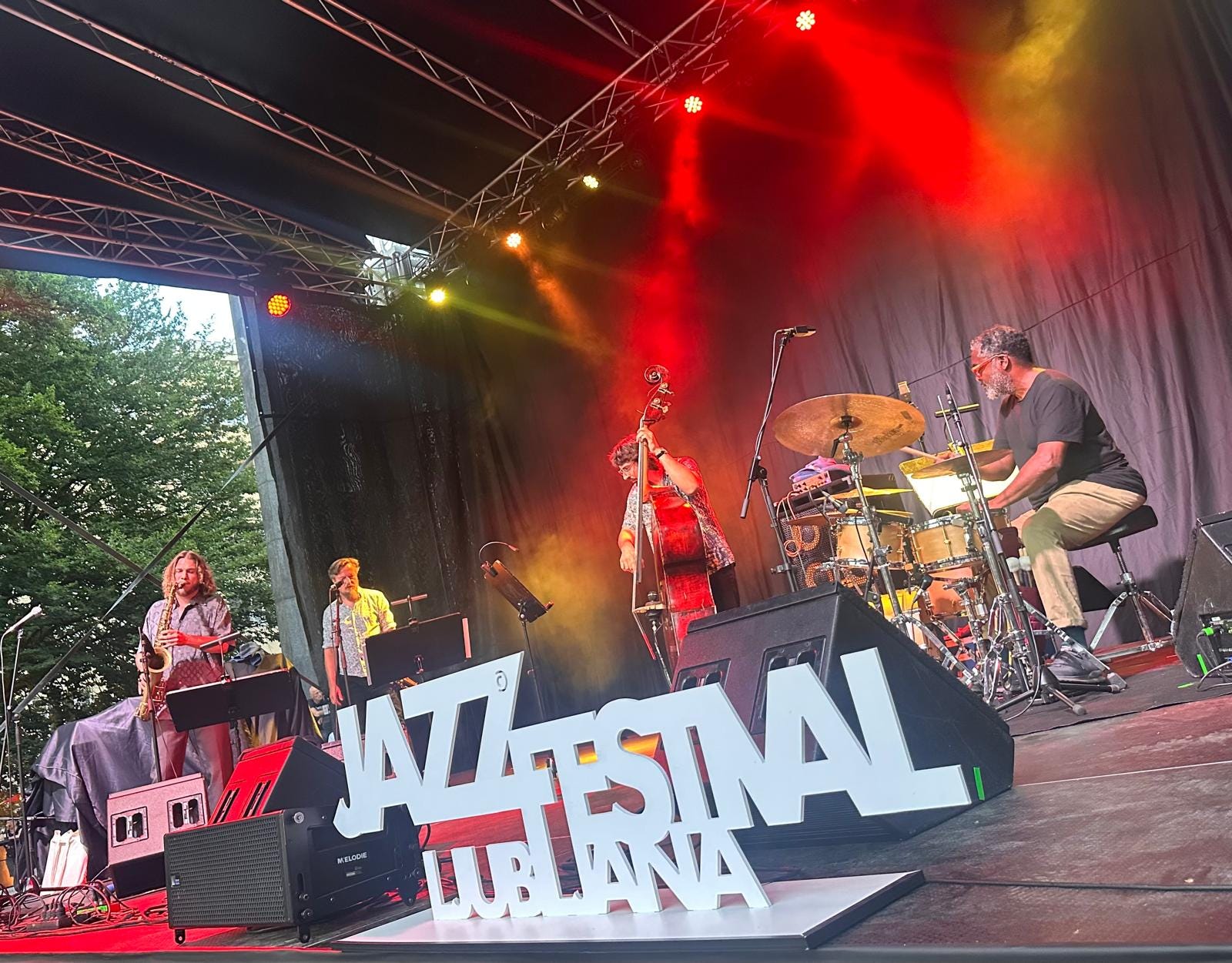
Cry reminded me most of the Scandinavian group Cortex, whose frenetic playing about fifteen years ago brought a fresh take on 1960s American jazz—particularly that fine intersection of post-bop and early free jazz inspired by Ornette Coleman. Beyond technical skill and a solid grasp of jazz history, what truly matters for a band like this is conviction—something that can’t be measured by formal musical criteria. Watching De Bock, Čolović, trumpeter Tomaž Gajšt, and the seasoned drummer Gerald Cleaver, I had the distinct impression that all four musicians genuinely live this music, rather than merely treating it as one stylistic option among many in the jazz songbook.
The concert took place outdoors, beginning in daylight while Dee Dee Bridgewater was still performing in one of the larger halls of Cankarjev dom. Cry played on the open-air stage in front of the monumental building, in pleasant shade but still during the day, as the audience was just gathering and settling in—one of the earlier time slots. All of this can make it harder to fully concentrate on the music, especially given the mixed seating concept: café-style tables and chairs in the front rows, followed by standard seating, with a bar at the back and a lawn to the side. Naturally, this creates clusters of audience members with varying levels of engagement. Still, Cry navigated these conditions with ease, playing with full energy and enthusiasm. Exactly as it should be.
This was an excellent introduction to the Sun-Mi Hong BIDA Orchestra, which brought together several of my favorite musicians—most notably saxophonist John Dikeman, who has been performing in Serbia for years alongside drummer Aleksandar Škorić, and the brilliant Mette Rasmussen, whose playing injects energy into numerous European jazz and improvised music ensembles. Sun-Mi Hong herself has recently come onto my radar as an outstanding composer and arranger. The lineup also featured Jozef Dumoulin, whose Fender Rhodes I first encountered on Vincent Peirani’s albums, as well as John Edwards on double bass and Alistair Paine on trumpet.
In a conversation several days before the concert, Sun-Mi Hong mentioned that the musicians in BIDA Orchestra are given a great deal of freedom once she establishes the core theme and tone of a piece. In that sense, this is very much a “players’ band,” yet it avoids both the formulaic sequence of solos and the unrestrained looseness typical of classic free jazz. Instead, it moves fluidly between structure, melody, and freedom. With such accomplished and imaginative soloists, and an open framework, it’s inevitable that certain moments—or climaxes—will stand out. For me, one such moment was an incredibly intense solo by Mette Rasmussen that evolved into a kind of collective ecstasy, though there were plenty of memorable highlights from other musicians as well.
The evening continued at Club CD on the sixth floor of Cankarjev dom, requiring a brief transition from the outdoor stage to an indoor space at the opposite end of the building. For those of us who stayed until the end of Sun-Mi Hong’s set—including the author of these lines—it meant missing the first few minutes of Aki Takase’s Timeless Ensemble, featuring Daniel Erdmann on saxophones, Vincent von Schlippenbach (aka DJ IllVibe) on turntables, Tino Ribeiro on double bass, and Dag Magnus Narvesen on drums.
Several elements aligned perfectly for me here: I had long wanted to see Aki Takase live; I’m a great admirer of Daniel Erdmann’s playing; and finally, the presence of a turntablist in an avant-garde jazz setting—still a relatively rare occurrence. It was precisely the interplay between Takase and DJ IllVibe that proved crucial to the band’s aesthetic and live appeal. The contrast and interplay between Takase’s piano—from Ellington- and Monk-rooted foundations to free, unrestrained expression—and Schlippenbach’s highly creative approach to sampling, grounded in a deep understanding of jazz improvisation, was simply brilliant. Particularly striking was a passage where the two exchanged phrases in a kind of call-and-response, as well as a solo DJ piece (I could spot, among others, a Lester Bowie record peeking out of his crate, even from a distance).
After the concert, I found myself wondering whether I had simply been dazzled by this DJ component—something I rarely encounter in this context. Much like how non-jazz listeners might be blown away by a virtuosic saxophone solo that leaves me indifferent, having heard thousands of similar ones. Perhaps that played a role, but I’m quite convinced that DJ IllVibe was an excellent fit for this ensemble.
There was also Takase’s playful onstage narration and a touch of witty conducting. Daniel Erdmann was compelling in his contributions, but this was more of a collective spectacle than a showcase of individual achievements—so it’s only fair to highlight the contributions of Tino Ribeiro and Dag Magnus Narvesen as well. Above all, this was my first live encounter with Aki Takase—a truly charismatic legend who holds the entire history of jazz piano in the palm of her hand, only to turn it upside down and captivate even the most demanding listeners.
The following day, the Patricia Brennan Septet performed on the outdoor stage, presenting material largely based on the album Breaking Stretch, in a slightly modified live lineup featuring Jon Irabagon (alto and sopranino saxophones), Mark Shim (tenor sax), Kalí Rodríguez (trumpet), Kim Cass (double bass), Keisel Jiménez (percussion), and Dan Weiss (drums).
I have to admit it took me some time to connect with this studio material at first—it’s not immediately accessible, even if it might seem so on the surface. In a way, I had a similar experience with both albums by Mary Halvorson’s Amaryllis ensemble, in which Brennan also plays vibraphone. In both cases, we’re dealing with highly composed music, where the core themes are complex and elaborated, and where arrangements take precedence over individual improvisation. I’ve seen both groups live, and while there is space for improvisation, there isn’t a strong sense of deconstructing or reconstructing the studio compositions—rather, subtle variations within a carefully arranged framework.
This was one of those performances that won’t be remembered for a “wild solo” or a particular burst of energy, but for its high-level collective musicianship and glimpses of individual skill within a clearly defined musical context. Patricia Brennan is a serious contemporary jazz composer, demanding serious listening—despite her cheerful and engaging stage presence, where she speaks about her fascination with mathematics or her identity shaped between life in Mexico and the United States. In that sense, I found myself missing a slightly stronger leap into the unknown, but this was nevertheless a highly competent performance by one of today’s leading jazz musicians.
Good stuff.
Patricia Brennan, I’m jealous.
I don’t know Aki Takase and I’ve downloaded a couple albums for my queue.