


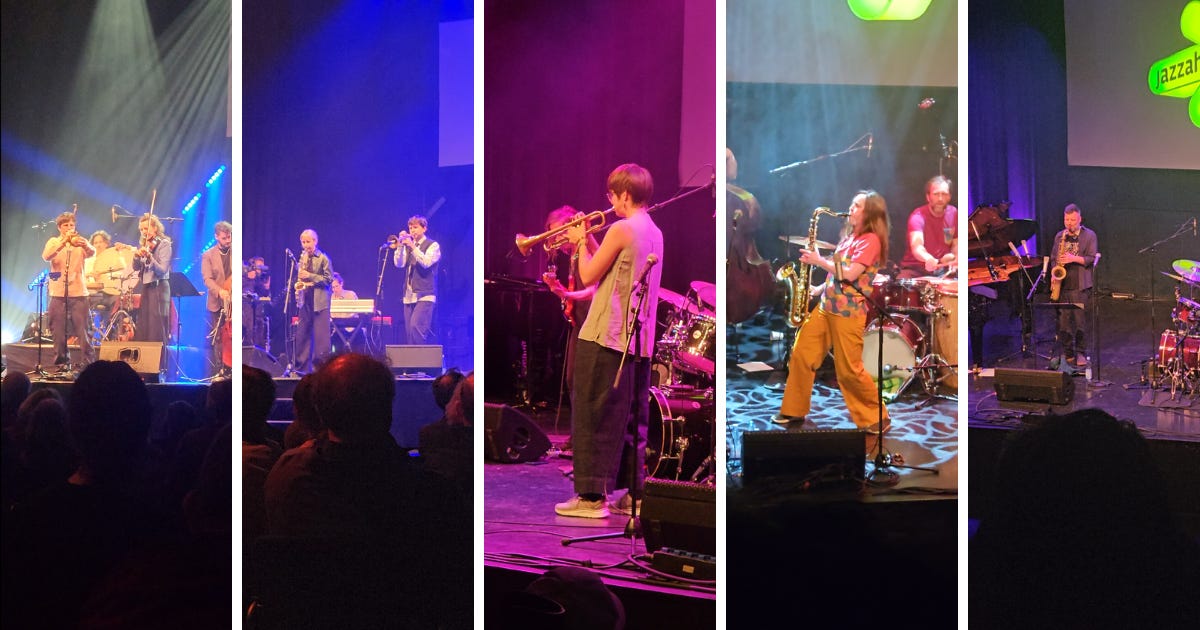
Before diving into the list of the “best concerts” at this year’s jazzahead!, it’s worth noting that—of course—I didn’t see every performance. That was physically impossible, as I also attended various talks, conferences, professional gatherings, and similar events. On top of that, I arrived later than planned on the first day due to flight issues. This significantly reduced the number of concerts I could attend; from those that remained, I made a selection based on what I was most interested in after listening to some material in advance, which left me with around 10–15 performances.
Among those that didn’t make the final cut, I would still highlight a couple of interesting acts. For instance, Jasmine Myra, whose new album Where Light Settles is about to be released on Gondwana Records. I like this label and many of the artists who release music there, so it felt natural to look forward to this concert as well. And musically, it was just right—but perhaps too delicate for the oversized trade fair hall. This type of concert is something I prefer to experience in a theater setting or a mid-sized concert hall with a capacity of 200–600 people. Myra’s music was gentle, subtle, warm, and melodic, but I couldn’t fully experience it here.
The situation was different with the Wajdi Riahi Trio, whose more energetic music within the classic piano trio format translated better to festival conditions. Within the framework of contemporary post-bop, this musician functions quite well, and everything was solid. But for me personally, nothing beyond that. Perhaps it also has to do with a certain saturation with this format, from which I now expect an absolute spectacle in order to feel a stronger emotional response. In any case, I’ll keep an eye on his name in the future.
The final “honorable mention” goes to the band Knobil - trio consisting of double bassist and vocalist Louise Knobil, bass clarinetist Chloé Marsigny, and drummer Vincent Andreae. Conceptually, this was a very interesting performance, and I had the impression of listening to a successor to Esperanza Spalding who has ventured into free jazz and avant-garde theater. Knobil is an outstanding double bassist with intriguing compositional ideas. I found the material I heard to be somewhat uneven in quality—that’s my only criticism. But what worked, really worked.
Richard Koch – Rays of Light
I hadn’t heard of trumpeter Richard Koch before, and this was one of those very pleasant surprises—the kind that makes me love jazzahead!. The lineup itself was intriguing from the start, featuring accordion, violin, and frame drum, alongside trumpet and double bass. Their point of departure is not what we typically perceive as standard jazz rhythm or harmonic complexity, but rather a heartfelt immersion in emotion and clear melodic patterns filled with pathos, from which they move into playful improvisations. Besides Koch himself, violinist Fabiana Striffler made a strong impression, and their interaction in the front line provided momentum for the entire ensemble.
yvonne moriel :: sweetlife
At this point, I can say I’m a fan of Yvonne Moriel, so this was an easy choice. I came to hear songs I love, and that’s exactly what I got, along with convincing improvisational development. I’ve already written about this saxophonist’s music in a previously published review, so I don’t have much to add here. It’s excellent contemporary jazz, and I particularly like both the horn section and the approach to bass lines through synths instead of double bass or electric bass.
This concert also took place in one of the large fair halls, which made it harder to fully enjoy. I simply don’t like watching jazz concerts in huge spaces—I feel that something gets lost in the sonic dispersion and the physical distance from the musicians; especially when it’s not a concert hall with tiered seating, but rather a flat setup where the visual barrier increases as you look over the audience in front of you.
Laura Jurd
It’s fair to say she arrived at the festival as one of its biggest stars, even though she’s still in an early stage of her career. The album Rites & Revelations appeared on many “best of the year” jazz lists, and I had followed her work even before that. Her eclectic approach—at the intersection of folk melodies, post-bop, and neo-fusion—sounded exceptionally cohesive, with a band that clearly knows how to maintain a sense of collective interplay even when venturing into improvisation. Alongside Jurd as bandleader, bassist Ruth Goller is also gaining recognition, having released the intriguing album Skyllumina on the popular International Anthem label; her pedal-based approach to the bass guitar here was impressive, while I did wish guitarist Tara Cunningham had taken a few more solos. The two of them bring a similar impact to the band as, for example, Rafiq Bhatia and Ian Chang do in Dave Douglas’s groups—adding an “edge” and a contemporary spirit to Laura Jurd’s music.
Langendorf United
“I can’t figure out whether they’re serious or joking,” one jazz enthusiast said to me, as we watched the concert together.
“Both, I think,” I replied.
And indeed, at times the band did feel a bit too TikTok-friendly—like when keyboardist Daniel Bingert was rolling around and doing somersaults in front of the first rows after a solo, dressed in summer shorts and barefoot. On the other hand, the playing itself was impeccable. In the introduction, we heard that bandleader Lina Langendorf had traveled across Africa, gaining highly relevant performance experience, and from the very first bars we were immersed in a musical universe reminiscent of Mulatu Astatke and similar ethio-jazz-inspired ensembles. But it didn’t stop there—we also heard a broader expressive range from Langendorf, one that more comprehensively bridges Western and African jazz traditions, somewhat akin to certain projects by Goran Kajfeš—yet distinct enough. The bandleader’s enthusiasm on stage was contagious, and Kulturzentrum Schlachthof proved to be a much more suitable, intimate space for a quality jazz concert. We saw that both during Laura Jurd’s performance and with Langendorf United.
Jure Pukl – Analog AI
A few years ago, Tord Gustavsen’s bassist couldn’t make it to a concert in Romania due to a delayed flight. Even though it’s a very tight-knit trio, it turned out just fine. The moment the band stepped out of its comfort zone, new sonic possibilities opened up—ones that might not have emerged if everything had gone “as planned.”
A similar—actually identical—situation happened in Bremen with Jure Pukl, as Joe Sanders was unable to make it to the concert. As a result, Analog AI became a trio featuring John Escreet on piano and future jazz legend Christian Lillinger on drums. Compared to the album I wrote about HERE, new perspectives naturally opened up, and the band acquired an unintended avant-garde edge. A sharper sound, three even more inspired and focused musicians, and compositions flowing into one another through brilliant sequences of top-tier solo performances. Pukl and Escreet as the core, and the incredible Lillinger as a human rhythm machine who would outplay any AI attempting to imitate him.