


I have been following Jure Pukl’s work since his 2010 album EARchiture, whose liner notes were written by Vijay Iyer—a pianist who, at the time, was making a remarkable breakthrough on the global jazz scene. A year later, Iyer would appear on Pukl’s excellent album Abstract Society. During that period, the Slovenian saxophonist aligned naturally with a strand of contemporary jazz led by musicians such as Iyer, Rudresh Mahanthappa, Steve Lehman, Tyshawn Sorey, and others—although it would become clear over the years that Pukl has never forced himself into fixed lineups or trends “from the same drawer.”
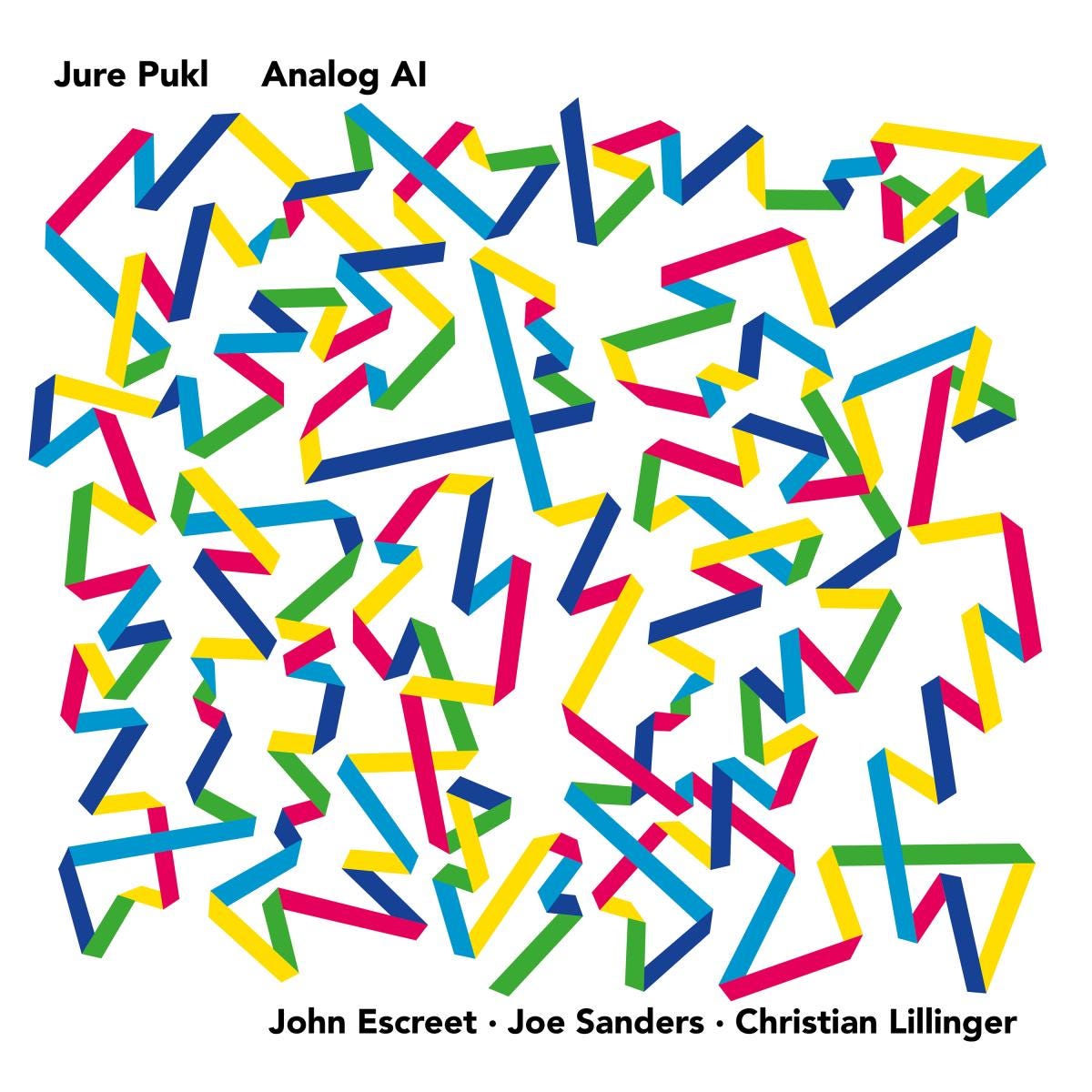
For years he fought to secure his place on the highly competitive New York jazz scene, and when he returned to Slovenia after the pandemic, I admit I felt a twinge of sadness—as if he had somehow “failed” on the world’s biggest and most important jazz stage. Of course, that would be an overly superficial way of looking at things. Over the past several years, Pukl has been extremely active, performing with some of the finest American and European jazz musicians of today. On the album Melt, he is joined by Peter Evans, Joe Sanders, and Nasheet Waits, while the current release Analog AI—again featuring Sanders—adds pianist John Escreet and drummer Christian Lillinger to the quartet.
Jure now lives and works in the European Union, a region with a dense network of high-quality jazz festivals and seriously programmed, well-funded jazz clubs. This stable infrastructure also allows for far more manageable tour logistics. He teaches jazz saxophone at a local university and lives in one of Europe’s most beautiful and well-organized countries. Is that really so little, in the turbulent and fractured world we inhabit?
If we look across Jure Pukl’s discography, we notice a fondness for wordplay in album titles and band names, often referencing important socio-cultural phenomena of our time. The new album Analog AI addresses one of the burning issues facing the creative music and arts community today: the mindset of market players in positions of power within the music industry, for whom prompting artificial intelligence is increasingly more profitable than dealing with actual people—something that is both complicated and expensive.
In the textual materials accompanying the album’s release, Pukl emphasizes that his band’s music is “a musical imitation of analogue artificial intelligence,” and that “their musical expression is a response to AI.” He stresses the importance of live music performed by real people for a live audience—points with which any sincere jazz lover will readily agree. The musicians on the album, myself as the writer of this text, and you as its reader likely all inhabit the same bubble, encouraging one another as the enemy approaches the walls, hoping that this resistance movement will withstand what may be the greatest threat yet posed by artificial intelligence.
But how do things stand musically? Does Pukl’s quartet truly “imitate analogue artificial intelligence,” or is this merely a clever phrase for confronting a (in)visible adversary? If we focus on this particular aspect of the album, a good starting point is the remarkable drumming of Christian Lillinger. His frenetic style—dense with notes and complex rhythmic solutions—does, to some extent, resemble a rhythm machine gone rogue, or a computer program that has begun to improvise. And in a rather elusive way.
From my perspective, however, it makes more sense to consider the album’s musical substance in a broader context. As much as the entire quartet possesses the skill and potential to play harmonically complex, rhythmically acrobatic, and freely improvised music (as heard in the highly successful “Collectivity”), the true quality of the album lies in its fine gradations: the layering of different rhythmic techniques and melodic discourses into a whole built on counterpoint, the confrontation of contrasts, and the balance between the “glorious tradition of jazz” and what we call 21st-century jazz—music once branded by AllMusic as “modern creative.”
In this sense, the two main “axes” of the band are Pukl and Lillinger. In his playing, Jure Pukl often starts from a fundamentally bebop-based approach, stretching from the late 1940s and Charlie Parker through other historically significant saxophone masters. Had he assembled a band merely to support him in this idiom, the result would likely amount to little more than a solid club session. But when positioned against Lillinger, the collision of these two worlds becomes genuinely thrilling.
A clear example is “12 Tone Samba in 9,” a showcase of rhythmic virtuosity in which Pukl and pianist Escreet wittily spar by subtly “displacing” classic jazz phrases from their tempo and context. A similar—often even more refined—approach runs through much of the album. Even when Pukl adopts a modernist, virtuosic stance, he remains inclined toward a warm and melodically lucid expression, as heard in the intriguingly arranged “Prometheus.” Finally, there is a well-judged balance between dynamic pieces and old-school ballads such as “7 Libras” and “Tender to 7 Libras,” where listeners from the Balkans will naturally associate the music with trumpeter Duško Gojković (whose “In the Sign of Libra” is among the key compositions of this former Yugoslav jazz giant).
Listening to Jure Pukl, there is little reason to worry about AI — or about the place of jazz tradition within a genre that constantly reconsiders and challenges itself, sometimes even rejecting its own premises altogether. Pukl has found an ideal modus operandi: deeply rooted in the essence of the jazz saxophone, yet fully open to re-examining its historical legacy through the perspective of today’s musicians and listeners.