


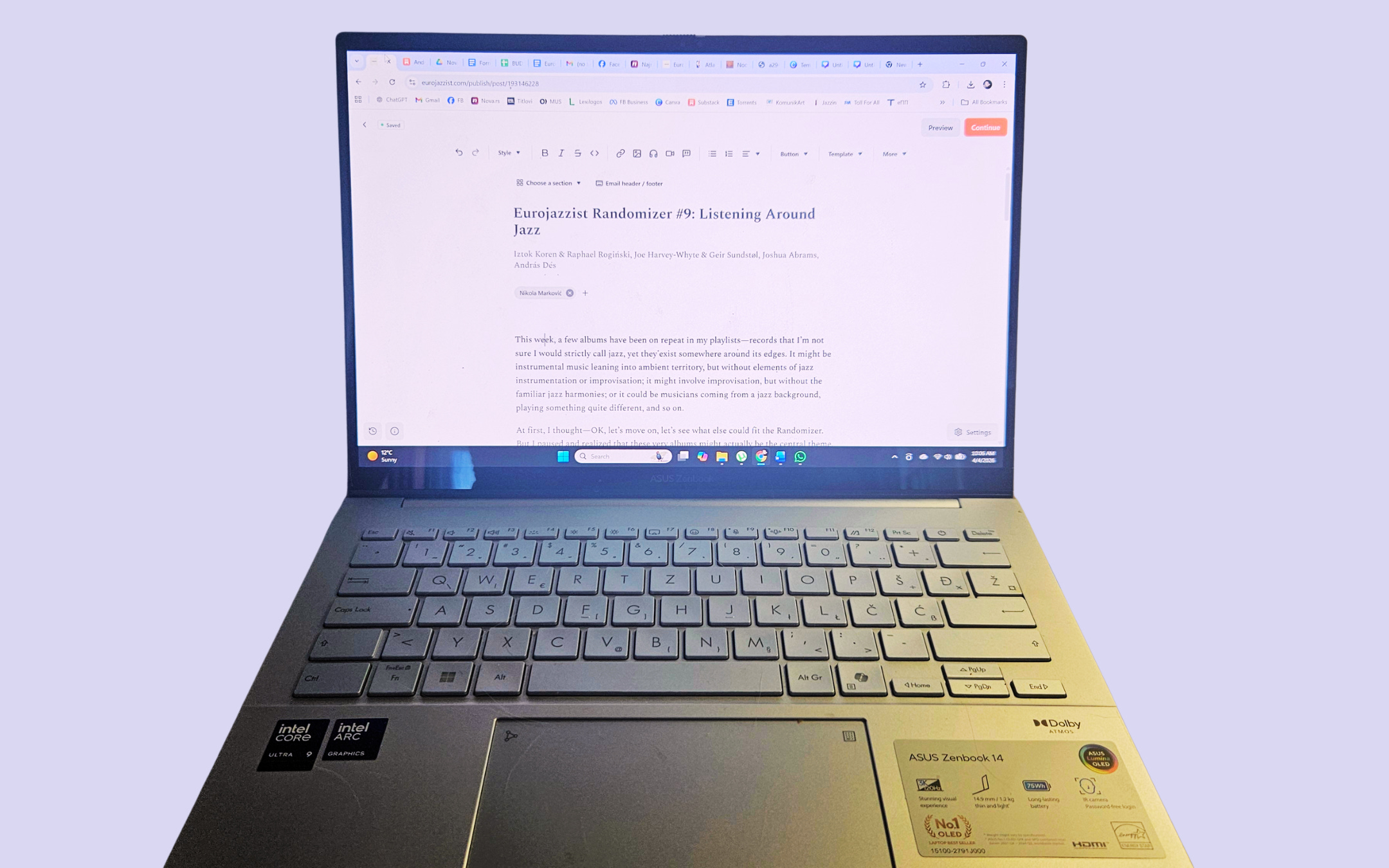
This week, a few albums have been on repeat in my playlists—records that I’m not sure I would strictly call jazz, yet they exist somewhere around its edges. It might be instrumental music leaning into ambient territory, but without elements of jazz instrumentation or improvisation; it might involve improvisation, but without the familiar jazz harmonies; or it could be musicians coming from a jazz background, playing something quite different, and so on.
At first, I thought—OK, let’s move on, let’s see what else could fit the Randomizer. But I paused and realized that these very albums might actually be the central theme. Because why not? The very notion of “jazz” today encompasses all sorts of things it didn’t in the sixties, seventies, and beyond. One could even speak of the “death of genre” as a concept in contemporary music, or at least of the way new generations of listeners perceive the idea of genre. In the end, it’s always a pleasure to write about good music—or simply to listen to it—whatever we choose to call it.
Iztok Koren & Raphael Rogiński are a compelling duo who recently released the album Nocturnal Consolations on the excellent label Instant Classic. I first heard of Rogiński when he played in the band Hera, led at the time by clarinetist Wacław Zimpel—once a leading figure in the Polish avant-garde jazz scene, who later moved away from the “jazz genre” into different musical territories. Since then, guitarist Raphael Rogiński has continued to appear in various projects that combine an alternative sensibility, improvisation, and ethnically rooted music from different—mostly European—meridians.
Iztok Koren is a member of the outstanding Slovenian trio Širom, whose music ventures into the realm of “imaginary folklore.” On this year’s album, Koren’s list of instruments includes banjos, guembri, steel drum, kalimba, effects, harmonium, and analog synth. I’m especially glad that the duo will perform in Belgrade on April 17 as part of the Fields Festival. I warmly recommend everything the two of them do, as well as the Instant Classic label itself.
Joe Harvey-Whyte & Geir Sundstøl have released the album Langeleik on the Norwegian label Hubro Music, which has intrigued me for years with its genre-transgressing output—from avant-garde and ambient jazz toward music that resists easy definition. Sundstøl, like the aforementioned Koren, plays a range of instruments, though pedal steel guitar is his most recognizable voice. Joe Harvey-Whyte also plays pedal steel, along with acoustic guitar, Optigan, and shruti box, supported here by a full band. In such a setting, an “Americana vibe” is almost inevitable, with the most natural jazz reference being Bill Frisell. But this should be taken loosely, as the music moves into new and unpredictable territories starting from these initial associations.
Alongside these two albums, I’ve only just begun exploring Joshua Abrams’ Music for Pulse Meridian Foliation. Abrams is known from Natural Information Society, a group that uniquely blends avant-garde and spiritual jazz with influences from North Africa and American minimalism in the lineage of Steve Reich, among others. His current album consists of a single piece, “Pulse Meridian Foliation,” lasting 36 minutes. At this point, I still have no idea how to describe it without resorting to copy-pasting someone else’s review online; for now, it simply remains “good instrumental music,” at least until I can fully process what I’ve heard.
András Dés
One of the first things I noticed after arriving on Substack is how few European jazz musicians are present. American musicians such as Ethan Iverson, Brad Mehldau, Christian McBride, Jakob Garchik, and Sam Newsome (just to name a few) already have a solid Substack following and write thoughtfully on a range of engaging topics. Many others are there as well. But Europeans—barely. I understand that musicians are generally tired of the constant pressure to maintain an online presence and engage with their audience across every possible platform—Substack might just feel like one more obligation. Europeans are already widely active on Instagram, and perhaps not even fully aware of Substack, which still feels like a predominantly American platform.
The first European I noticed was Dave Stapleton and his Substack; it’s also worth noting that he is both a musician and a label head, with Edition Records now among the leading jazz labels globally. After that, there was little to be found—until I came across the account of Hungarian drummer András Dés.
He publishes a newsletter once a month and writes beautifully; I always appreciate it when a musician is also a strong writer. But more importantly, Dés is a very interesting bandleader who has recently released the album Decisions We Make with a quartet featuring Martin Eberle (trumpet), Kenji Herbert (guitar), and Philipp Nykrin (piano), out on the impressive Budapest-based BMC Records.
Broadly speaking, this is a contemporary jazz album. What I find particularly interesting is that even after three or four listens, I still haven’t fully retained specific tracks or themes—I don’t get that immediate “aha, this is my favorite tune” or “that was an amazing solo” moment. And yet, I keep coming back to it. It feels more like a complex novel—with an introduction, development, multiple narrative strands, and an epilogue—than a collection of short stories, if we were to draw a comparison with literature. Or, in Netflix terms, this is a slow burn album. With a bit of patience, it reveals music that is emotionally accessible, yet layered and dramaturgically engaging.
In any case, it’s well worth reading what András himself has to say about the album in his latest newsletter—I highly recommend it.
To briefly return to Europeans on Substack—I hope their presence will continue to grow, as this seems like a platform where they can build more meaningful relationships with potential listeners. And also because I would genuinely like to read their thoughts and experiences on music and life; many of them certainly have something worth saying—and writing.
Eurojazzist recap – also published this week:


Hey Nikola, thanks for your beautiful thoughts about my Substack and our music! The paragraph about the slow burn aligns exactly with my vision of our music-making process.