


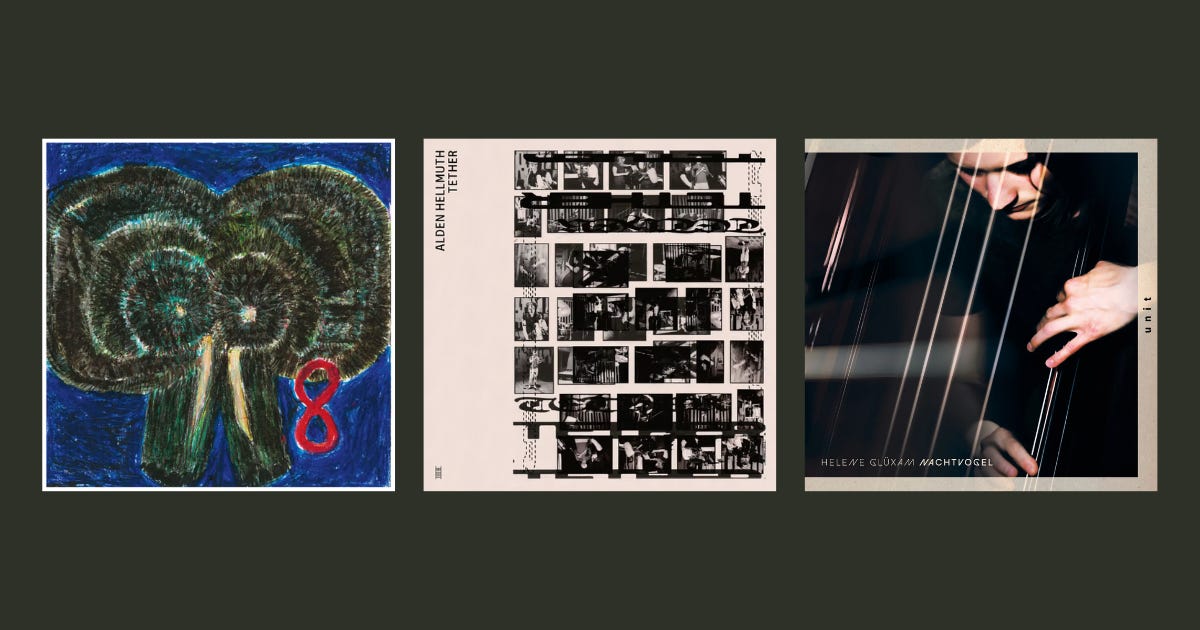
I’ve written about Jakob Bro on Eurojazzist on several occasions, both as a musician and as a producer and owner of the Loveland record label. I’ve also mentioned the festival of the same name, which takes place in Copenhagen in late November and early December. I first saw him live as a talented guitarist in Tomasz Stańko’s band; later, his performance with the “ECM trio” of Thomas Morgan and Joey Baron was one of the best concerts I’ve ever seen. A few years ago, I also watched the fantastic documentary Music for Black Pigeons, in which Jakob Bro is one of the key protagonists, and I grew even more fond of that whole “musical universe” around him. Ever since Loveland Records was revitalized, I’ve been following its new releases great interest, including Palle Mikkelborg’s excellent album Light earlier this year.
In short, you could say that I am a “fan”. So, as expected, I was happy when I saw the announcement of his album 8, whose official release was scheduled for August 8 — today. I marked the date in my reminder, and already this morning I found the album on Tidal and played it.

Since the previous release New Morning, and perhaps even earlier, there has been a noticeable tendency for Bro to turn towards larger line-ups, so it is not surprising that he gathered an octet here. This time he opted for a double rhythm section: drummers Marcus Gilmore and Brian Blade, and double bassists Larry Grenadier and Anders Christensen. There are also two saxophonists: Chris Cheek (tenor) and Jesper Zeuthen (alto), and the amazing Craig Taborn on piano. The repertoire consists of compositions by Jakob Bro and Paul Motian.
Besides Bro expanding his line-ups, his musical ideas are now also moving in somewhat freer directions — not necessarily towards “free jazz” in the conventional sense of the term, but definitely towards a more uninhibited playing and arranging expression. At times we hear his recognizable melodic passages soaked in folk sensibility, but also some more avant-garde pieces. After a couple of listens, my impressions are still somewhat divided and I am more inclined towards the “old Bro”, but it is far from the case that I don’t like this music. If I had approached it without any previous knowledge of the author, absolutely nothing would be missing.
I started listening to saxophonist Alden Hellmuth’s album Tether after reading Peter Margasak’s recommendation, but also after this release appeared on a few other lists of the best jazz albums of 2026. All those recommendations were well deserved, and what I find particularly impressive is how deeply rooted the album sounds in the jazz tradition — and especially in the alto saxophone tradition from Charlie Parker to the present day — while remaining fresh, without pandering to trends or adopting an overly modern approach to composition and arrangement. So, Hellmuth scores where it is most difficult: in pure jazz competence and the ability to produce interesting themes and solos again and again.
There is also an interesting double bass duo consisting of Logan Kane and Miller Wrenn, alongside drummer Justin Brown and a couple of guest musicians, among whom Haana Lee (sound design, effects and processing) stands out. Their contribution is undoubtedly significant and the band is very creative rhythmically, without staying within predictable bop patterns. But the band never resorts to “tricks”, “gimmicks” and “shortcuts” in seducing the listener, but rather builds upon the fundamental achievements of acoustic jazz through fine nuances and delicate creations, from its historical peaks to the 21st century.
I first came across the name Helene Glüxam a few years ago, on the NASOM (The New Austrian Sound of Music) list by Austrian Music Export, as part of a programme that supports selected Austrian artists in performing abroad. I also noticed that last year she won the Austrian Jazz Award in the “Best Newcomer” category. At the time, there was no album released, only a few YouTube clips that I watched and I remembered her name — and now, finally, a solo album has appeared, released by the active Swiss label Unit Records.
So, this is a solo release on which Helene Glüxam plays double bass and sings, which in itself can suggest many different directions of expression — from pleasant-sounding mainstream jazz to the avant-garde improvised performance in the style of Joëlle Léandre that I am particularly fond of. Glüxam, however, builds her own path that belongs to neither of these two directions, but is rather a kind of “testing the ground” and exploring her own possibilities as an author and performer. Her singing is without lyrics and functions as an equal instrument alongside the double bass; they play off each other and complement each other through improvisation, but often also through very accessible melodies or arrangements that sound like stripped-down acoustic adaptations of indie rock or pop songs. An interesting start to the career of this talented musician.
Hey Nikola, give a listen to Neptunian Maximalism on Bandcamp.
Let me know what you think.