


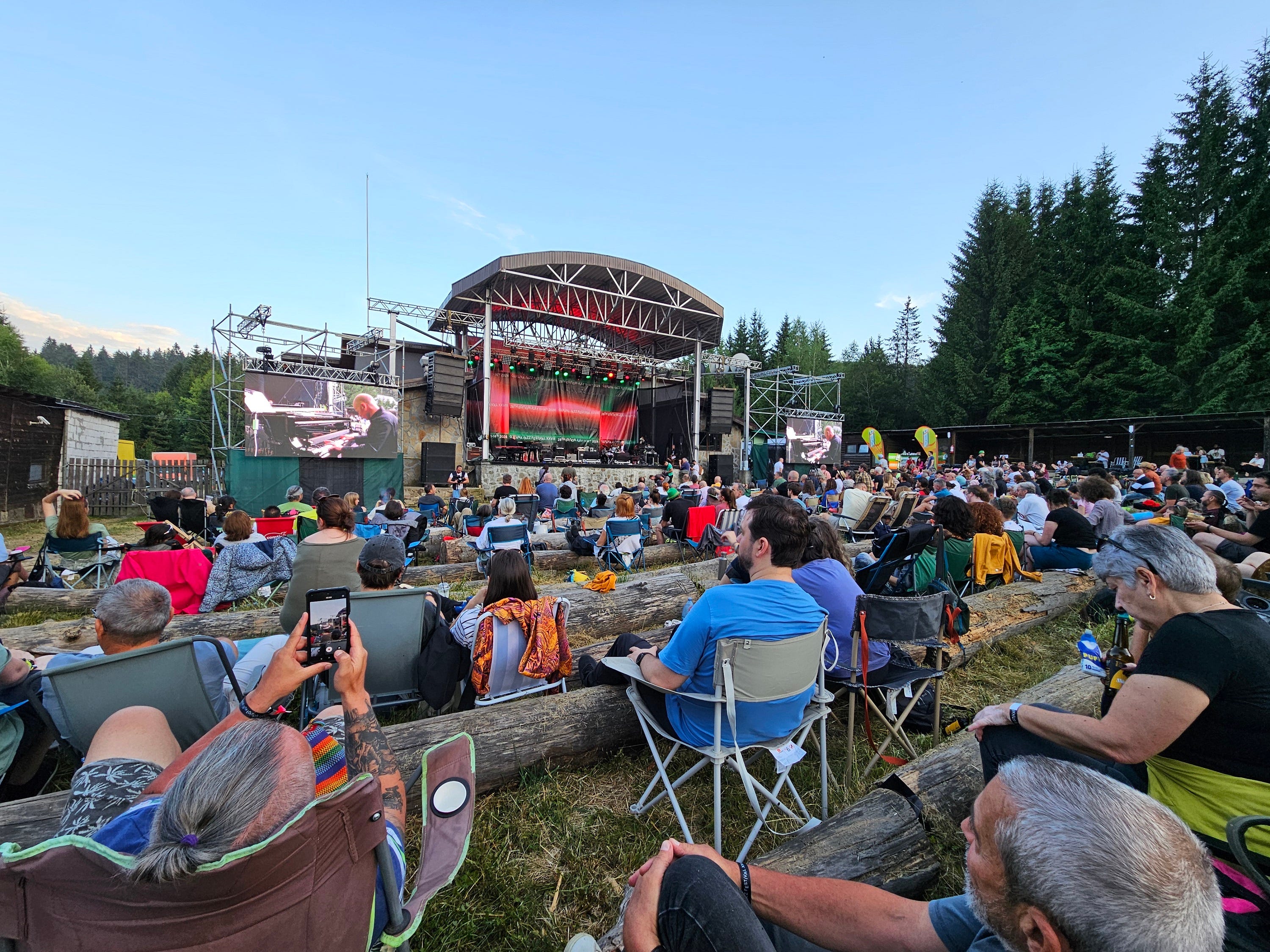
It was 2019 when I first seriously asked myself: could there be something wrong with the way jazz is presented to audiences live?
In October that year, I was one of the guests of the “Jazz in Germany” programme organised by Initiative Musik and the German Federal Foreign Office, where, among other things, we visited Deutsches Jazzfestival Frankfurt. The programme was OK and quite similar to the concept common in Southeast Europe: some legends, some middle-aged mainstream performers, and a few bands from the more avant-garde side of the scene.
However, something felt strange. While we were waiting in the foyer before the concert evening began, I looked around and soon realised that I was by far the youngest person in the room (I was 39 at the time). By my rough estimate, the vast majority of the audience was 55+ or even older. I kept looking around to see if I could spot at least someone around my age, but the result remained more or less the same: perhaps I noticed only a few “younger” couples in their 40s, along with the few of us from the group who stood out from the average.

I didn’t understand it. By then I had been to various festivals around Europe and, although older audiences had always dominated, the age structure had never been quite this uniform. There was always a mix. I wouldn’t say the programme was really the problem either, as it was only partly “conservative”, but no more so than, say, the Belgrade Jazz Festival, where the audience is considerably younger. At the time, I was simply left puzzled, but I didn’t think much more about it.
On this same trip through Germany, a conversation had been organised for us with the artistic director of Jazzfest Berlin, Nadin Deventer, who was at the beginning of her tenure at the time. She spoke with great enthusiasm not only about the programme, but also about the way the concerts would be presented to the audience. She talked about the creative stage and sound setup for Anthony Braxton’s concert, festival locations, etc. I realised that this was not simply a desire to choose an “unusual location” or come up with some viral stunt for a young audience, but an attempt to approach the presentation of jazz music in a fundamentally different way from the usual one.
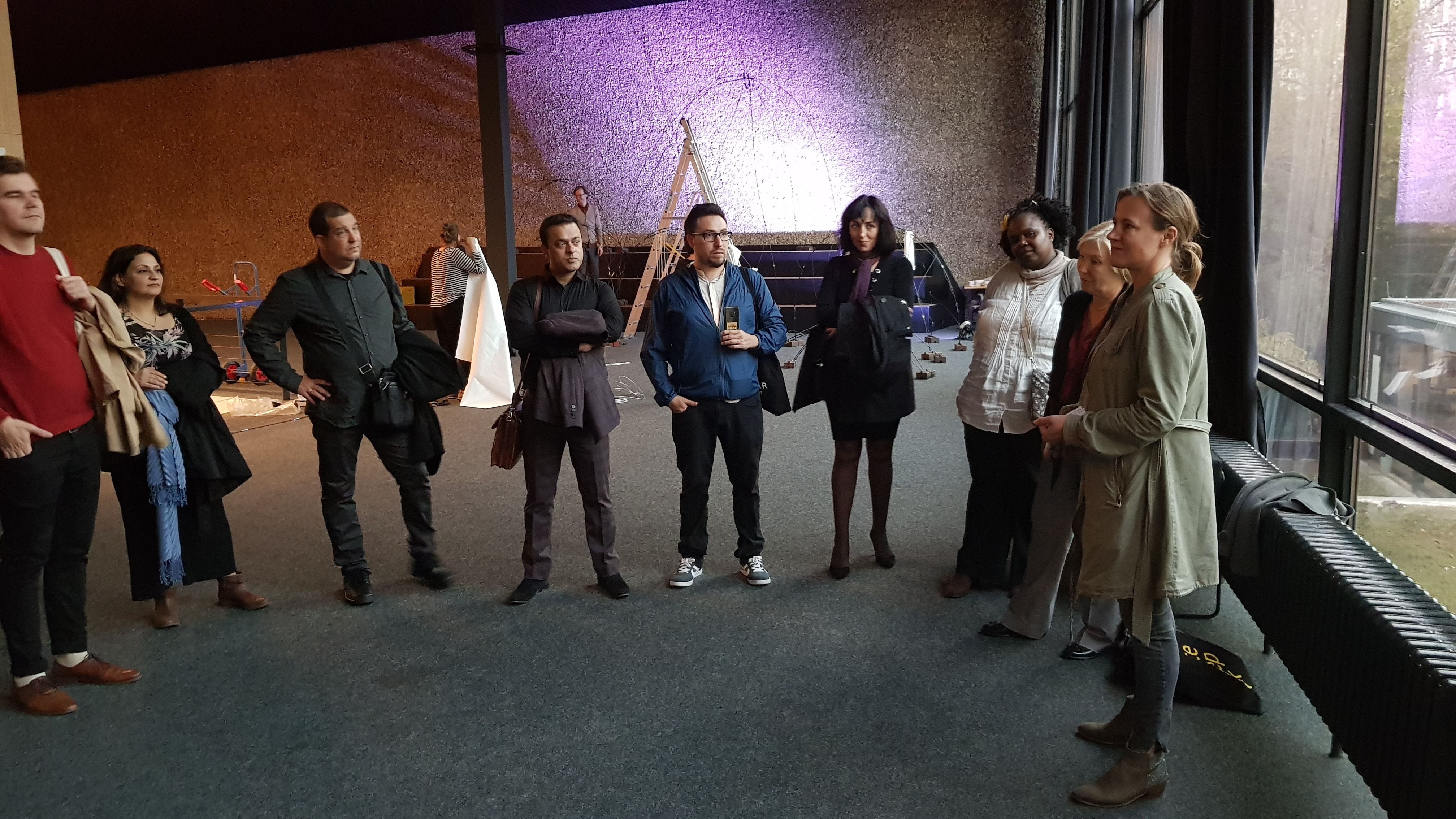
A few days later I returned home to Serbia and started thinking about all of this. From the beginning of the last century to today, music has evolved in unimaginable ways. Both in terms of genre and in the production of studio releases. On the other hand, the way music is presented in a concert setting has remained more or less the same for decades. You have a concert hall, a stage, a sound system and an audience sitting in chairs opposite the musicians. There is lighting, perhaps some projection on a video screen, 3–4 concerts per evening in a simple chronological order. Applause, a routine encore, an exhibition in the foyer to fill the time before the concert, a panel discussion as a side programme that interests only journalists, and that’s it.
Over the years I have attended festivals in many attractive locations, sat in stages inside fortresses and castles, on mountain tops, in museums, churches, on beaches, in botanical gardens, and all sorts of other places. But the essence of the music presentation was still the same, and the relationship between musicians and audience was organised in more or less the same way, with minor variations in sound or in the way we sit (or lie down) in front of the musicians.
Here we might note that (at first glance) a lot has changed from 2019 to today. One of the biggest changes is the approach to social media and the rise of TikTok and the Reels format on Instagram. It has become almost imperative to do something crazy, unusual, out of the ordinary, something that will make us stop doomscrolling. If we are talking about music, we can notice the rise of “flash mob” performances, where a group of performers suddenly appears in the middle of a city, plays or dances their piece and disappears, and then someone records it and shares it on social media and it goes viral. It is also attractive when someone plays in an absolutely unusual location, such as a cave, deep in a forest, and so on. Tourism has long been intertwined with concert offerings, but this connection has evolved even further in recent years.
My view is that this ubiquitous segment of the “evolution” in music presentation primarily concerns the evolution of advertising and PR strategies. As someone whose everyday work is connected to media and public relations, I certainly understand why these innovations are important and necessary. But as a lover of jazz, avant-garde or simply creative music, I feel that we need to go deeper, beneath the tip of the iceberg.
I started doing my current job in that same year, 2019, when I was on the “Jazz in Germany” trip. Over the years, the Komunikart agency has, among other things, specialised in working with museums, galleries and independent contemporary art productions, so my everyday work has included writing press releases based on curatorial texts, interviews with curators specialising in contemporary art, features about particular exhibitions, and so on. I studied philosophy for a time and during my student years socialised with art historians (whose study group was at the same faculty), so in a certain sense this new job felt familiar to me, while at the same time representing an exciting journalistic and intellectual challenge.
Thinking about the way curators conceive exhibitions in museums and galleries, my mind kept returning to what Nadin Deventer had said in Berlin. I couldn’t remember every individual detail, but in the way she presented her ideas I recognised much more of the approach of a contemporary art curator than that of a typical “jazz programmer” or “artistic director”. Of course, who is going to play matters and the essence is still the music and quality performers (by whatever criteria), but the way that music is presented matters just as much.

Let’s develop that analogy with the visual arts. In a conventional museum exhibiting paintings from previous centuries, the paintings will be in conventional frames, with standard lighting, arranged in an appropriate thematic order and hung on the walls, more or less at eye level.
If we are talking about contemporary art, for example from the second half of the 20th century or the 21st century, the situation becomes more complex, with installations and video art, performances, and so on. The way we think about gallery space changes, as does the positioning of works, and the lighting is different. You might come across a labyrinth; or move from a room with paintings and installations into a space for video projections; or into some kind of interactive situation where, for example, you have to squeeze past naked performers and “brush against” them (the legendary performance by Marina Abramović and Ulay).
Now, let’s imagine a jazz concert in a typical concert or theatre hall. Everything we have already mentioned – a slightly raised stage, rows of chairs, 3 concerts per evening, 60 minutes of music, applause, a spontaneous or forced encore, and so on. This kind of setup would be analogous to a museum display of 18th-century art. On the other hand, jazz music is very much alive, potent, the scene is full of creative people, young musicians who keep emerging and recording exceptional albums. The last thing we could say is that jazz is museum music, although conservative and traditional jazz, focused on the achievements of the middle of the last century, still exists and is still performed.
We could therefore say that the music being performed is somewhat disproportionate to the way it is presented, that is, to the usual concert stages and halls. If we connect this with the ever-present desire to bring the world of jazz closer to a new and younger audience, the further conclusion would be that something has to change in the very approach to what constitutes a “jazz concert”.
I am aware that there are counterarguments to these ideas. Many festivals simply bring in pop performers to attract young people who might hear some jazz along the way, and this principle has been around for decades. Many organisers simply rely on a “performer for young people” to attract an audience even if the concert takes place in a “boring” venue. I am not disputing these strategies, but I think they are simply not enough – something that the most progressive concert programmers in jazz are themselves recognising.
We could also say that concert halls with appropriate acoustics, sound systems and architecture are simply built to transmit sound to the audience in the most perfect way possible, just as it is played on stage. Or that they are designed to meet the need to rationalise seating for as many people as possible. That is absolutely true, but it represents only one piece of the “puzzle”.
Do jazz musicians simply walk into a studio, press REC and play? Or do we have a sound technician who meticulously sets up the sound, technicians who position microphones, amplifiers and monitors in particular places, and then a sound engineer who later spends several hours mastering? Studio work itself has also evolved significantly over the decades.
And then, when all of that is finished, we have people who write texts about the album, create visual art for the CD and LP cover, take photographs for promotional materials. Everything that we as listeners “hear” is mediated through the work of all these people and is never simply “the music as it was played”, but the product of an appropriate concept and modification of the original musical idea, additionally passed through the “filter” of our personal experience of listening to jazz, our personal worldview, our view of art in general, and the mood we are in when we listen.
With all this in mind, it would be logical to approach concerts as creatively as possible, but also with great respect for the emotional and intellectual depth of jazz as an art form. In that sense, I think it is important to separate the “advertising approach” from what is essentially connected to the art itself. And this brings us to the point of the text – we need concert curators.
We need them because programmers/selectors/artistic directors (in most cases) do not deal with these things, or do not know how to deal with them. At least they need to start thinking about them as best they can.

For years, the Pančevo Jazz Festival in Serbia has had a theatrical set at the back of the stage – some kind of abandoned factory or the ruins of an old building. Anyone who regularly comes to Pančevo for the festival knows this set well and has a particular visual association with the festival. They know they will not simply enter the Cultural Centre of Pančevo looking the same as on any other day, but that during the festival it will represent an entrance into a different universe, one we associate with the jazz festival and quality music.
This is not a major change compared with the typical festival situation, but we can feel that even a small intervention changes the atmosphere and, ultimately, the perception of the music, even if we are listening to it in an ordinary concert hall.
So, for example, we can hire set designers. We can hire visual artists to enrich the concert space in a particular way. Or filmmakers to conceive what will be shown on the video screen behind the stage. Or perhaps on special screens in the foyers. A photography exhibition does not have to be presented in standard frames; the possibilities are endless.
A fantastic example of an approach to concerts is the band Nik Bärtsch’s Ronin, which for years has had its own stage lighting technician (or rather – artist). It was not simply lighting that followed the musicians from above, as is usual, but particular light sources were positioned in different places on stage, while the person responsible for the lighting controlled these sources so that at every moment they followed the music and were in harmony with it. The original musical idea was not “compromised”; quite the opposite – the experience of Bärtsch’s concept of zen-funk minimalism was enhanced through a visual approach corresponding to the broader artistic idea.
All of these are approaches that are not overly invasive in relation to classical jazz presentation and that respect the limitations of standard concert halls. But if we do not want to stumble around dealing with the visual aspects of performances even though this is not really our speciality, there is no shame in hiring professionals. Curators. People who will not simply place some work of contemporary art in the concert space, but will devise and realise the festival’s visual concept together with commissioned artists, and through conversations with the festival’s artistic director and selector, with whom they would jointly determine what best suits the festival’s reputation and the space in which it takes place.
One of the most interesting examples of so-called “jazz curation” I saw was in 2016 at the artacts festival in the Austrian town of Sankt Johann. On the main town square there was a small wooden hut, a “sound cabin”, in which festival performers played three-minute solo improvisations for one person during the afternoon. You would arrive a little earlier, register with the organiser, who would enter your slot in a table, show up at the agreed time and, for €2 per person, have a completely private mini-concert. Because of the great interest, in practice these were often concerts for two. I had the fantastic pleasure, for example, of having Mikołaj Trzaska play a saxophone improvisation just for me and my partner Monika; and a natural part of the concert was also chatting a little before and after the performance – because such proximity makes something like that feel natural.
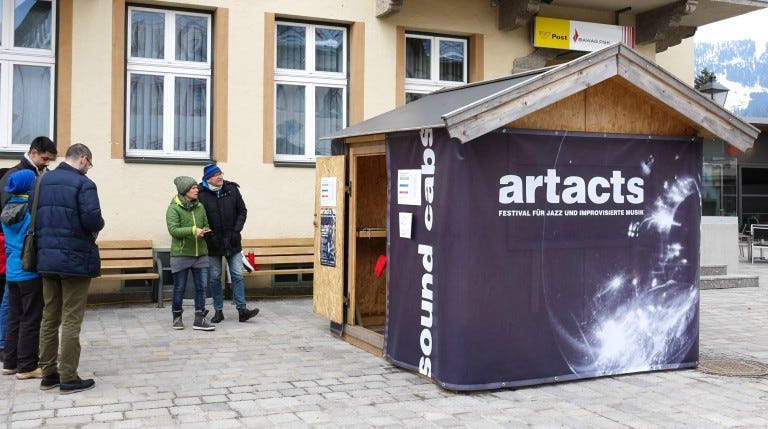
For obvious economic reasons, this is not feasible as a festival’s “main programme”, but it points to the possibilities of a creative approach to jazz concerts.
What I particularly liked here was precisely the emphasis on that essential approach to art – removing every possible form of mediation in the conventional sense, to the point where the musician is literally a metre in front of you, creating music on the spot, just for you. It was not about presenting jazz as something different from what it essentially is in order to make it “more attractive”; quite the opposite – what was emphasised was precisely its essential quality.
I am also a great lover of concerts in nature – especially those involving smaller spaces and the absence of professional amplification, where the mediation between artist and audience is likewise minimised.
It is also great when we are not simply “thrown into nature” for its own sake, or for tourism-related reasons, but when it has some artistic meaning as well. At the recent concert by Tord Gustavsen and Trygve Seim in the Romanian village of Socolari, on the estate of painter Gheorghe Fikl, I felt how this particular natural setting worked ideally with the aesthetics of Scandinavian jazz, in surroundings where we could hear a stream and found ourselves at the edge of a dense forest, with a stage made of stone and wood, in a place where “sounds next to silence” resonated with the environment. Here we did have conventional amplification, professional cameras and all the rest, but the spirit of the place fully matched the spirit of the music.
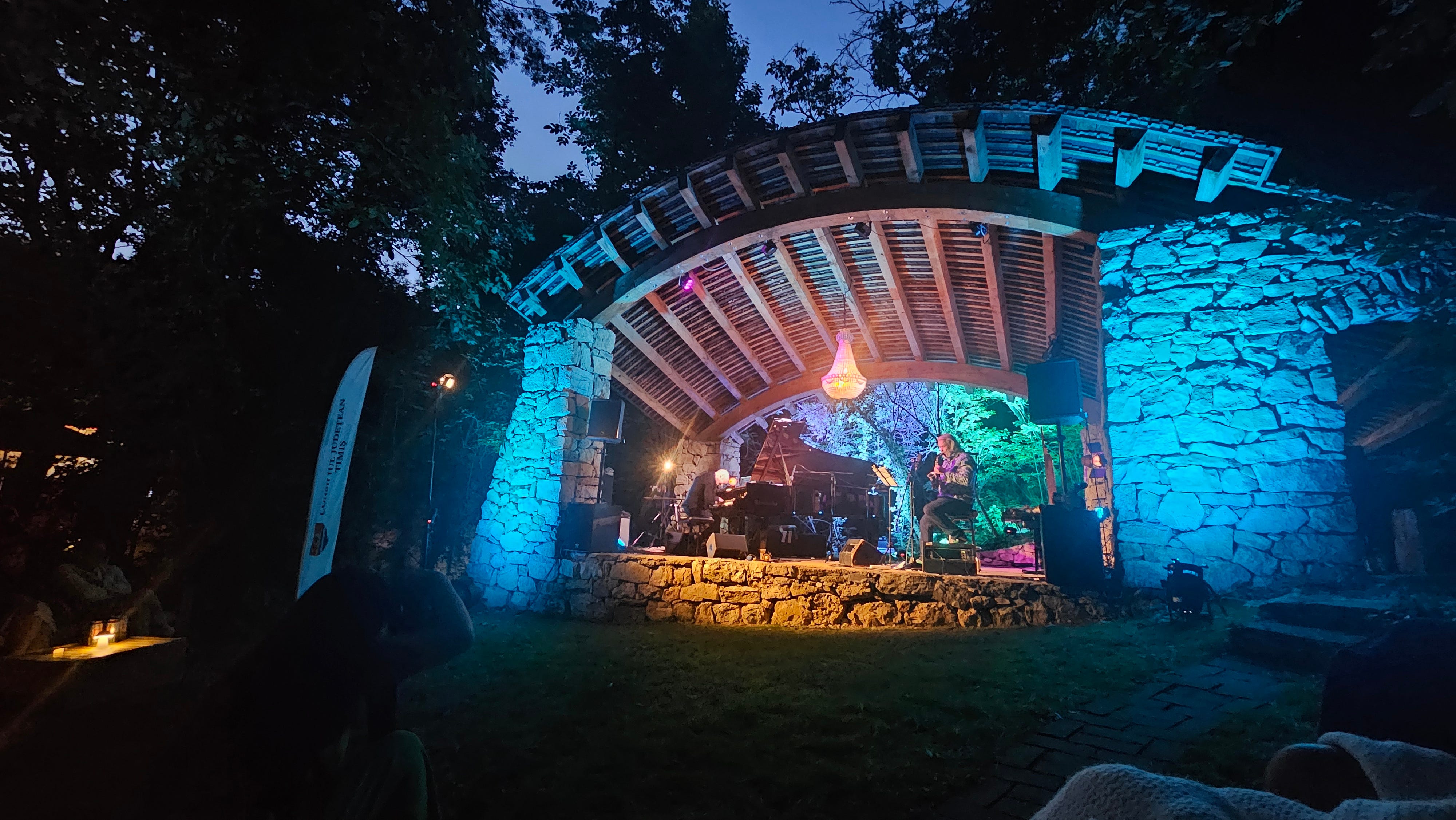
At this very concert, Gustavsen and Seim performed together with Fikl, who painted on a canvas to their music during the second part of the concert. I especially emphasise this because an encounter with the world of visual arts does not only bring jazz a creative approach to presenting music, but potentially also a new, artistically highly educated and interested audience. People who may not listen to jazz, but who certainly have the potential to grow to love it or at least occasionally enjoy it at a concert.
Why not address precisely them, and do so in a way that organically includes that community? Instead of straining to reach as many people as possible through the most general approaches, the right path might be precisely this targeted engagement with communities with which jazz has essential points of contact. And not (only) through media campaigns, but through the active inclusion of programmes that correspond to the spirit of contemporary art, that is, by bringing jazz closer to this kind of approach.
Through that process, we, the existing jazz lovers, will also come away enriched by new experiences, artistic and human perspectives.
Dear Nikola,
Thank you for your piece, which brings together and articulates some reflections that have been circulating in our field for quite some time.
The fact that the nature of the listening experience is intimately connected to the very essence of live music is evident in the history of jazz itself. Jazz originated in the streets and dance halls and then, in a journey that on the one hand rightfully elevated it to the status of art music, but on the other brought it dangerously close to the dusty rituals of classical music, gradually became music for the concert hall.
Much of today’s music—even when deeply rooted in the great African American tradition—seems to push against this now chronic rigidity of the listening experience, reclaiming the body, the community and, at times, intimacy.
The same is true of the ways in which entertainment and culture are consumed today, as you point out.
Many festivals and concert organisations—you mention Nadin Deventer and Berlin, but this is certainly not limited to that context—are trying to find original ways of reaching new audiences, not only in terms of age, but also in terms of the many groups that are culturally and economically excluded from traditional cultural spaces. This is certainly an issue that curators, first and foremost, need to take on.
I do think, however, that there are a few other elements worth bringing into the discussion. Let me try to summarise them.
1. Economics.
Creating site-specific and genuinely original formats involves costs that are not always easy to sustain. At the same time, the availability of existing infrastructures—concert halls, stages, sound systems, seating, and so on—naturally encourages us to make use of what is already there.
2. The nature of the music.
Some performances require specific acoustic conditions, a certain degree of concentration, and silence—elements that even the most creative and engaging innovations cannot always guarantee. There are forms of listening that are demanding by their very nature, and we should perhaps be careful not to regard that as a problem to be solved.
3. The risk of turning it into just another event.
As happens in many other fields, the search for an original approach can sometimes become more important than the music itself. Innovation can easily turn into a format-driven exercise, where the experience surrounding the music ends up overshadowing the music.
4. The most important factor, in my opinion: the musicians themselves.
They have to want this in the first place—and often they don’t, or simply don’t know how to imagine it. I don’t blame them for that. If you have spent years studying with the goal of eventually playing on a big stage in front of thousands of seated, silent people, and if you have developed your musical language around that kind of experience, it is not easy to suddenly switch gears and imagine something fundamentally different. Especially when the “system”—whether boring or not—is already there to accommodate you, and proposing something new may feel difficult or even risky.
5. The risk of uniqueness.
Unless a new format becomes widely adopted, every “creative” festival tends, to some extent, to seek exclusivity for what it has imagined: the concert for a single spectator, the original and immersive venue, and so on. This inevitably leads to a model based on exclusive production. In the current festival economy—with costs constantly rising and ticket prices unable to absorb the whole burden—that is not exactly easy to sustain.
Having the privilege and responsibility of directing a festival with many unique characteristics—such as its relationship with wineries and the local area, among others—like Jazz&Wine of Peace in Cormons, which I will also write to you about privately at some point, I find myself constantly having to balance creative ideas with the practical, regulatory and safety requirements imposed by national legislation. And unfortunately, that is not always easy.
In any case, I think the questions you raise are important and absolutely worth pursuing. I hope that a closer, more open and trust-based dialogue with artists can help us move in this direction.
Best,
Enrico
I’ve been listening to to live jazz since 1970 in many different contexts. I do not like the jazz festival venue as it lacks intimacy. I’m also a jazz photographer and have found the local jams that occur in small spaces, sometimes out doors and sometimes in informal bars provide some of the best spaces to understand and enjoy the music best. Fortunately, here in Baltimore and Washington DC we have many places to enjoy jazz up close and preferably with minimum amplification. For acoustic jazz over amplification ruins the experience.