


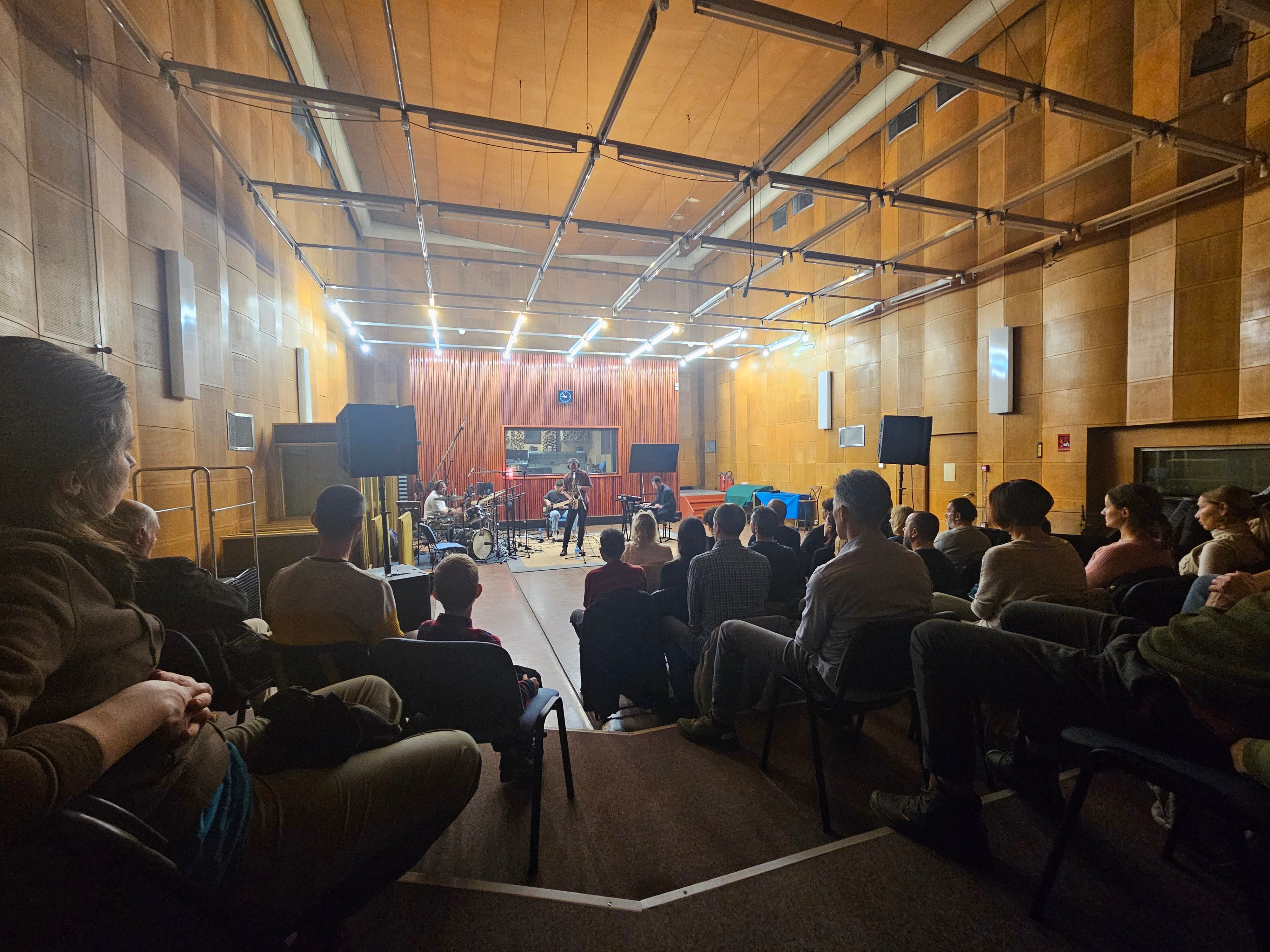
Ever since I started going to jazz concerts—some 25 years ago, give or take—a whole new musical world opened up to me. But at the same time, I also entered a world of new behavioral conventions. In my teenage years, I went to hundreds of rock and metal shows where you could more or less behave however you wanted without anyone giving you a strange look. Then I moved from smoky clubs into concert halls, cultural centers, galleries, and so on. I learned the routine—applause at the end of a solo and at the end of a piece, cheers at the peak of a solo. But also—sit still in your seat, don’t flail around or disturb those next to you. Be polite. Be cultured. Don’t yawn or whisper if the concert is boring.
Don’t fall asleep.
OK, no one ever told me that last part explicitly or implicitly, but it somehow went without saying. It was basic cultural behavior. As we all sit there, dead serious in a concert hall—respectable citizens and „intellectuals“—we’re expected to be at our best in every way. For us, there is no fatigue, no boredom—we must be composed, proper, and seen in our finest light. Especially at a jazz concert, a social event often considered prestigious. This isn’t some dive where you can slump into a corner and doze off after a few too many drinks or whatever.
First stage: Shame
OK. But what happens when you’re really, really tired, and you still want to see your favorite jazz band or musician—you’ve been waiting for that concert for weeks, maybe months?
It was 2009. On the first night of the Belgrade Jazz Festival, I watched the full evening program and got home around 3 AM. Then I went to work early the next morning. At the end of the workday, around 4–5 PM, I stayed in the office to prepare concert reports from the previous night for Jazzin.rs. There wasn’t even time to go home—I went straight to the second night of the festival. One of the stars of the evening was Tomasz Stanko, who had released the fantastic album Dark Eyes just a couple weeks ago. I had listened to it inside out. Stanko himself was a legend, and I loved his previous work. I was genuinely looking forward to that concert.
It was the second concert of the evening, scheduled for 9:30 PM. It didn’t start too late, but during the break between sets I began to feel an overwhelming wave of fatigue and drowsiness. I allowed myself to close my eyes for a moment while waiting for the band to come on stage, but I realized it would only get worse as time went on. I had to focus, somehow, and enjoy it at all costs. This had never happened to me before, which made it even more frustrating.
Once the concert began, what should have been pure enjoyment turned into a struggle to stay alert—to live up to the moment. For myself, for my love of Stanko, for jazz, for the need not to embarrass myself at the most important jazz event in the country, where I had come as a longtime fan and music journalist. It went fine for the first couple of tunes—until the gentle ballads began. Then the agony started: I would suddenly notice that I had drifted off, then force myself to stay awake, and repeat the cycle until the end of the concert. I felt disappointed. I shared that feeling only with close friends—I didn’t go around telling people that it had defined my evening.
OK, I told myself. You’re not that young anymore—it’s normal.
But I couldn’t shake the feeling of shame.
Second stage: Acceptance and Reconciliation
I pushed it all aside and carried on with my jazz life at full speed. I attended festivals across Serbia, occasionally traveled to Croatia, and even went to Austria for the Jazzfestival Saalfelden for the first time. Life was good—everything was in place. Then autumn came, along with another intense run of local jazz festivals I covered for Jazzin.rs and a few other magazines. In practice, that meant watching entire festival programs—both what I enjoyed and what interested me less. I approached the work enthusiastically and tried to do it as honestly as possible.
But of course, if you go to festivals every weekend—often from Thursday through Sunday—fatigue will catch up with you. And then it happened again. This time, the “victim” was a concert by Ron Carter at the Novi Sad Jazz Festival in 2011. A living legend of jazz in Serbia! To be fair, I wasn’t particularly enthusiastic about the albums he was releasing at the time, but still—a legend is a legend. You show up, you pay your respects, and so on. That evening, Ron Carter was third on the bill. The main program started at 8 PM, and by my estimate his set would begin around 11 PM. Not too bad.
However, the breaks between sets dragged on, and Ron Carter didn’t come on until around midnight—at least as far as I remember now. I could feel the fatigue creeping in. I knew what was coming. The atmosphere was unusual: despite being by far the biggest name on the program, the audience had largely dispersed by that point. The trio of Norwegian guitarist Gisle Torvik had drawn a packed and enthusiastic crowd, but for Ron Carter—not so much. I attributed that to the audience profile: not die-hard jazz fans, but people simply looking to spend an evening with a suitable cultural program. After two concerts, they had no reason to stick around for a midnight set.
The concert began. Carter was joined by Mulgrew Miller on piano and Russell Malone on guitar. Their music was beautiful and soothing. Perfect for closing your eyes and letting go… which, of course, is exactly what happened. I was sitting far enough from the stage and thought—they won’t see me, it’s not like I’m being provocative. The audience was scattered across an oversized hall. As much as I respected Ron Carter, his music with the Golden Striker Trio didn’t mean as much to me as Stanko’s. There was no self-imposed pressure that I “had to enjoy it.” I closed my eyes, and everything fell into place. I was relaxed. The music was beautiful. The experience was slightly displaced from the usual focused, eyes-open listening—but I wouldn’t say I “missed” the concert. It was simply different.
Third stage: A story to laugh about
A year later, I visited the Jazz Festival Saalfelden for the second time. For those who haven’t been, it’s important to note that the program runs all day—from 9 AM to a few hours past midnight. If you’re a die-hard enthusiast and want to catch as many concerts as possible, it will take a toll on your physical and mental state. As the festival progresses, you inevitably become saturated, no matter how fantastic the program is. I’ve never been to the Big Ears Festival in Knoxville, but from what I’ve read on Substack, it seems to present a similar kind of “challenge” even for the most dedicated listeners.
In the small hall of Kunsthaus Nexus, the band Steamboat Switzerland was performing. As it turns out, part of that concert is available on YouTube, so I don’t need to explain too much about what kind of music it was—see below. Some parts of the performance were quite loud and explosive, which was one of the band’s defining qualities. Every time I had dozed off at a jazz concert before, it seemed tied to gentle trumpet or piano tones—music that naturally invites sleep. Here, everything was bursting and exploding, while I was “sleeping like a baby.” Well, that might be an exaggeration—but it was similar to the Ron Carter concert, even though the music there was far more melodic.
Later, I talked about it with a fellow journalist who had experienced the same thing at that very concert. Not because we didn’t like the band, but because fatigue caught up with both of us at the same moment. We found it hilariously funny that we had dozed off during such a performance—one where you’d think that would be impossible. It became a great anecdote, and in that shared recognition—that it had happened to someone else—the sense of shame finally disappeared.
One of the musicians from that concert is a subscriber to my Substack, and I hope he won’t mind if he’s made it this far into the newsletter. If it wasn’t already clear, situations like this often happen out of an overwhelming desire—shared by us jazz enthusiasts—to see as many concerts as possible, even when it exceeds our physical limits. Sometimes it passes quietly, and sometimes it leads to moments that surpass our wildest expectations.
Epilogue
After these experiences, I began to view sleeping at concerts with much more calm and understanding. It can happen at a “boring” concert, but it can just as easily happen during a fantastic performance by a band you love. Of course, it’s always better to be awake, well-rested, and fully present. Over the years, I’ve learned to manage my energy more rationally—not to see everything at all costs, but to stay as fresh as possible for the concerts that matter most to me. But we’re only human—ordinary people of flesh and blood—and there’s no need to beat ourselves up for occasionally behaving in a very human way, even if it might seem inappropriate at first glance. Especially when it happens out of the most sincere, wholehearted desire to experience art beyond all limits.
At the Pančevo Jazz Festival last autumn, even before the first concert had begun, I noticed a senior citizen who had already closed his eyes and drifted off somewhere. I smiled to myself, with understanding, and silently wished him a pleasant evening.
The one time I got to see the Modern Jazz Quartet, I was 18 and went with my best friend's mother. She fell asleep ten minutes into the set. And I never let her forget it. Then again, the MJQ wasn't exactly Maynard Ferguson...
I’ve definitely fallen asleep at shows, notably Bill Frisell put me down like a baby. Another time it was borderline rock jazz and I was in the front row out like a lamp before my friend elbowed me.
A decade ago I would have felt shame, but I’m past that. Managing energy is definitely helpful, I also like it when festivals end at decent hours (New Orleans Jazz and Heritage Festival wraps at 7pm each day). Sometimes I buy tickets for shows long in advance and don’t have a lot of control over whatever else fills my week- often work and family commitments.
I say- it’s great that we made it to a show, it’s not “polite” to fall asleep and if it happens we must be pretty exhausted and it’s what our body needs.