


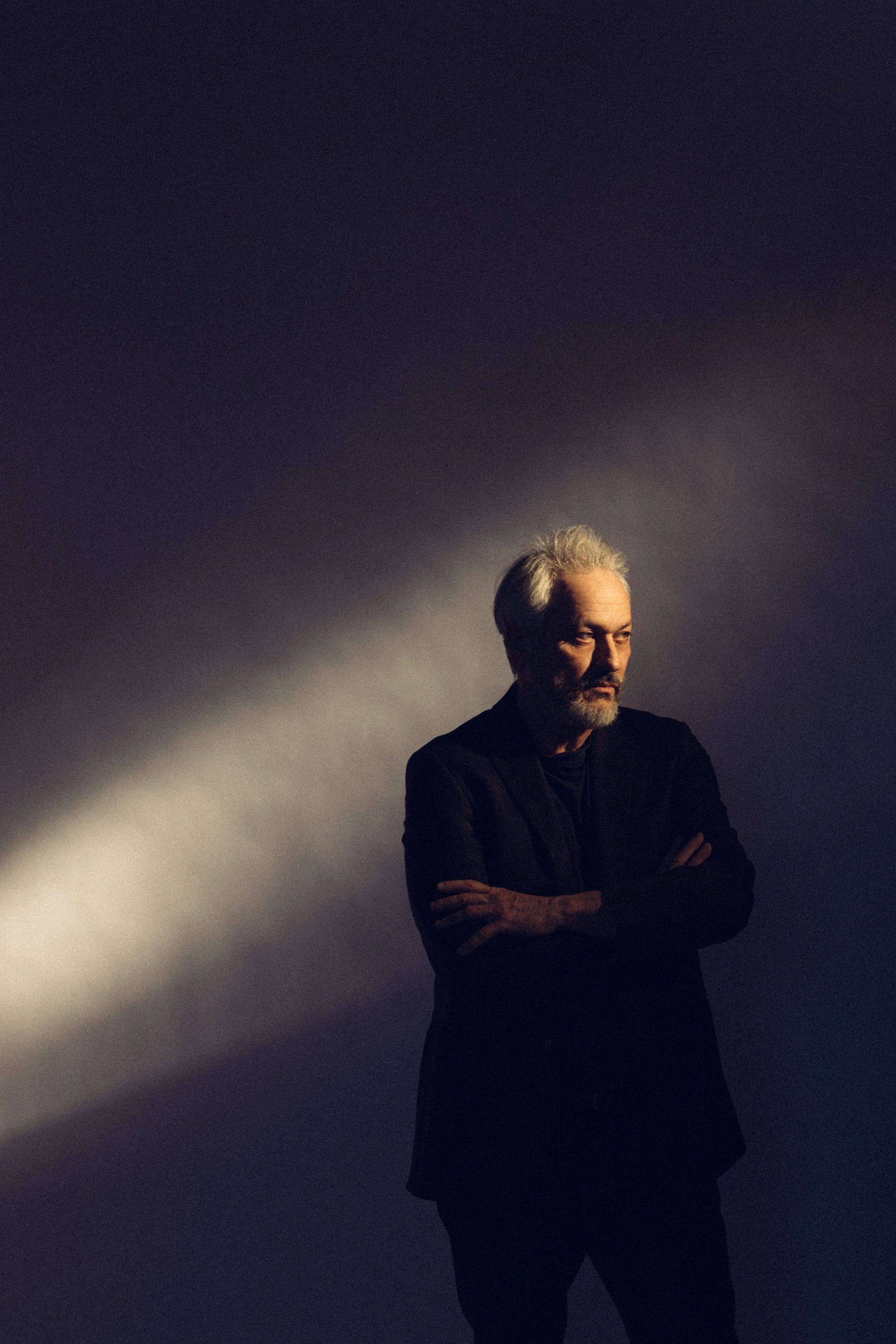
At the moment of publishing this text, Marc Ribot is already well into his new European tour with Ceramic Dog, a trio that also features drummer Ches Smith and bassist Shahzad Ismaily. The final stop on the tour is Pula, Croatia, where they will perform on July 4 at the Circolo venue as part of the Jazzbina concert series. This year alone, the series has already hosted The Tiptons, James Brandon Lewis, and Exterminator ‘81, a project led by Croatian keyboardist Toni Starešinić. Following Ceramic Dog, The Necks trio will appear on September 19. In short—this is serious programming.
After contacting the organizer regarding press accreditation for the concert, I mentioned that I would write an original piece on Marc Ribot ahead of the show, since Eurojazzist doesn’t have a conventional news section for press releases. Over the following weeks, several ideas crossed my mind, the most entertaining being a possible list of Ribot’s 10 or 20 best guitar solos. I’ll definitely return to that idea at some point; however, I felt that such a piece wouldn’t be the most appropriate way to frame a tribute to the Ceramic Dog trio.
OK, let’s start over. We won’t write about Marc Ribot the guitarist. If Ceramic Dog is, to a large extent, a punk-rock trio in which Marc Ribot is the lead singer, perhaps it would be more interesting to reflect on him as a vocalist?
For four decades now, Marc Ribot has been one of the most brilliant guitarists in the world; put him in any band, give him a few tracks and a solo or two, and there’s no way you won’t notice his contribution. In Serbia, he is still most widely appreciated as “Tom Waits’ guitarist,” although there is also a strong circle of fans devoted to the “Zorn universe,” where Ribot has played a prominent role. Personally, I believe Ribot is the greatest guitarist in the history of music—and I know that statement may be excessive, but so be it. Many serious authorities would certainly understand why Ribot is (at least) one of the most important guitarists in contemporary popular and improvised music. On that point, I believe there is a consensus.
On the other hand, there is Marc Ribot as a bandleader and singer. He released his first album under his own name, Rootless Cosmopolitans, in 1990, at a moment when he had already built a magnificent body of work with Waits and with The Lounge Lizards. Since I hadn’t listened to this album in years, I played it again to check whether there was any singing on it—there is, on several tracks, starting with a deconstructed cover of Hendrix’s classic “Wind Cries Mary.”
I must admit that I might not have recognized his voice in a blindfold test—it sounds younger and different than it does today, when his vocal style is clearly more defined. It felt more like an exploration of new territory. In the late ’90s and early 2000s came two albums with Los Cubanos Postizos, where we again hear him only occasionally and in a more functional context, as he leaves the more prominent vocal roles to others.
The first Ceramic Dog album, Party Intellectuals, was released in 2008. It opens with a frenetic cover of “Break on Through” by the legendary The Doors; it feels as though this „seasoned“ Ribot is “winking” at the one who sang Hendrix 18 years earlier, opening a new chapter in his rich career.
At this point, Marc Ribot is not only a legendary guitarist, but also an author of numerous albums across different contexts—from solo acoustic guitar to more avant-garde band settings. There are many musicians who begin their careers in relatively commercial waters, only to explore more experimental expressions later on. But what if you’ve already spent decades as one of the most prominent figures of the boldest branch of the American avant-garde and improvised scene—that is, jazz understood in its broadest sense?
Seen from that perspective, the turn toward Ceramic Dog appears entirely logical, especially if you perceive Ribot as one of the greatest punks among (free) jazzers. At least, that’s how I see it.
I clearly remember the moment when the track “Masters of the Internet” from the 2013 album Your Turn appeared. It became a major media topic—at least on websites that follow alternative and jazz music.
“Download this music for free / We like it when you do / We don’t have homes / Or families to feed / We’re not human like you / We live inside your iPod / We’ve no religion or god / We’re slaves who only live to serve / The masters of the Internet / The masters of the Internet.”
It was the peak era of free downloads, and Ribot’s lyrics could hardly be more direct in conveying the song’s message. In that sense, this track is an important cornerstone in defining Ribot’s authorial persona within Ceramic Dog, introducing him as a songwriter unafraid of slogans and direct engagement with pressing issues. At the time, it may have been a more narrowly “professional” topic, but with Donald Trump’s first term, the situation of course became more intense. Many musicians felt the need to speak openly about Trump and the consequences of his presidency, and Ribot was no exception.
On Your Turn, I feel that Marc Ribot becomes increasingly free as a singer. Of course, we are still talking about his “utilitarian” approach, shaped by the songs themselves and rooted in a punk-rock aesthetic. He uses different microphones and production approaches for his voice, but occasionally lets it ring out freely. Although we know that Marc Ribot is not a typical lead vocal, like singers in alternative rock bands or jazz singers, his voice is easily perceived as natural, meaningful, even attractive within the context of Ceramic Dog. Just as we hear small “imperfections” in his solos—masterfully positioned within the musical context—his voice plays a specific role within the overall performance concept. If the “narrator” is angrily delivering his lines, then Ribot’s charged vocal will sound exactly right. In that sense, his style becomes a synthesis of two elements—Ribot the narrator (the one presenting his poetry or „story“) and Ribot the punk (the one disregarding conventions of vocal “beauty”).
YRU Still Here? is an essential Ceramic Dog album. The opening track, “Personal Nancy,” presents Marc Ribot as a furious slam poet and narrator, a hilarious yet simultaneously angry and witty songwriter. “Fuck La Migra” worked brilliantly for me when performed with another band that promoted the album Songs of Resistance: 1942–2018, with which he appeared at the SuperUho festival in the Croatian coastal town of Primošten.
Back in 2019, I was quite skeptical about how songs previously performed by vocalists such as Fay Victor—or other guest singers on that album—would sound; it turned out that the concern was completely unfounded, and that Ribot is a true artist of vocal improvisation, reinterpretation, and adaptation across different contexts and bands.
At that concert, I first heard the song “Activist,” which would appear two years later on Ceramic Dog’s album Hope. I have no words to describe the excitement I felt hearing this piece; it’s a small poetic masterpiece that is at the same time hilariously entertaining. The music, of course, is excellent as well. At a concert in Paris five years later, Marc Ribot performed the same song in a solo setting, where it sounded completely different. On that occasion, I also heard the song “The Empire State Building,” based on a tourist brochure text, which in that version could be read as a hilariously entertaining anti-capitalist manifesto.
Poet? Stand-up comedian? Punk musician? Vocal improviser? He’s all of that—and more. Hearing him across three concerts in three different vocal settings, I realized that Marc Ribot is a true master of live performance in the broadest sense.
Ceramic Dog is definitely his most “relaxed” band. Not if we consider the lyrics, of course, but from a purely musical standpoint. This means that the music follows a punk-rock flow and does not rely on obvious genre deconstruction, nor does it foreground improvisation in the way his more jazz-oriented projects do. That doesn’t mean there is no improvisation. The mere presence of Ches Smith and Shahzad Ismaily already signals to the listener that they will witness top-level musicianship—just without unnecessary display.
Although Ceramic Dog may appear musically “balanced” in that sense, its psychological effect on listeners and audiences should not be overlooked. Those who come with a background in New York’s creative improvised music scene will further appreciate the band’s looseness; if you approach them from a rock or alternative perspective, you may be drawn in by the subtlety of their improvisational spirit, which emerges from the cracks of this seemingly “genre-based” music.
See you at the show!
I’ve been listening to more Marc Ribot lately and don’t know about him, so I really appreciate this post.