


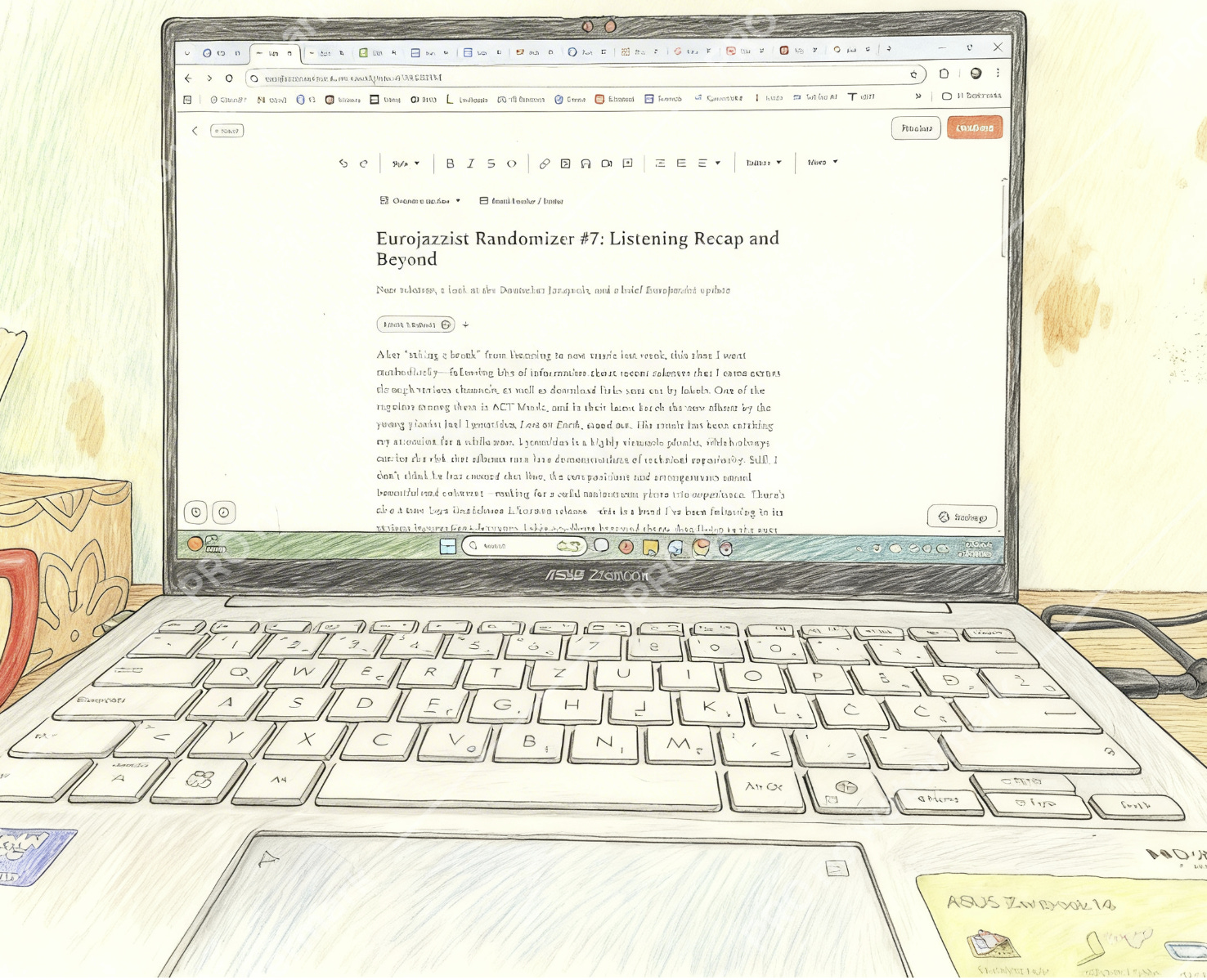
After “taking a break” from listening to new music last week, this time I went methodically—following bits of information about recent releases that I came across through various channels, as well as download links sent out by labels. One of the regulars among them is ACT Music, and in their latest batch the new album by the young pianist Joel Lyssarides, Late on Earth, stood out. His music has been catching my attention for a while now. Lyssarides is a highly virtuosic pianist, which always carries the risk that albums turn into demonstrations of technical superiority. Still, I don’t think he has crossed that line; the compositions and arrangements sound beautiful and coherent—making for a solid mainstream piano trio experience. There’s also a new Lars Danielsson Liberetto release Echomyr—this is a band I’ve been following in its various incarnations for years. I skip an album here and there, then listen to the next one, and so on—whenever I feel like hearing genuinely beautiful and accessible music. Both releases should be out in April.
I haven’t started listening yet, but I’m especially looking forward to the first album by the lineup Daniel Erdmann’s Thérapie de Couple – I Wanna Hold Your Hand, François, which will be released in April by BMC Records. Daniel Erdmann is a wonderful saxophonist I first heard in the witty ensemble Das Kapital. Later there was Velvet Revolution—both groups performed in Serbia. I like his playing style, which balances pure beauty and playful phrasing, between lyrical melodies, meaningful virtuosity, and hints of free style. That back-and-forth between the serious and the ironic—always wrapped in thoughtful arrangements and excellent bands—makes him a very exciting bandleader. And in the new band is also my favorite violinist—Théo Ceccaldi.
A few days ago I saw that We Jazz Records from Finland—one of my few favorite labels—has launched a compilation series titled Friends and Neighbors. As they put it: “We select music from artists and labels we love and, with their approval, share these discoveries in the form of a free monthly digital compilation with all We Jazz Bandcamp monthly subscribers.” The first track on the compilation is by the Finnish band Uusi Aika, whose self-titled debut album I loved. Somehow I missed that they released a new album, Luurankolauluja, at the end of last year. The first album could roughly be described as introspective spiritual jazz with touches of Indian spirituality. The second is somewhat more eclectic and shows a band continuing to explore the possibilities of its expression. I’ve only listened once so far, but I’m looking forward to spending more time with this music. Of course, this paragraph is also a recommendation for the entire compilation, as I have quite a lot of trust in We Jazz. The listening and download link is here.
I should say that there were also a couple of albums on the playlist by musicians I’m generally interested in, but I was disappointed this time. I considered whether to mention them at all, but I’ll skip it. Like some other jazz writers I’ve read, I think that in this abundance of never-more-accessible music, there’s no need to spend time on what (we think) doesn’t work, but rather to focus on a positive approach.
Deutscher Jazzpreis
Sometimes I get the impression that most of the major and best-known annual jazz polls for albums and musicians tend to stand still, rotating the same names by inertia—even if many of those artists certainly deserve their leading positions. That’s why the Deutscher Jazzpreis (German Jazz Award) selection is particularly interesting for several reasons.
This is nominally a “local” award with an emphasis on German residents, but that very fact already contains its inclusiveness. After all, we all know that Berlin is a hub for artists from all over the world, while other German cities are also quite open to newcomers who initially come to study at music academies and then stay to live and work in the country. So this selection actually features musicians from various countries, as well as many Germans I had previously only followed sporadically.
There are also a few international categories, which are still strongly focused on European candidates. For example, among the nominees for Best Big Band is Maria Faust Sacrum Facere—the fantastic ensemble of the Estonian-Danish saxophonist I’ve been following for a long time; then the Webber/Morris Big Band, and so on. In the shortlist for Best Album is Angel Falls by Sylvie Courvoisier & Wadada Leo Smith. It’s not just about Eurocentrism as such, but also about the balance between mainstream and avant-garde, which compete here on equal footing. As is often the case with such selections, I think it’s ultimately irrelevant who “wins.” But it is both interesting and important to look at these broader selections and get to know some new, valuable, and significant artists.
Eurojazzist recap
Just a few days after publication, the article Are You a Jazz Audiophile? became the most-read of all 20 pieces published on Eurojazzist so far. More than the statistic itself, I’m glad that readers are commenting on both articles and Notes—that there is genuine feedback and an exchange of impressions and opinions. And that’s not limited to this topic, which is more immediately communicative than, say, a review of an avant-garde album.
Unfortunately, there aren’t many relevant jazz concerts in Serbia, so more extensive concert and festival reports will have to wait until the first trip—which will be a visit to jazzahead! at the end of April. I’m also preparing several written interviews, and for now I’m only thinking about some kind of audio podcast format. At the moment, my writing rhythm is at the desired level, and I’m looking forward to online encounters and getting to know jazz enthusiasts from Europe, the United States, and other parts of the world.
This Erdman'sn concert is fantastic and the video is great by the way