


In another turbulent work week, I found the most enjoyment in music I already know—I didn’t experiment with new releases. But jazz life was exciting, in several different ways. After four months of work and 48 published pieces, Eurojazzist has started receiving interesting feedback from various sides. Just in the past few days, several musicians and labels I hadn’t previously been in contact with reached out to me by email. I still haven’t had time to listen to all the music that’s come in; I probably won’t like some of it, while I’ll enjoy other albums more. As I go through them, I’ll be happy not only to discover new music, but also to meet new people with similar passions and interests.
**
Meeting with Esat Ekincioğlu
I first saw double bassist Esat Ekincioğlu with the band Kuhn Fu, when they performed in 2022 at Studio 6 of Radio Belgrade. We briefly said hello during the soundcheck, but nothing more than that. A few days later, they also played at the Pančevo Jazz Festival in my hometown, in a completely different club atmosphere—it was wild and fun. The following year, I saw his “Mediterranean avant-garde” AVA Trio at jazzahead!, and unfortunately missed their Belgrade concert last year at the Todo Mundo festival. We reconnected a few months ago and have stayed more or less in touch since: he once visited Belgrade privately, and a few days ago he arrived in Serbia to play several concerts with local musicians.
We agreed to do an interview that will be published in audio format in a few weeks on Eurojazzist, and I was greatly helped in this by the Czech House in Belgrade—a fantastic new cultural space run by the Czech Centre. In addition to the concert space (where AVA Trio performed last year), there are several other multi-purpose spaces across a few floors. Since I had already collaborated with the Czech Centre through Radio Belgrade and we have a good relationship, they were kind enough to lend us one of their spaces for a quiet conversation and recording. Many thanks once again!
More important than all of this is that Esat came because of a new band in the making. Alongside him, this trio includes drummer Aleksandar Škorić and the fantastic saxophonist Hayden Chisholm. This New Zealander is well known to anyone following the European jazz scene and needs no special introduction. After building a significant reputation during his years living and working in Germany, he moved to Serbia a few years ago, where he still lives today. At his BAM club, he occasionally organizes concerts featuring musicians from different parts of the world.
The Chisholm–Ekincioğlu–Škorić trio played their first concert ever in Novi Sad, and their second in Belgrade a few nights ago. Due to personal reasons, I couldn’t attend, but Esat sent me the audio. So, like in a story—a New Zealander, a Turk, and a Serb, originally from the small town of Bački Jarak, met. They built their careers in Germany and the Netherlands. They came together in Belgrade and formed a new band. Is there a better example of the beautiful cosmopolitan spirit of jazz?
The Art of Interview
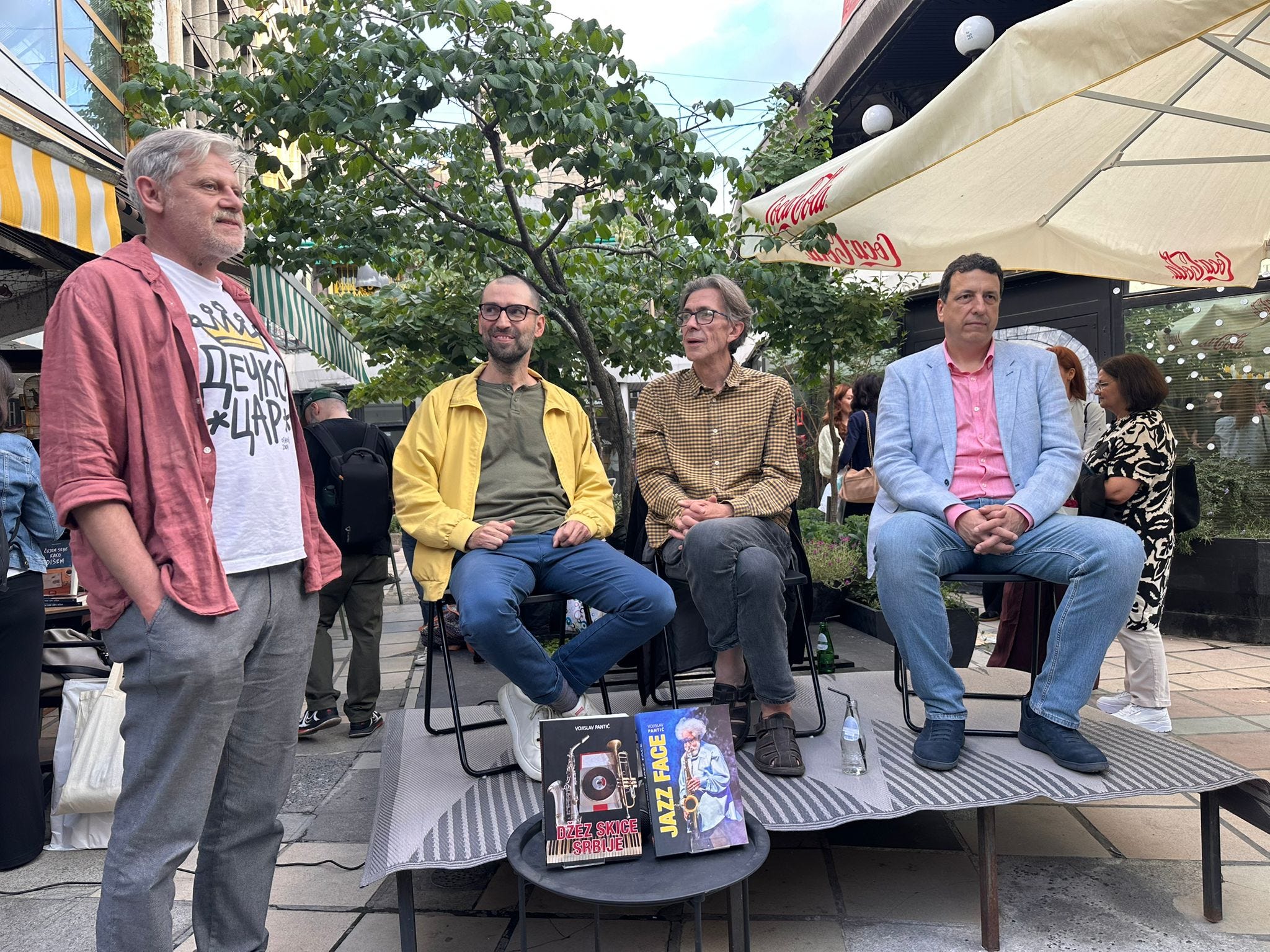
The next day, I spoke at the promotion of the book Jazz Sketches of Serbia by journalist, publicist, and festival programmer Vojislav Pantić. The main promotion took place at the Belgrade Youth Center in front of more than 100 people, while the one in Novi Sad had a more intimate setting. Now we had a third promotion at a micro literary festival in the heart of Belgrade, organized by the indie bookstore Makart, where we also talked about his previous book of interviews, Jazz Face. The event was held outdoors, in a small traffic-free square, with a very relaxed and informal atmosphere. Since it was primarily a literary event, we were something like an “off” program, as we belong more to the realm of publicist writing.
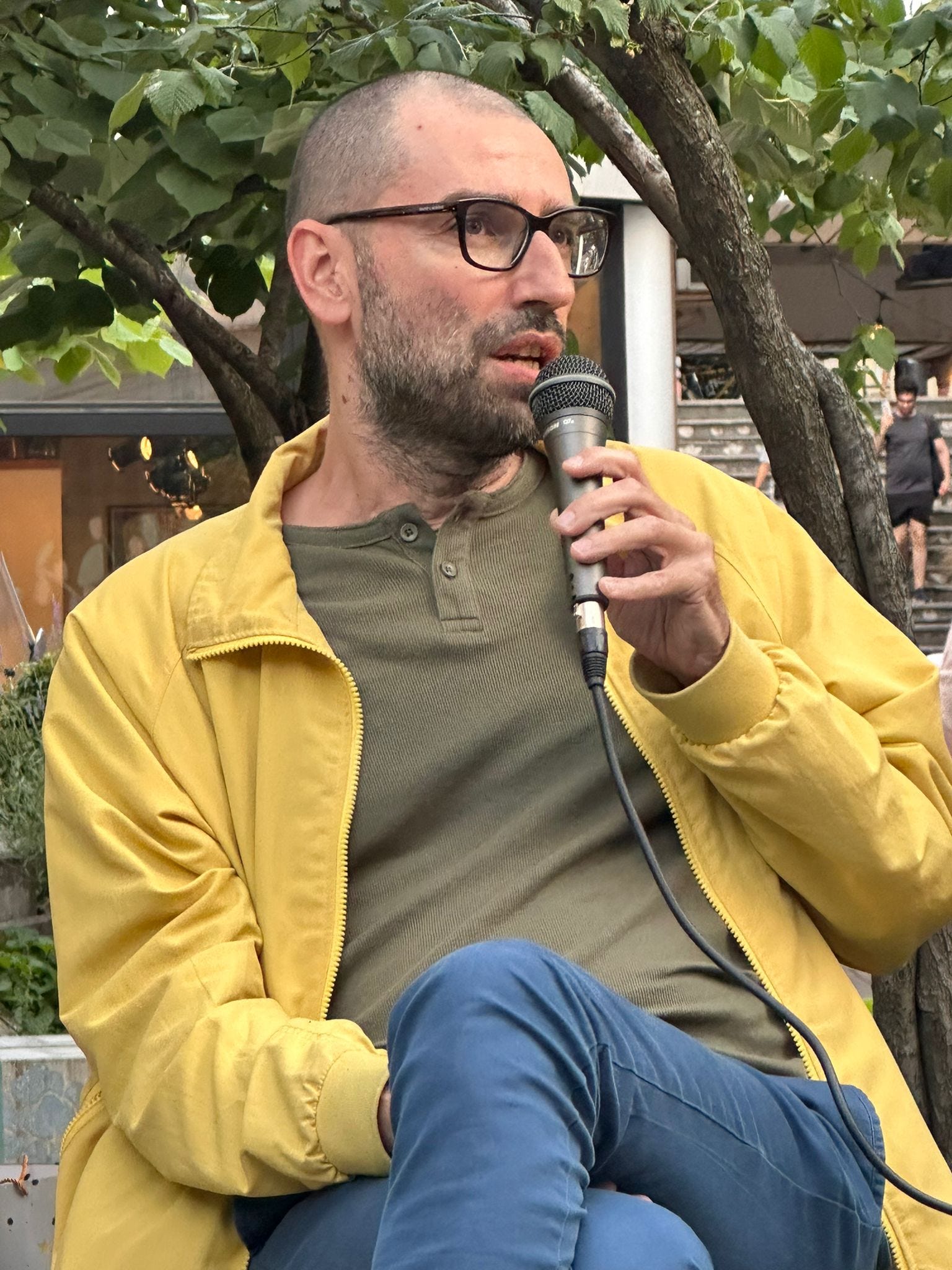
Alongside the usual observations about the book, we also spoke on stage about the craft of making a good interview. Or perhaps the “art of the interview”? I’ve always felt that the interview as a form is a slightly weaker side of my journalistic work, and also the one that doesn’t always depend solely on me, but on the the person I’m talking to as well. There have been some great interviews, but also some complete failures. That’s why I found Vojislav’s observation interesting—a technique he adopted from another author (whose name I’ve forgotten), which suggests that the interviewee opens up best when we touch on their formative years—what first brought them into the world of music, jazz, art. As he pointed out, musicians often get bored talking (for the hundredth time) about their current bands and projects, but they enjoy going into something more personal.
I was also reminded of a remark by a popular Serbian podcaster Agelast, known for his long-form conversations. He said something along the lines that in the first half hour, the interviewee says what they have prepared—their learned response to the interview situation. Only after that do they “loosen up,” and it’s in that phase that we get what is actually the most interesting, entering the personal realm.
Of course, in today’s “fast journalism,” a lot is done online, which can turn out either great or completely pointless. But the best things happen in human contact and in what touches on psychology and interpersonal relationships—sometimes even more than in how factually prepared we are for the conversation.
Serbian Jazz on Substack
Last month, I published the piece Essential Contemporary Jazz Records from Serbia, which was among the most-read in May. I conceived it as my universal answer to the question “who are the most interesting jazz musicians in Serbia today,” which kept coming up in different forms in my recent conversations with jazz enthusiasts from other countries.
Jon Greenbaum (cohost of North Star Sounds on Jazz 90.1, WGMC) reached out to me even before I published that piece and asked about recent jazz production from my country, and my response more or less corresponded with the article that followed. A few days later, he let me know that his selection of Serbian musicians found a place both in his radio show and in a text on his Substack page Jazz Digest. He opted for the more avant-garde names from my list—Szilard Mezei, Jasna Jovićević, and Marina Džukljev. I’d say—an excellent choice, one that actually pinpointed the musicians with the relevant international reach.
This week, I was particularly delighted by a piece titled “Basamak” on the Substack page Amplify: Journeys in Jazz. At first, I didn’t quite get it—I saw the title and thought it was the same as the latest album by the Belgrade group Fish in Oil. Then I realized—it is a piece about that album. From a completely new perspective, by someone approaching the band from a personal angle and with fresh ears. I forwarded the text to bandleader Bratislav Radovanović and bassist Branislav Radojković, who warmly welcomed Joel’s introspective review. It’s a cliché to say that “music transcends borders,” but that doesn’t make the point any less meaningful or beautiful.
Of course, it is entirely normal and expected in today’s digital age for music to reach all corners of the world with ease. But is that really the case if you come from a small market and a “non-established jazz country”?
More Substack feedback
Hungarian drummer András Dés wrote in his regular monthly newsletter that, while waiting for his flight at the airport, he came across my note on Jarrett’s album The Survivor’s Suite and decided to use that “extra airport time” to enjoy this musical masterpiece. The text that followed is beautiful, eloquent, and literarily very engaging. I’ve already recommended his Substack before, and I’ll do so again—not as a kind of thank-you for the mention, but because he truly writes skillfully and intelligently.
But yes, of course I felt a certain satisfaction knowing I somehow contributed to his enjoyment of that “empty” airport hour. I could almost feel what it’s like to put on headphones, lean back, and play Jarrett’s The Survivor’s Suite with no other agenda or side activity in life. The overly fast pace we live in often turns music into just one of many parallel activities—cooking, driving, working on a laptop, and so on—but it becomes a real delicacy and joy when we do absolutely nothing else. “The bustling airport around me fades away, the world slows down—there is time for everything,” wrote Dés in his text, which you can read HERE.
Nikola — this genuinely stopped me in my tracks. I wrote about Basamak because the music moved me. The idea that the people who made it read those words and welcomed them — that's more than I could have hoped for.
This is exactly why I started the blog. Music spreads person to person. You were the bridge between me and Fish in Oil. And now somehow a guy in Portland writing about jazz on a Saturday morning ended up in Belgrade.
Thank you for that.