


“Can you recommend some Serbian jazz for me?”
Since launching Eurojazzist, I’ve encountered variations of this question on several occasions. It’s perfectly natural: jazz listeners abroad don’t have enough information about music coming from this region, and simply don’t have the time to explore every possible scene in every country. On the other hand, I’ve been following the Serbian jazz scene very closely for the past couple of decades, and even longer.
It’s not easy for me to answer this question briefly. Recently, I threw out a few names that first came to mind—and quickly bit my tongue. It wasn’t fair, because I instinctively reached for the avant-garde artists I personally prefer, but the Serbian jazz scene is diverse, and someone else might be drawn to something stylistically different, yet equally valuable.
It’s also worth noting that it’s not easy to define what exactly the “Serbian jazz scene” is, since many musicians live and work abroad. They are, at the same time, part of other, more developed scenes. There’s no need to explain who Bojan Z is—a pianist who has been named Jazz Musician of the Year in France and is an established name in European jazz. Jelena Kuljić has a strong career in Europe, especially with the band KUU!. Double bassist Nenad Vasilić has lived and worked in Austria for nearly three decades. Also, drummer Vladimir Kostadinović… And so on. They have easier access to international markets and media, so I prefer to focus here on those who live and work in Serbia.
I don’t claim to present any kind of objective selection that would evenly represent all subgenres and generations. What I consider essential Serbian jazz records from the past 15 years might seem like a misguided choice to someone else from my country. I will certainly leave out some popular and very high-quality jazz musicians and bands whose music simply isn’t to my taste. Fortunately, I’m not the only jazz journalist in Serbia (though there aren’t many of us), and others will offer different selections. We’re all different, and there’s nothing personal about it beyond personal musical preferences.
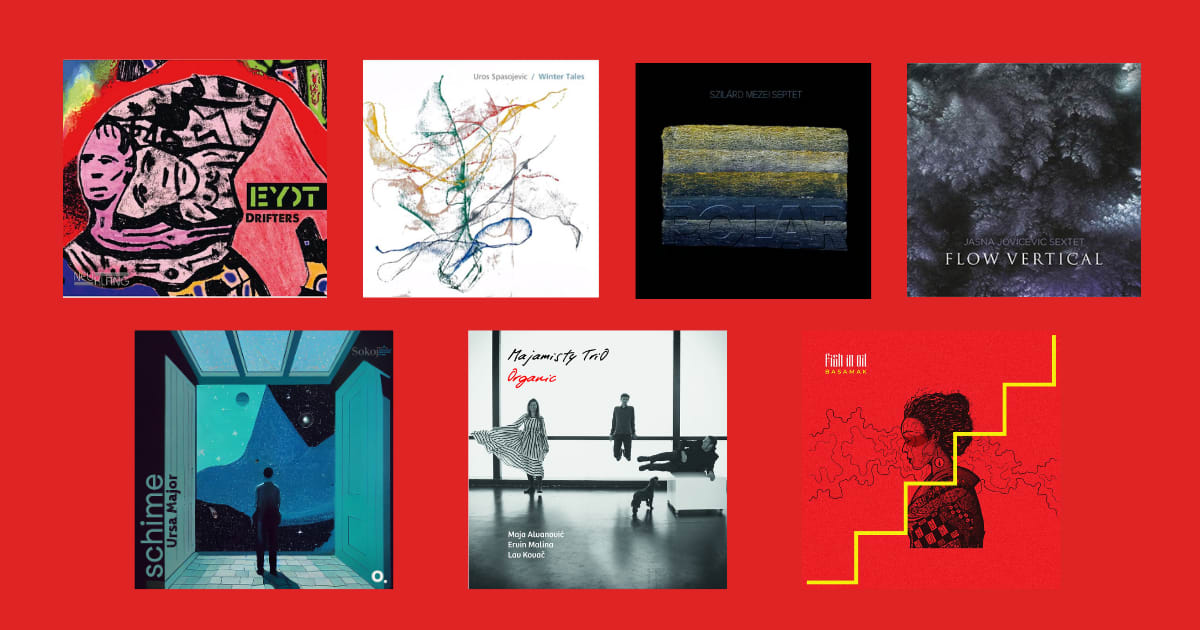
*Each album title is also a hyperlink to the full album. The albums are listed strictly in chronological order, without implying any qualitative ranking.
Eyot – Drifters (Neuklang Records, 2013)
The music of this quartet blends neo-fusion and contemporary jazz in the vein of British bands like GoGo Penguin, Mammal Hands, Get The Blessing, and others, while also incorporating odd meters and melodic traits characteristic of the Balkan region. The focus is firmly on the band and their tight, cohesive interplay, with an emphasis on the compositions themselves. Pianist Dejan Ilijić is the frontman and principal composer, seamlessly and organically weaving these local influences into a global jazz language, occasionally breaking away into extended solo excursions. I’ve chosen their second album Drifters, recorded and released in Germany, as a reference point—particularly the tracks “Coils,” with its beautifully layered compact structure, and “Drifters,” which served for years as a concert highlight, where Ilijić drives the music toward a powerful crescendo.
Szilárd Mezei Septet – Polar (Not Two Records, 2015)
I’ve mentioned Szilárd Mezei several times before; he is probably the musician from this region who has received the strongest international media attention among Serbian artists—appearing in DownBeat reviews and occasionally in rising star polls. He is a highly serious and dedicated composer—composition is central to his work, even when combined with free and avant-garde jazz forms, as well as Hungarian musical heritage. Given that he has been releasing at least two or three albums per year since the early 2000s (often more), it’s difficult to single out just one. I opened my folder of his digital releases and picked one that used to be among my favorites—but many others are equally worth exploring. A representative track, showcasing his compositional ideas, is the title piece:
Jasna Jovićević Sextet – Flow Vertical (FMR Records, 2018)
I’ve already written about Jasna Jovićević in the context of her recent album. It’s important to note that she also performs in more traditional free jazz trios, freer improvisational settings, and collaborates with musicians from the Austrian and broader European jazz scenes. Still, I see her ensemble “Quinary”—and the sextet that preceded it—as the most representative of her work, where she merges avant-garde, chamber jazz, and Indian spiritual concepts connected to her yoga practice. Flow Vertical was the first such album, where Jovićević plays spacedrum alongside saxophones and also sings.
A standout track is “Rum Runs Through The Veins,” which brings all these elements together: it begins with an extended saxophone intro and gradually unfolds into new directions around the third or fourth minute.
Majamisty Trio – Organic (Mistyland, 2020)
When it comes to the classic piano trio format with Scandinavian influences (from Tord Gustavsen to E.S.T.), I would highlight Maja Alvanović. The lineup has changed over the years, with various guest musicians, but in my view the band reached its peak on Organic, featuring double bassist Ervin Malina (excellent with the bow) and drummer Lav Kovač, a younger-generation musician who will appear again later in this list. Alvanović comes from a classical background, which proves to be a strong match with a seasoned jazz rhythm section. Without insisting on extended piano solos, she allows space for subtle nuances and interaction among all three players.
The definitive track here is “Jungle”:
Uroš Spasojević – Winter Tales (Self-released, 2020)
Bass guitarist Uroš Spasojević is something of a micro-phenomenon on the Serbian scene. He lives in the small town of Valjevo and releases a large number of albums independently, often as the sole musician or in small formats. He is deeply influenced by ECM—an important aspect of his musical identity—whether through figures like Eberhard Weber, John Surman (especially in his approach to the one-man concept), or artists from ECM’s New Series. He releases albums of varying sensibilities, but I prefer him most in a fully solo setting. In that sense, Winter Tales is an excellent example, with the track “Sea” standing out:
Fish In Oil – Basamak (Gramofon, 2022)
Bandleader Bratislav Radovanović is a guitarist strongly influenced by Marc Ribot—and he makes no attempt to hide it. He also openly cites John Zorn’s Electric Masada as a major influence. During the band’s most prolific recording phase, the lineup included musicians from diverse backgrounds, giving their sound a breadth and a distinct vibe compared to the New York downtown scene—yet still within a stylistic eclecticism that touches on Nino Rota’s film music, the Latin-inflected sound of Ry Cooder, and more. After the passing of the legendary Serbian percussionist Papa Nick and the departure of longtime saxophonist Dušan Petrović, the band began exploring new lineups and directions. Their last album with that earlier lineup—and in many ways its culmination—was Basamak. A key track is “Opšta mobilizacija”:
Schime – Ursa Major (Sekvoja, 2023)
For much of the 21st century, Serbia lacked a strong mainstream jazz band rooted in the post-bop tradition. That changed with the emergence of a core group of musicians around saxophonist Luka Ignjatović and drummer Peđa Milutinović—two technically accomplished artists with fresh ideas within the jazz idiom. Schime has also gone through several lineup changes before settling into a quartet with double bassist Boris Šainović and pianist Sava Miletić. They also released an excellent album with the chamber orchestra Muzikon and performed at the prestigious Moers Festival in Germany. Still, my choice falls on their stripped-down quartet and the album Ursa Major, where they reach a level of maturity and mutual understanding necessary for this kind of ensemble to truly breathe.
There are several standout tracks, but for this occasion I’ll highlight “Dawn Tranquility.” A note: Schime tend to start their pieces slowly and gradually build toward climaxes. Ideally, listen from the beginning and let it unfold—but if you must skip ahead, try starting around the third or fourth minute for a quick impression.
Marina Džukljev, Aleksandar Škorić, Horz Music
This concludes an overview of some of my favorite Serbian jazz albums of the 21st century. Each of the above-mentioned musicians has other excellent releases worth exploring. In this section, I’d like to mention a few artists who, for various reasons, didn’t make the main list but certainly shouldn’t be overlooked.
First and foremost, Marina Džukljev, who maintains a series of strong international collaborations with musicians from Slovenia, Austria, Germany, and beyond. I’ve written here about her concert with John Dikeman in Belgrade. I simply prefer experiencing her live performances, which may be why I haven’t devoted enough attention to her recorded output. She operates in a wide field of avant-garde and free jazz, as well as free improvisation. The album Industriesalon, recorded with Michael Griener and Christian Weber, is well worth a listen.
Aleksandar Škorić is a wonderful free jazz drummer, though I wouldn’t say he has yet recorded a definitive album (despite releasing frequently on Bandcamp). The closest would be the live album by the WOS Trio with saxophonist Predrag Okiljević and bassist Ksawery Wójciński, which I would certainly recommend.
Predrag Okiljević is part of the group of musicians gathered around the Horz Music label, whose core over the years has included him, drummer Lav Kovač, and bassist Marko Čurčić. Their best-known band is Dragon’s Fuel, which I feel hasn’t quite reached its full potential, although they have a couple of very solid albums—Pomorandže, drawing on the British aesthetic of bands like Polar Bear and Led Bib, and the more song-oriented (almost “exotica”-styled) Fruška Džungla. There are also several other lineup variations involving these musicians that are worth checking out if you have the time.
“The Serbian Wave”
An unusual phenomenon on the Serbian jazz scene occurred when Italian label owner Antonio Martino (A.MA Records) discovered Serbian jazz—particularly musicians working in hard bop and post-bop. In effect, he took on a role that might be expected of a national label, creating a recording infrastructure for the mainstream of Serbian jazz. Some of the leading talents of this orientation found a home there, such as Ivan Radivojević (my personal favorite among them—I believe his best work is still ahead), Milena Jančurić, Ksenija Kočetova (a talented pianist based in Vienna), Miloš Čolović, and others. Saxophonist Rastko Obradović also naturally belongs to this circle, if we’re speaking about the core of the mainstream scene. As does drummer Peđa Milutinović with his project drumbooty, which represents a contemporary, New York-style take on fusion.
Institutions
The Big Band RTS is the key orchestra in the country, preserving the tradition of the big band sound. They occasionally venture into more adventurous collaborations—such as with Samuel Blaser—but my interests lie elsewhere, with due respect to the orchestra’s work. I would say something similar about Vasil Hadžimanov, by far the most popular jazz musician in the country. His VH Band has already achieved cult status. He built his reputation on a fusion sound that falls outside my personal interests, so I mention him primarily for informational purposes.
Sorry if I didn’t mention you
This is the moment when someone might think I’ve forgotten to mention this or that musician. My apologies! This is, after all, a text from a personal perspective on a personal platform—it doesn’t aim for encyclopedic precision, nor is it obliged to list everything that has happened in Serbian jazz over the past 15 years. But I hope it will at least help someone get acquainted with a few important musicians and albums; once that spark of interest appears, it’s easy to keep exploring further.