

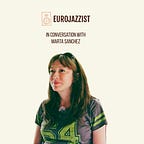

I’m concluding my trilogy of posts about Marta Sanchez with an interview we did in Raška, the morning after the concert where she performed with her trio. Before heading to Belgrade, where she had two concert nights scheduled, we managed to find about ten minutes to talk about her current solo piano album, “For The Space You Left”, released by Out Of Your Head Records in the first part of the year.
In my Eurojazzist Randomizer #21 I wrote: An important aspect of this record is its approach to prepared piano, which doesn’t mean that this is an avant-garde album in the sense of complete improvisation based on sound texture. The preparation is there to enrich the sonic picture, but the focus is on the essential values of solo piano expression based on the holy trinity of composition, arrangement and improvisation. Every segment here seems equally important and effectively highlighted, and Sanchez shines precisely in these fine nuances, in the interplay between melody and sound texture.
Since the interview isn’t too long, this time I’ve prepared not only the audio, but also a written version of the interview, which follows below.

Eurojazzist: I would like to talk to you about your latest CD, solo piano record „For The Space You Left“. I read that you started working with that material back in 2017 on a residency in some cabin „outside of civilisation“. So, why did it take so long for you to put it on a record?
Marta: Well, I didn’t finish all the material. I didn’t finish writing the music back then in 2017. Then I was really busy with other projects. Because it’s solo piano, there is no pressure. It’s only me, and I didn’t find the time to keep writing until the pandemic came. So then I was like, “I think this is the perfect time to finish this.” I wrote the music, but it took me a while to play, shape it, and to see what I wanted to do with it. I had to play the music a lot to see where it was going to go.
Eurojazzist: And the original idea, as I can recall, was to have some personal perspective on the prepared piano. So, how do you approach it? What are your ideas and specific techniques when working solo piano with a prepared setup?
Marta: The intention wasn’t to explore the prepared piano. If you listen to my writing for quintet or even for trio, I always like to play with different melodies and layers. And when you have five instruments to do that, it’s easier. But when you have only a piano, it’s harder to differentiate the things.
So yeah, I play with registers a lot. There is something happening in the highs, in the middle, in the bottom. But then I was like, “Oh, if I use prepared piano, I can actually differentiate that even more.” For example, having something on the piano that sounds percussive, it’s like I have a drum there, and then I have a different sound in the bottom part of the piano if I put some tape, and so on.
And the approach has been evolving. When I started writing, it was a little bit more complex. I just saw what other people were doing, like John Cage or others. So I started using screws at the beginning, but that damaged the piano, so I stopped. The things evolved a little bit. I was seeing what other piano players were doing and trying things. It has changed a lot.
The preparation also changed since 2017 because I also started playing the music live. Every piece had a different setup, and I realized I can’t do that because it will take 5–10 minutes between tunes to change the preparation. So I had to commit to something that was more or less the same for every piece, except for minimal changes that will take one second to do. It became more simple. And now I also use pedals for live concerts. Mixed with a little bit of preparation, way less than before. But it’s enough that I can differentiate the layers and the original idea.

Eurojazzist: From the point of view of somebody in the audience, we usually see the piano, but we don’t see what’s happening in there. So, can you tell us a bit, what’s your typical setup? What kind of objects do you put in the piano?
Marta: Normally, I would put tape on the lower register and metallic paper on the highs and a combination of Blu Tack and sticks or magnets. Right now, I basically use just pedals, and then I use magnets and Blu Tack for the percussive effect, because the string doesn’t vibrate, so it gives a percussive sound. And magnets to change a little bit the quality of the sound. I do that also with pedals.
But normally, for the record, it’s tape on the lower register, a combination of magnets, sticks, and I think rubber. It’s similar to the effect of the Blu Tack. And then metallic paper on the highs.
Eurojazzist: It’s not a technical question, but when you compose for a solo piano, does it differ for you from composing for a trio or a quartet?
Marta: Of course, it’s different, but the main idea is a little bit the same. It’s different because the textures are different. The timbre is different. Whatever is doable for me playing the solo piano is not the same as with five people. You have to write things that you can also play.
Eurojazzist: So when you start composing, you don’t have just a melody in mind, but you have the whole relations of texture.
Marta: Yes. I always say that I start with anything. Sometimes I start with a melody, sometimes with some harmony, or with a rhythm. But the more and more I think about it, I think I always have a texture in mind.
Eurojazzist: Texture in terms of how some instrument might sound?
Marta: In terms of the total effect.
Eurojazzist: I would like to talk with you about composing, but from a different angle. Last night there was a talk about how to write about music, which is sometimes abstract, completely instrumental. But, from the composer’s point of view, how do you put some emotions, feelings, or ideas that may be verbal into something that is abstract, so – the other way?
Marta: For example, when I wrote a song for my mom, it was a concrete idea about that. But normally, I think what’s in the music is not the idea, but whatever will happen, it’s the feeling that awakens in me. Let’s put it that way.
Eurojazzist: So it starts from the feeling, basically.
Marta: Yes. Even if you are thinking about something concrete. Normally, I don’t think of something concrete like, “Oh, I’m going to do a song about...” Unless I did it as a song for my mom or something like that, or about other people when I do lyrics. But otherwise it always reflects something that is happening in my life at that moment.
So, I was telling you yesterday when we played „3:30“ that I had insomnia and I was waking up at 3:30. But really, it’s not about that. I probably put the title later. It’s more like I was feeling anxious, and that’s reflected in the music. That’s how I was feeling during that time: crazy, not sleeping…
I think it’s impossible, if you are honest with yourself, not to put that in the music. Because you are reflecting, you are passing everything that is happening in the world through your own system. Whatever you are feeling, and whatever you are living, is going to be in the music. Even if you don’t want to.
Eurojazzist: And for this solo record, can you remember what the inspirations were, and how did you think about converting your emotions into some sounds?
Marta: I don’t remember exactly how I was feeling, but I think I can see some kind of nostalgia or loneliness. Or I was in the middle of the woods and it was snowing, you feel a little bit... You are by yourself all day. I can remember it was like, it’s not sadness, but a little bit of some nostalgic feeling and loneliness when I was in McDowell residency.
Then came the pieces that I wrote during the pandemic. I think you can feel that these are from a different period. And these are more crazy.
Eurojazzist: So when it comes to solo piano, does it usually start from some sense of solitude or being with yourself?
Marta: No. I don’t think that necessarily. During this residency you see other people, and you are with them, but also it’s people that you don’t know. And you spend the whole day. You have dinner with the people, but then the rest of the day is just you. And the phone, in my cabin at that point, didn’t work. So I couldn’t even call friends. And it’s snowing. Sometimes you can’t leave the cabin. You have to stay there the whole day.
And yes, it’s a little bit lonely. A little bit.


