


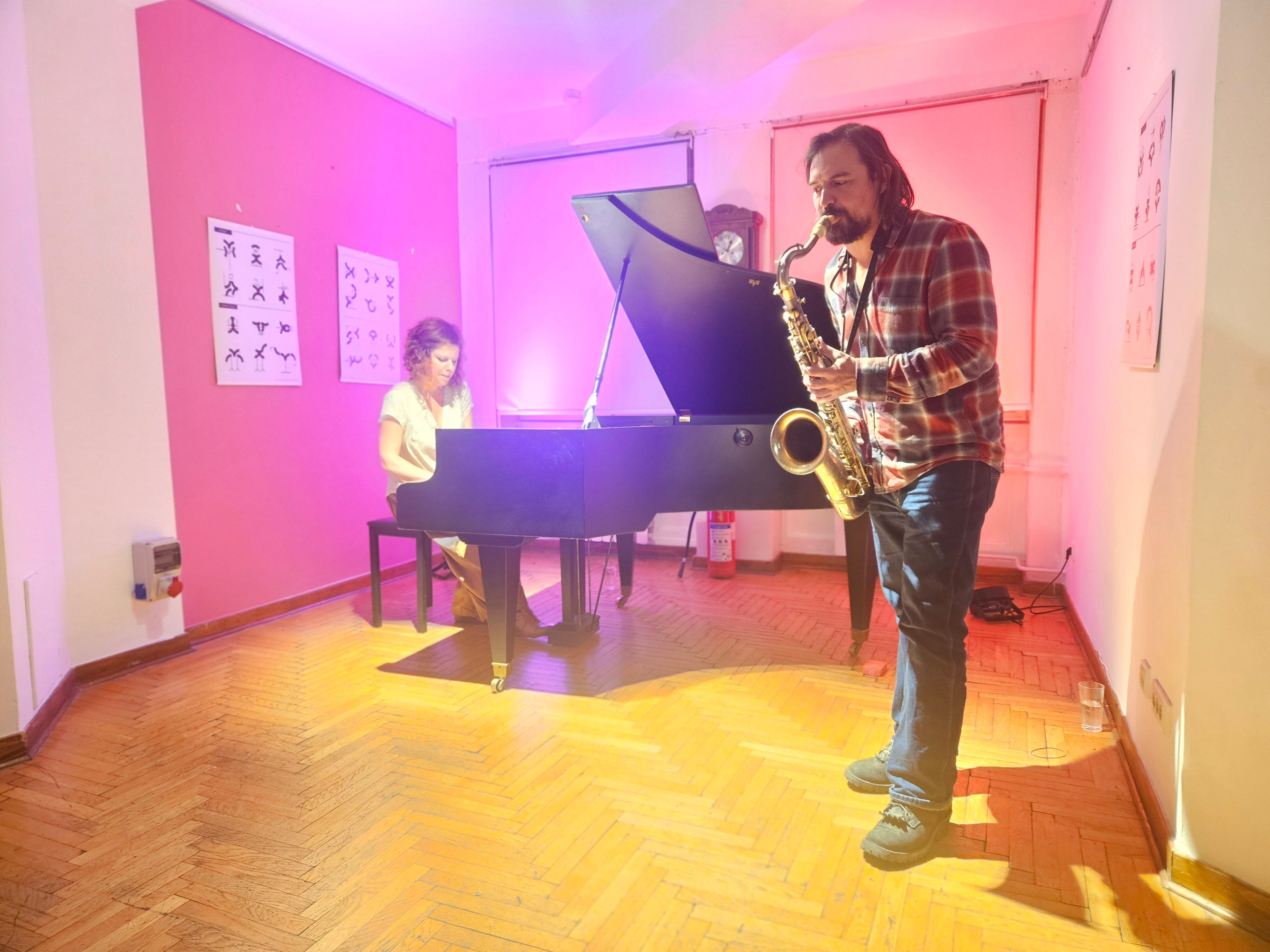
Can freedom be faked in free jazz? Do free jazz musicians sometimes fall into mannerism, repeating the same phrases and tricks? How do we tell a good free jazz musician from a bad one?
Once upon a time, it was enough for me that a saxophonist went into falsetto or started growling, squealing, and shrieking for me to feel excited. If everything was wild and loud—even better. The very concept of free jazz is inherently thrilling, but over the years I began to notice how even free jazz musicians can fall into routine. I don’t think this is intentional, or merely riding on the coattails of a tradition with a great reputation; rather, it’s the simple fact that it is difficult to invent something truly new and, in the literal sense, liberated from musical patterns and conventions of playing within the subgenre. Most musicians approach free improvisation with a pure heart (since there isn’t much money in it anyway), but at the end of the day there are not many whom we recognize as “the real thing.”
I think I immediately experienced saxophonist John Dikeman as one of those, ever since he performed in Belgrade in 2013 with the frenetic free-punk-jazz trio Cactus Truck. Later he returned to Serbia many times in different formations. To the broader jazz audience, his most high-profile engagements would probably be his appearances with William Parker and Hamid Drake, or as part of the ensemble Universal Indians + Joe McPhee. But that is only a small part of his activities.
For me personally, his duo performances with Serbian drummer Aleksandar Škorić remain unsurpassed: both of them lived in the Netherlands for a long time, where they met, and later played concerts that catapult us like a time machine somewhere into the year 1967. Or at least into how I imagine duo concerts by John Coltrane and Rashied Ali—or some other sax-drums duo from the crucial years of free jazz—might have sounded. The combination of explosiveness, spirituality, and creative madness at their concerts would always bring joyful smiles and a sense of ecstasy.
Naturally, I was thrilled when I saw that he would play no fewer than three concerts in Belgrade—one in a duo with pianist Marina Džukljev from Novi Sad, and two in an international formation called FLEG BRN, completed by Christopher Robin Cox (trombone), Peter Ajtai (double bass), and Škorić on drums.
I was especially interested to see him with Marina Džukljev, because until now Dikeman has mostly shone live in lineups that themselves bring a powerful drive—an explosion grounded as much in the rhythm section as in the saxophone spectacle. In addition, Marina Džukljev is a pianist with roots in classical training, but who has embraced free improvisation and extended piano techniques, performing and recording with avant-garde and free improvisers in Slovenia, Austria, and Germany, among others. She has never played jazz standards or performed in traditional jazz ensembles, approaching the genre from a different angle. (Peter Margasak also wrote very beautifully about her on Substack). In short, I wanted to point out that her style is often even more abstract than Dikeman’s, which is nevertheless rooted in the classics of American free jazz—so their first joint concert in a duo formation carried a pleasant dose of uncertainty.
The venue called UK Parobrod is small and in fact resembles a slightly larger room or an old-fashioned salon apartment. This format was perfect because there is no need for amplification, and there is no distance between the artists and the audience. When I sat in the first row, in practice that meant I was one or two meters away from Dikeman’s saxophone. Which can also be seen in the first video that follows:
Although I earlier mentioned the Coltrane–Ali duo as a reference in the context of performances with Škorić, here I would rather place Dikeman in the same sentence with another great American saxophonist, Charles Gayle. Or, if we stretch it a bit, we can also hear something of Brötzmann’s fury. What excites me particularly about Dikeman is the rawness of the sound he achieves—the specific “dry” quality of his tone that almost physically carves itself into the listener’s eardrums.
It is as if the entire history of the best moments of free jazz has converged in his playing, which is nevertheless unique enough not to sound like a replica or reproduction. More like an evergreen. The same goes for something elusive and perhaps insufficiently describable: the feeling that the musician before us is sincere and truly liberated, that he is ready to strip himself musically even more than we expect, to push just a little harder and cut into our emotional tissue. These are not beautiful melodies that caress us, but a kind of shock therapy—a call to step out of our safe zone and enter the music with a heightened state of awareness.
In this constellation Marina Džukljev was the “European voice.” We often saw her reaching into the belly of the piano, using various objects to modify the instrument’s sound, leading Dikeman’s sound into the realm of abstraction. Personally, I like Džukljev best when she offers hints of her classical richness on the keys, when she demonstrates an exceptional sense for the dramaturgy of a solo. She never overplays and knows very well when to merely tease the imagination, when to “explode,” and when to return to sound experiment. From time to time she reminds us that she can play with great virtuosity, but she does so only when it truly makes sense within the sonic picture of the band she is performing with. In that sense she is a perfect team player and a good fit for ensembles that rely more on interaction and mutual understanding than on rapid-fire instrumental barrage. On Friday, this was a very good fit.
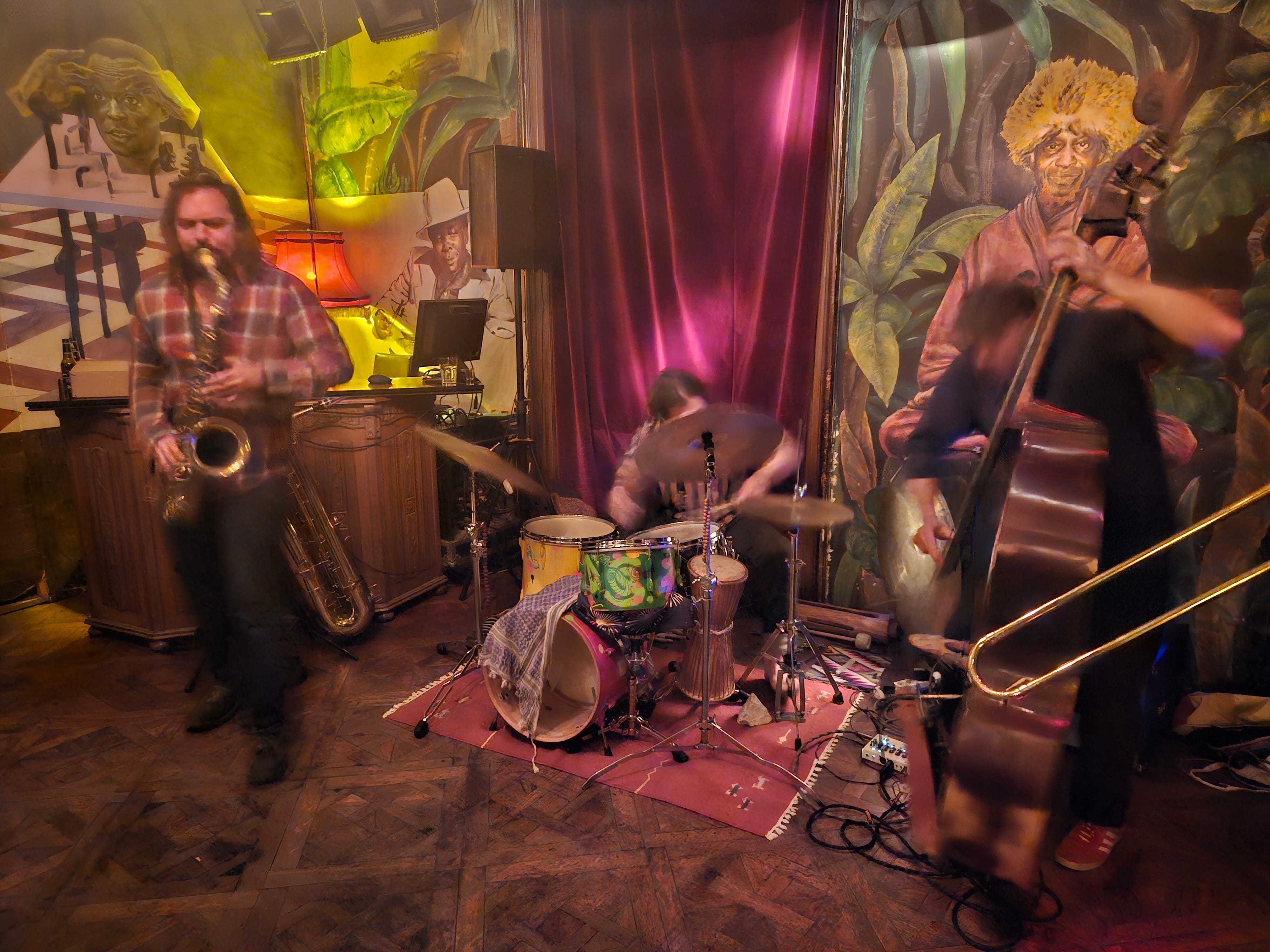
On Saturday and Sunday, a lineup called FLEG BRN performed at two different locations in the city. Alongside Dikeman, who for this occasion also brought a baritone saxophone, the band consisted of Christopher Robin Cox on trombone, double bassist Peter Ajtai, and the previously mentioned drummer Aleksandar Škorić. I missed the first concert, held on Saturday at the club Guvernanta, but I did show up at Strogi Centar, a club that hosts a variety of performances—from mainstream jazz to funk, and ultimately free jazz as well. Like many Belgrade clubs and cafés in the city center, this one has the atmosphere of a large living room, with wooden parquet floors and high ceilings. The intimate setting was therefore guaranteed, so even the presence of 15–20 die-hard free jazz devotees did not make the space feel half-empty. It was just right and comfortable for everyone, yet still sufficiently boiling with energy.
This time everything unfolded within the realm of expectations: the band began grinding mercilessly from the very start. It was a true Machine Gun. I think I could watch Dikeman and Škorić in almost any combination, so at first I did not pay much attention to the contributions of Christopher Robin Cox and Peter Ajtai. That does not mean their playing was lacking—only that I am too big a fan of the aforementioned duo.
It was not entirely new to me, but this time I particularly noticed how Dikeman impresses not only with energy, spirituality, and that elusive quality we call “sincerity,” but also with formidable technique and control. Imagine a car entering a sharp turn at full speed while overtaking a truck; somehow it does not fly off into the ditch, but maintains control and exits the danger with great precision, continuing to race even faster. In the same way Dikeman successfully reins in his own volleys, stacking several short passages before launching into growls and screams—once we as listeners have sufficiently entered his rhythm.
Perhaps I did not entirely enjoy the fact that the performance was divided into two equal sets; it felt as if the break was too long and the momentum was lost. Fortunately, in the second part the band sounded even more inspired—we heard several excellent moments from Škorić and Ajtai, while Dikeman pushed his blues-inflected free playing, emphasizing the original American contribution to the subgenre.
After the concert with Marina Džukljev ended two evenings earlier, in casual conversation I remarked that the performance had been “the best possible European free jazz,” and was immediately asked whether I might be exaggerating. I found myself wondering—who exactly decides, and at what moment do statements like this become “truth”? Given that Dikeman and Džukljev are only in their early forties, and Škorić is in his thirties —still relatively young years for elite status in jazz—it is clear that a lot of time must pass before any of them becomes “canonized.” But my feeling is that they are on the right path.