


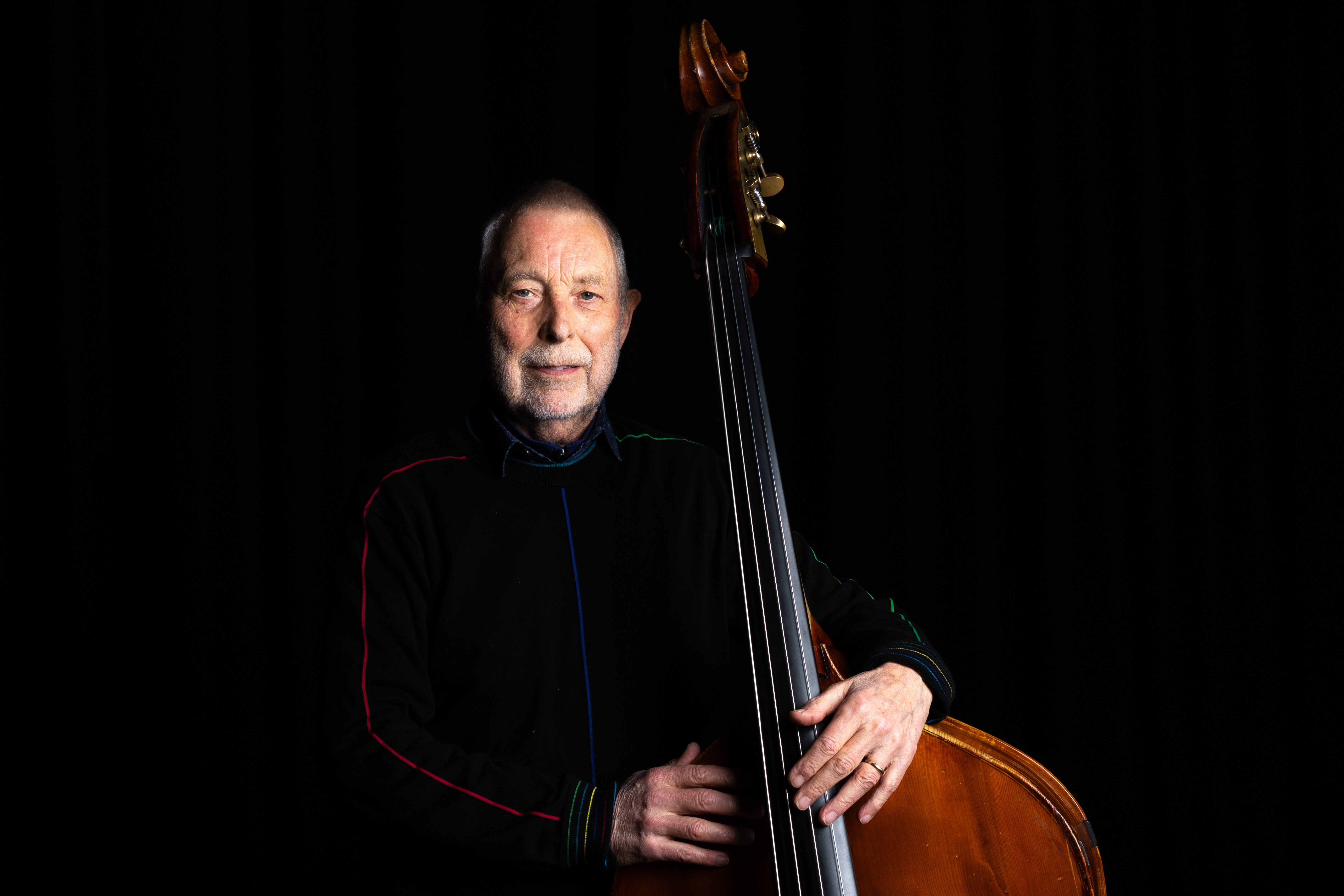
On the day this text is published, legendary double bassist Dave Holland celebrates his 80th birthday. I’m sure several more pieces dedicated to this jazz giant will appear on Substack, and that every single one of them will be excellent, properly summing up his decades-long career, his importance and his influence on the scene.
When it comes to my own relationship with Holland’s music, however, things are somewhat different and more complicated.
I’ve been listening to jazz since 2001, and during the first few years I listened exclusively to the classics and albums recorded up to 1967, so there wasn’t much room for Dave Holland. When I finally came across his name, it happened completely by chance, through the 2002 album “What Goes Around”. Only later did I become familiar with his historical significance, but his early-2000s work still mattered less to me than everything else I was listening to at the time.
When the Belgrade Jazz Festival was revived in 2005 after a 14-year hiatus, one of the major, almost mythical boosts to the festival came from a Dave Holland concert that people still talk about today, not only because of the music, but also because of the incredible crowd and chaos in the Main Hall of Dom omladine, caused by the poor organisation of seated and standing areas. Paradoxically, this major failure by the festival team, by any objective measure, was perfect for building “hype” and creating the image of an event. Something was so exciting that people were practically climbing over one another just to see these fantastic musicians.
Holland was joined that night by Chris Potter, Robin Eubanks, Steve Nelson and Nate Smith, and by my own choice I missed this important piece of jazz history in Serbia. Arrogantly, I dismissed it as some kind of “boring mainstream” and saved my limited funds for a couple of other concerts that year.
The shift in my perception of Dave Holland’s work happened in parallel on two levels. The first was historical: I heard (and fell in love with) the legendary album “Conference of the Birds”, while around the same time I also watched the famous documentary “Miles Electric: A Different Kind of Blue” about the concert at the Isle of Wight Festival, where a young Dave Holland was one of the protagonists. I became aware of the sheer breadth of his career and its exciting first phase, including his involvement in one of the key transitional periods in jazz history.
The second important event came in 2012, when I went to the Garana Jazz Fest in Romania for the first time. At the beginning of the third festival evening, while it was still daylight, the first concert was given by Holland’s (then new) PRISM line-up, featuring Craig Taborn, Kevin Eubanks and Eric Harland alongside the bandleader. I was vividly reminded of this concert after listening to one of the three parts of the “Freedom Call” box set that Edition Records is releasing these days, featuring three previously unreleased Holland concerts from the 2000s with different line-ups.
It was magical. Craig Taborn was the obvious favourite for me, but I also really enjoyed Eubanks’s “dirty blues” guitar parts, and of course Dave Holland’s playing. Some of it undoubtedly had to do with the fantastic atmosphere at Garana, a festival with a hippie vibe where people sit on tree trunks, surrounded by forest in the middle of nowhere. The crowd gave the band a standing ovation, certainly more heartfelt than the polite applause jazz bands often receive.
The very next year I saw the same line-up at the Skopje Jazz Festival and was thrilled once again, confirming that my first impression hadn’t been a fluke.
Over the following years, I saw Dave Holland several times at various festivals, in different line-ups. I also began to recognise something far more essential in his work than the way particular groups sounded in a concert setting.
It was his tone on the double bass. Beautiful, round, precise, full, warm. I would say – textbook, in the best sense of the word. The kind where Holland is the “professor”, setting standards for others to follow if they wish.
Of course, we could name various double bassists whose tone and style might be described as paradigmatic of jazz as a whole. Ron Carter, for instance, or Paul Chambers. In that sense, Holland’s style is somewhat different and clearly belongs to the decades that followed, but at the same time it contains something elemental, something that bridges eras and connects the 1940s and 1950s with modern times.
As a talented young man, he caught a glimpse of the fusion era; as a composer, he came of age in the vicinity of the free jazz aesthetic. He then went on to set his own standards for what some would call mainstream and others “modern creative” music, in the language of contemporary jazz criticism. Throughout all of this, his tone is like an anchor, something that “grounds” the music and gives it a foundation, in the best sense of the word.
The other thing I began to notice concerns Dave Holland as a person. I don’t actually know him personally, but I’ve watched and read interviews and observed the way he communicates with audiences, musicians on stage and, finally, the media. Even without any “behind-the-scenes” access, you can easily sense the positive energy that radiates from him when he walks onto a stage. I have the impression that this energy is unmistakably transmitted to the musicians and the audience, becoming an essential part of the overall experience of every one of his concerts.
On one occasion, as part of the PR team of the Pančevo Jazz Festival, I spoke with Holland on the phone in place of a journalist colleague who had prepared the questions but didn’t speak English well. There were a couple of questions about his work with Miles, and I was slightly worried that he would be bored having to tell, probably for the thousandth time, the same stories about that period.
But I was completely wrong. It wasn’t even merely professionalism or a well-practised way of answering; I could feel his genuine joy in remembering that time and his collaboration with Miles Davis. Perhaps even a sense of humility and gratitude, which remains powerful even today, when Dave Holland is one of the greatest living legends of jazz.
All these essential qualities of his music and personality have probably contributed to Dave Holland’s ability to remain relevant in every decade of his career, never fading into obscurity over the course of nearly 50 years.
Happy 80th birthday, Mr Holland.