


I first heard about Fred Lonberg-Holm sometime around 2008, when the album Beat Reader by the legendary Vandermark 5 came out. There was something incredibly exciting about the way he approached the cello, but also about his ability to fit that distinctive sound into a jazz band context. At the time, I was into several bands that incorporated elements of (post-)punk or noise into their expression, such as the New York group Gutbucket or various projects by Otomo Yoshihide; Lonberg-Holm stood shoulder to shoulder with them in multiple ensembles he enriched with his sound, combining a clean tone and amplified cello with distortion and pedals. That sharp edge in his playing was (and still is, of course) remarkably layered: free improvisation, post-bop, noise rock, free jazz…
As early as 2009, he appeared at the Ring Ring Festival in Belgrade with a band then called Keefe Jackson’s Fast Citizens, as part of an elite Chicago jazz circle. A few years later, the group released the album Gather, this time under the name Fred Lonberg-Holm’s Fast Citizens, clearly signaling who was in charge. The lineup included saxophonists Aram Shelton and Keefe Jackson, Josh Berman on cornet, bassist Anton Hatwich, and drummer Frank Rosaly. I wrote about that album with great enthusiasm at the time, considering them the most important band of the post-Vandermark 5 era.
As the years went by, I began exploring other tendencies in jazz and gradually set aside that whole circle of musicians—Lonberg-Holm included. That is, until a few months ago, when I received an email from my radio editors asking what I thought about a duo that might perform in Studio 6. I was on a weekend trip abroad, skimmed through the message, and saw two names: Swiss saxophonist Christoph Erb, whose work I didn’t yet know, and—no surprise—Fred Lonberg-Holm. I wasn’t familiar with their duo format, but I quickly replied that Lonberg-Holm is a living legend and that I would listen to their material as soon as possible. Within a few days, I went through their Screw and Straw albums and confirmed they were well worth booking.
Studio 6, Radio Belgrade
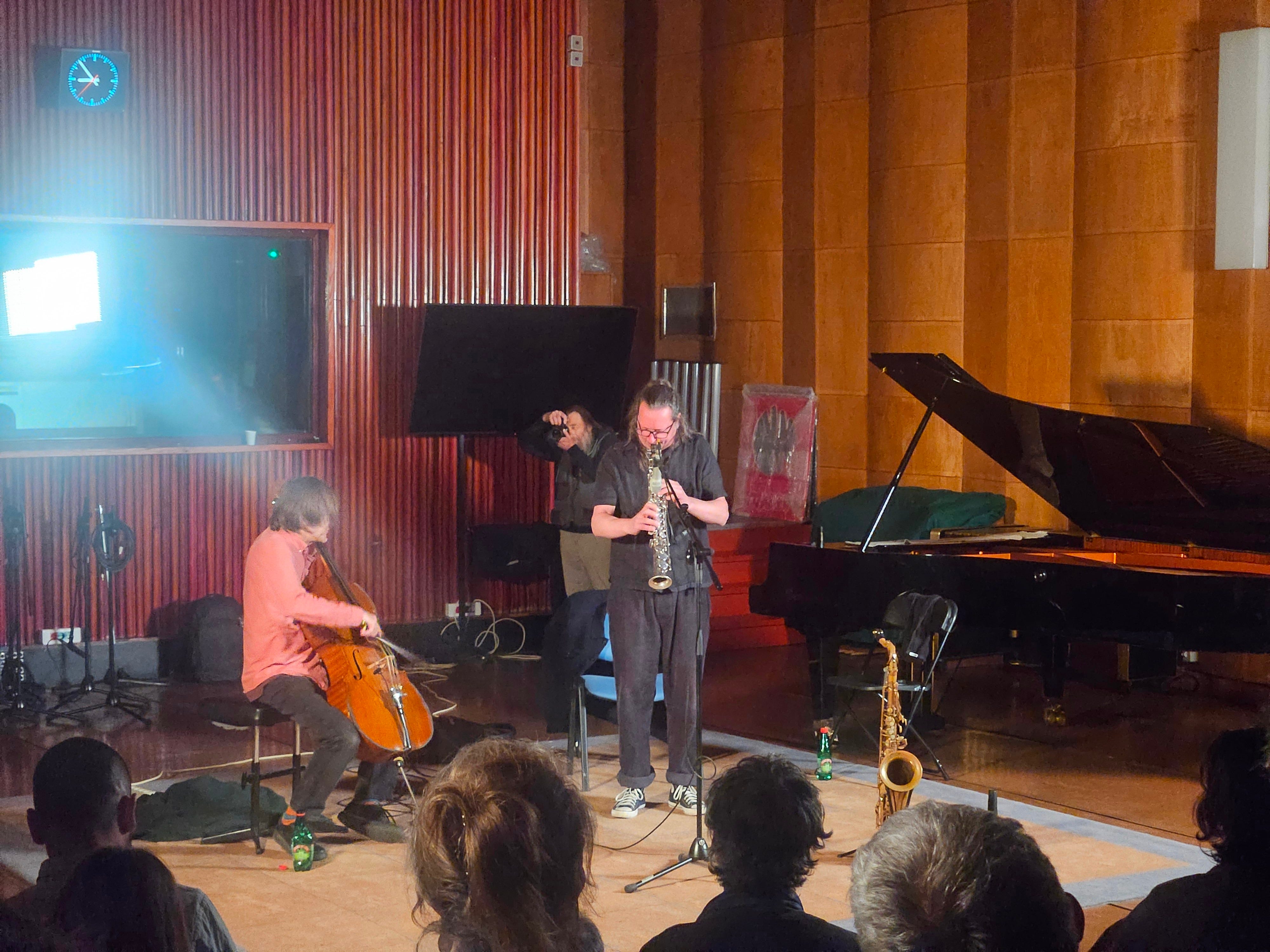
A few months later, the concert finally took place. Studio 6 runs on well-established routines. At 5 PM there is a soundcheck, when the sound engineer and assistant arrive, along with one of my editors and myself, ready to assist the band during setup. Because of the specific conditions of performing in a radio studio, sound adjustment can be quite complex. There is no standard monitoring system, so in some cases musicians need to wear headphones to hear each other—at least in more conventional jazz settings. None of that was necessary here, but the sound still required careful fine-tuning so everyone would be satisfied.
Although I have to admit I haven’t closely followed Lonberg-Holm’s recent activities, I undoubtedly see him as a legend of the Chicago jazz and improvised music scene. I was genuinely thrilled to see him walk into our studio (even if I didn’t quite show it; over the years I’ve tried not to overwhelm musicians with fan-like enthusiasm). We exchanged a brief introduction, began setting up the equipment, and so on. Unfortunately, it turned out that Lonberg-Holm had some issues with his amplifier, so he decided to perform the concert entirely acoustically. The soundcheck ended, and we dispersed until the performance a few hours later.
Concerts in Studio 6 feel like gatherings of a large group of friends. I often meet people there whom I first encountered at concerts, and we’ve been crossing paths in this way for the past 15–20 years. The studio itself can accommodate 60–80 people, and I usually know at least half of them personally. Recently, a significant portion of the audience has also consisted of the new Russian diaspora with an affinity for avant-garde sound. Registration for the concert is mandatory via email, and the limited capacity is usually filled within the first few hours after we send out the newsletter—just as it was this time.
Christoph Erb plays soprano and tenor saxophone, and his musical language consists of micro-gestures, long sustained tones, subtle explorations of texture, and so on. In that sense, he clearly belongs to the free improvisation scene, which is particularly strong in Switzerland, while traces of traditional jazz vocabulary appear only occasionally. It was therefore amusing that the concert took place on International Jazz Day (pure coincidence—they simply had a free date on their tour), which meant that Radio Belgrade 3 inadvertently made its own kind of programming statement. Editor Ksenija Stevanović prepared an excellent introductory text for the concert, elaborating on the significance of free improvised music in this context and giving it prominence on a day that usually foregrounds the jazz mainstream.
The entire concert was acoustic, and in that sense I felt a slight regret at not hearing Lonberg-Holm in some of his more characteristic amplified improvisational situations; still, his vocabulary is unmistakable and compelling even in an acoustic setting.
My father often jokes about my musical tastes, comparing the music I enjoy to the creaking of a door or a poorly sealed window. I usually go along with that joke—it amuses him, and he immediately understands what kind of concert I attended. That’s probably how I would describe the evening in Studio 6 to him. To a more discerning readership, however, I would speak of the subtle interaction within the free improvisation idiom; the exploration of the relationship between sound and silence; the possibilities of extending the capacities of acoustic instruments beyond the European tonal system. The relationship between instruments and space—when Erb places his saxophone against the floor to produce a desired distorted sound. The nuances that emerge from the way Lonberg-Holm presses his bow against the cello. A multitude of details in their interplay and mutual responses, forming a distinctive musical flow.
Screw and Straw with Ilia Belorukov and Aleksandar Škorić
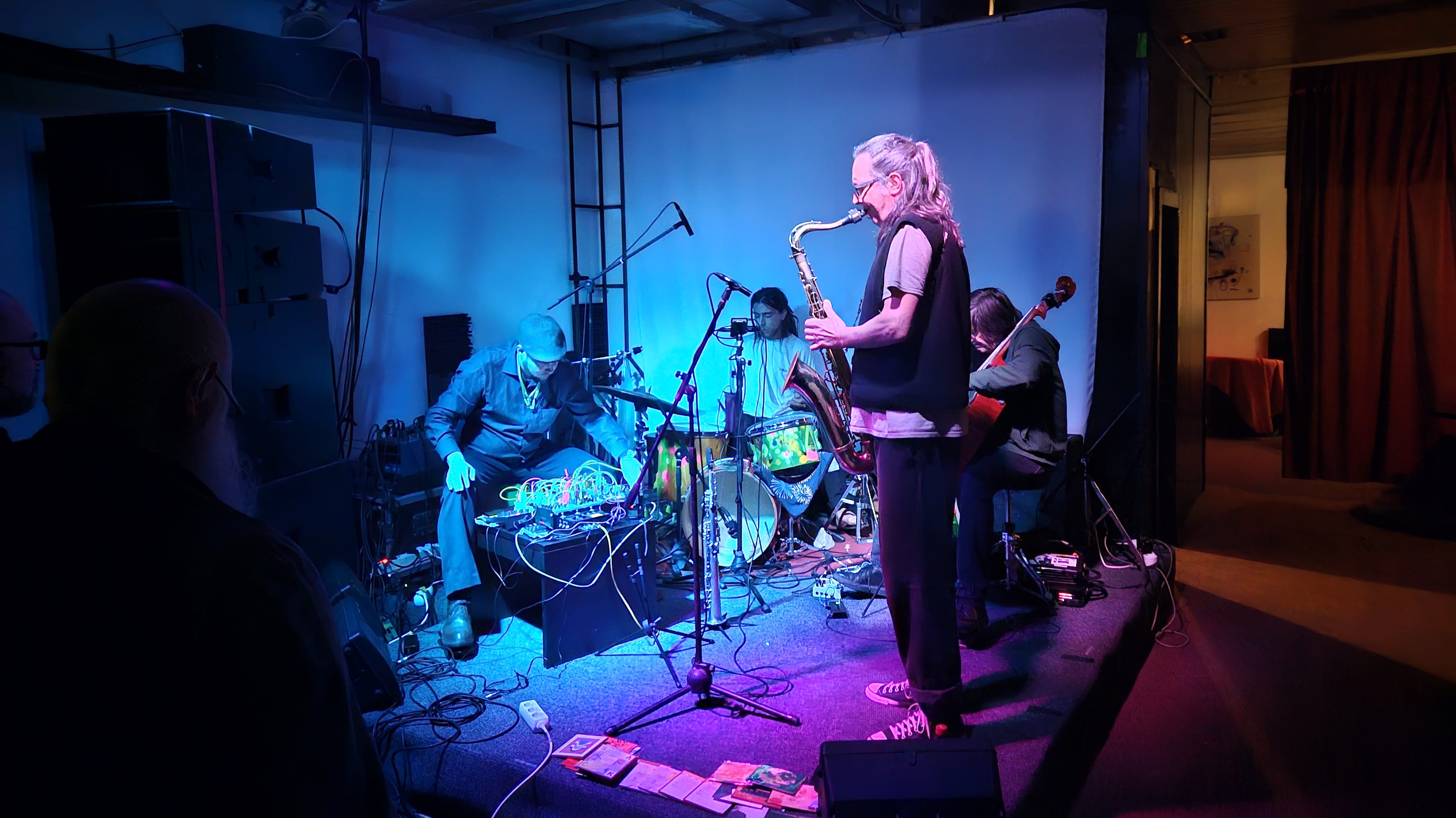
I already mentioned the two musicians in the subtitle in my previous concert report from Belgrade; each has enriched the local scene in their own way. One arrived from Saint Petersburg, while the other returned from the Netherlands and Belgium, where he toured, among others, with legends such as William Parker and Japanese saxophonist Akira Sakata, alongside his striking collaborations with John Dikeman. On this occasion, they expanded the duo, which after Studio 6 first performed in Novi Sad and then returned to Belgrade for a show at the underground club Kontrapunkt.
Ilia Belorukov opted for modular synth and electronics this time, without saxophone, which was a logical choice with Erb as the primary wind player. Lonberg-Holm was able to plug into an amplifier, giving him the option to really open up, but the set still began as a kind of continuation of what we had heard in Studio 6—subtle interplay enriched with new layers of sound. At a certain point, however, the entire band loosened up, moving into louder passages; even Erb briefly shifted into a more overtly jazz language, and for a moment the group sounded like a postmodern variation on John Coltrane’s modal jazz. I didn’t time it, but it seemed the set lasted somewhat longer than the one at the radio, and it included an additional encore piece.
All in all, there were strong moments, as well as passages of searching for a shared language. But that is precisely the charm of free improvisation: through encounter and spontaneous interaction, something new and exciting is sought—a moment when all the points connect and the music takes on a compelling form. There were more than enough of those peaks across both concert evenings.
Thank you for this scene report from Belgrade, Nikola. I was also into Lonberg-Holm and Keefe Jackson and Gutbucket at the same time!