


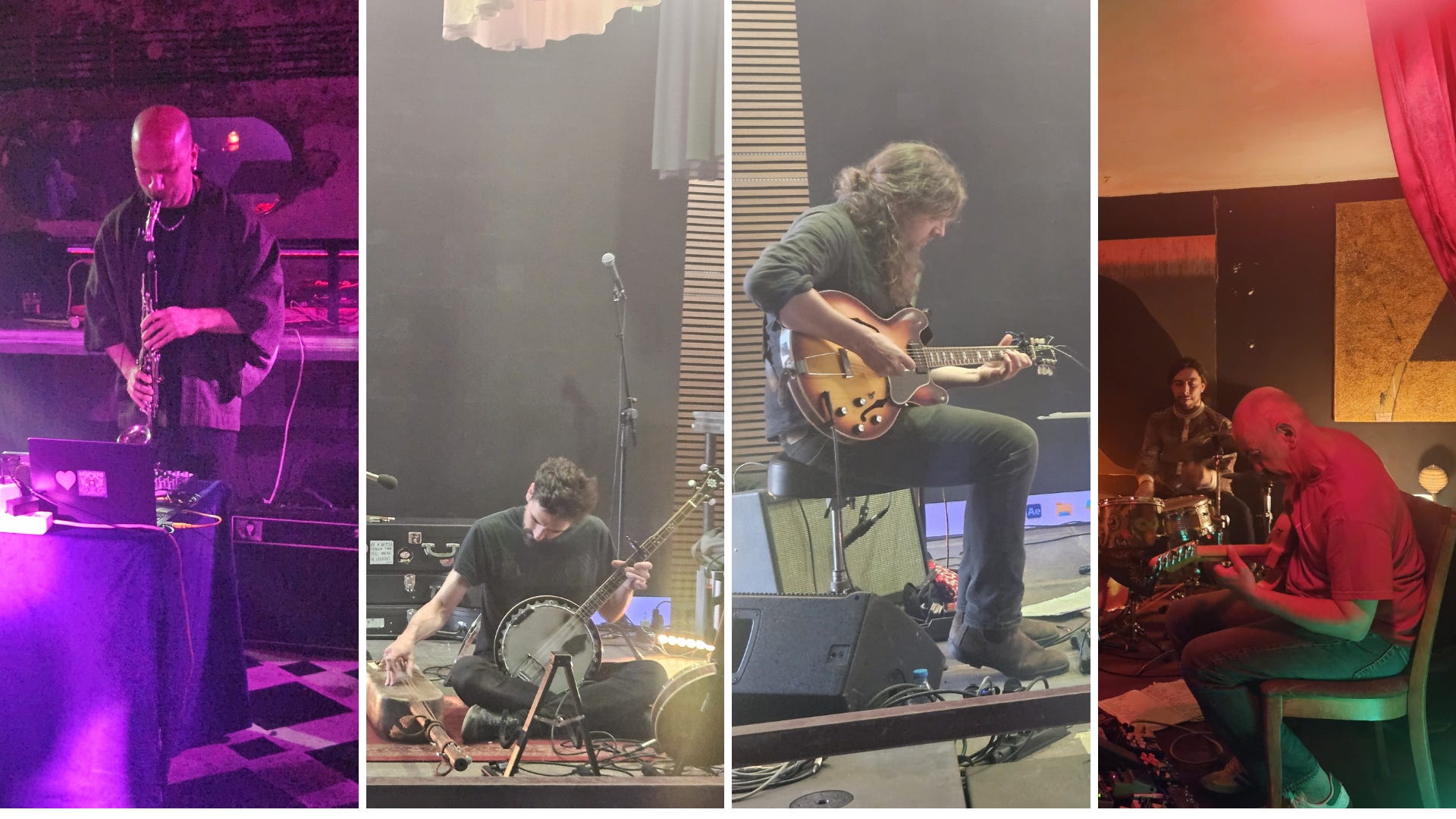
As I’ve mentioned on a few occasions, Belgrade doesn’t really have a great offer of jazz concerts by well-known international musicians. However, when it comes to the club or underground scene, the situation is somewhat better. Or when we’re talking about areas where jazz intersects with alternative music. One of the side effects of the war in Ukraine has been a large influx of recent arrivals from Russia into Belgrade—tens of thousands, mostly young people, often from the creative industries and the arts, have been here for 2–3 years now and are very active across various fields. Among other things, they’ve launched several new alternative music festivals and venues, and many of them also show up at concerts we organize at Studio 6 of Radio Belgrade—especially when it comes to avant-garde jazz. All of this has brought fresh blood into the local concert life.
Wacław Zimpel
The first concert I attended this week was a solo performance by Wacław Zimpel (clarinet, electronics). Those who closely follow the free jazz scene might remember his first notable band, Undivided, whose album Passion was voted the best album of 2010 by readers of the freejazzblog.org. Over the next few years, he established himself as one of the most exciting voices of the Polish avant-garde jazz scene, after which he increasingly turned toward experimenting with minimalist music. During that period, he released several excellent albums as well. Then he gradually moved into the world of electronics, drifting further away from jazz, only occasionally performing in formations more firmly connected to the genre.
We first exchanged emails back in 2016, when I was curating the music program of the Nova Festival in Pančevo. A friend from my youth, who has good connections at the Polish embassy, hinted that the new ambassador was into jazz and that there was a good chance of co-funding a concert by a Polish musician if I had a strong idea. Zimpel was the first person who came to mind—I reached out to him, and we agreed that in 2017 he would bring the LAM Trio. I remember that whole process and all our conversations, both by email and in person, very fondly, and a recording of the Pančevo concert is available here:
After that, he came to Serbia several more times—some concerts I attended, some I missed. When we met in the half-empty Dim club, it felt like a reunion of old friends, even though we hadn’t really stayed in touch over the years. I was genuinely happy to see him, and it seems to me that Zimpel also remembers that whole experience from about ten years ago with fondness. He recalls how fantastic his last Belgrade concert was with the Indian band Saagara—a project he has been actively maintaining for over a decade—unfortunately, I wasn’t at that performance.
Somewhere online I read that Dim club has a “Berlin vibe,” which I can’t really confirm since I’ve only been to Berlin a couple of times and didn’t quite grasp much of its club scene. But it is one of those rustic, abandoned factory spaces with peeling walls, hosting DJ nights and avant-garde/alternative concerts.
After the short intro set by experimental guitar player Vukašin Đelić, Wacław Zimpel fit well into that setting with his set, which this time leaned more toward electronics than instrumental playing. The Polish musician used the clarinet mostly as one of the sound layers he manipulated during the performance, and in that sense I was left with a slight sense of missing out; but it’s clear that this is the direction Zimpel is moving in today and something he obviously enjoys. The day after Belgrade, he set off on tour with British DJ and electronic music artist James Holden, which has been one of his main collaborations in recent years.
In any case, I’ll be returning on Eurojazzist to Zimpel’s magnificent body of work from 2010 to 2020, which is personally closest to me. Stay tuned.
Iztok Koren & Raphael Rogiński
Today, it is no longer considered entirely appropriate to use the genre label “world music,” and there are more and more voices pointing out its problematic nature. Whether it’s about the position of Western-world arrogance that lumps everything else into a single drawer without making an effort to understand it, or the idea of the “exoticization” of other musical traditions—often older than the European one, not to mention the American. To be honest, I myself haven’t thought about all of this enough, and I’m now carefully reading and listening to reflections by very thoughtful musicians such as Vijay Iyer and Golnar Shahyar, who often address, on their social media, questions of how Western media and audiences relate to music from other parts of the world, as well as the discourse of public speech about different musical traditions. In any case, I still have a long road of learning ahead of me, and I’m glad to have people I can learn from.
Perhaps a few years ago I would have instinctively labeled the music of Iztok Koren & Raphael Rogiński as “world music.” Fortunately, terms like “imaginary folklore” are now circulating more widely through media and social networks, and there’s also that old Jarrett description of his solo improvised music—“universal folk music.” Iztok Koren plays various instruments, but the central ones are the banjo and the guembri, while Rogiński plays electric guitar. Their music is repetitive, atmospheric, elegiac. Slow and patient, even when unfolding in short pieces and vignettes. We could also call it cinematic. One can imagine American prairies as the visual backdrop of the music, but also North African landscapes. Or ancient Europe, as we who know it only through books and films might imagine it, yet still have a sense of its sensibility.
The concert took place within the Fields Festival, which spans a very broad range of genres, with an emphasis on the new/experimental/innovative within the market underground. It was scheduled for 6 PM, while it was still daylight outside, and flashes of the setting sun were breaking through the large windows of the Karmakoma club straight onto the stage. The audience was still gathering, as it was the first concert of the evening. Personally, I really appreciated these circumstances—there was no crowd or chatter, the sound was well set, and the musicians were focused and inspired. Everything was just right and lasted exactly as long as it should.
Fish in Oil
Although Fish in Oil has existed since 1993, the format we recognize today has been active since around 2010–2011. The band was founded by Serbian guitarist Bratislav Radovanović, who at one point became “infected” with the sound of Marc Ribot and John Zorn’s Electric Masada and transferred those musical affinities into the band. But also much more—the sensibility of Ry Cooder, the film music of Nino Rota and Ennio Morricone, a love of Charles Mingus, punk rock, and so on. After about a decade in a more or less stable lineup, in recent years Fish in Oil have increasingly been experimenting with various musicians, with the only constants being Radovanović himself and bassist Branislav Radojković.
At the gig in Kvaka 22—another Belgrade “loft space”—they were joined by truly excellent musicians: free jazz drummer Aleksandar Škorić (whom I mentioned in my text about John Dikeman’s concerts in Belgrade), violist and vocalist Jelena Popržan (who lives and works in Austria and occasionally returns to her native Serbia), and saxophonist/electroacoustic improviser Ilia Belorukov, who moved to Serbia from Saint Petersburg a few years ago.
Although I’ve already noted this, I’ll say it again: this was an underground club gig, with everything that such a concert entails. That is—fluctuations in the quality of the sound mix, chatter in the audience, and so on. There was also a completely drunk (or stoned?) guy yelling in the front row, whom people kept moving aside every five minutes, and even the musicians had to intervene from the stage. There were also regular fans in the front rows genuinely enjoying themselves. And some random people who just went out for the night. Also, family and friends of the musicians.
On the other hand, this kind of messy atmosphere can bring a lot of good—there’s no pressure of an “official concert”, and the band can really let loose, go all in. Sometimes they even have to, to overpower the audience noise, and sometimes they probably want to—because why not relax, surrender to each other, step on the gas, and see what might emerge from that spontaneity and mutual energy?
Jelena Popržan may come from a “new music” scene (classical/ethno/impro) or a reference system we associate, for example, with Iva Bittová, but I also recognize in her a sharp spirit, a joyful and playful intellect reminiscent of the legendary bassist Joëlle Léandre. That’s exactly what I thought last night while enjoying some of her improvisations. Both she and Škorić—musicians with strong and distinctive personalities—fit into the band perfectly. They brought a lot of their own voice, but didn’t overtake or hijack the stage; in the manner of experienced musicians, they found a way to enrich and catapult into the cosmos what is the music of “old Fish in Oil” with what is “theirs.” Unfortunately, Ilia Belorukov’s saxophone was collateral damage of the club sound mix—it was barely audible at moments when he seemed most playful. His electronic improvisations worked well, but for a full impression I’ll have to wait for another opportunity.
I’ve seen various Fish in Oil formations, and this one so far feels the most exciting. Radovanović and Radojković seem very happy in this new phase of the band, which relies less on a fixed lineup and more on “fluidity” and trying out different new approaches within a recognizable authorial universe. This time they named the band Fish in Oil Underground— I wouldn’t mind if they stuck with that name and concept.
I love the stuff about Fish in Oil.