


I first heard about clarinetist Wacław Zimpel when the album „The Passsion“ by his then-group Undivided (Bobby Few on piano, Mark Tokar on bass, and Klaus Kugel on drums) won first place in 2010 in a reader’s poll of the influential Free Jazz Blog. I immediately listened to the album because I considered this choice highly significant, but I did not spend much more time with the album. It happens.
But the name stayed in my head. On the Jazzin.rs website, which was very active at the time, my colleagues followed his work closely, and Zimpel’s name would come up whenever a new release appeared. I don’t remember exactly what I thought during those first listens, but my playlists were constantly filled with a considerable amount of music that we would characterize as „free jazz“ or some freer variation of „post-bop“ music. I was overwhelmed, and whenever some new but similar music appeared, like dozens of other albums, my patience would wear thin.
That changed when I heard the album „Stone Fog“. Hand on heart, stylistically this was not an overly „different“ album, but I found the playing quite convincing. An initial connection was established, which I definitely deepened when I heard the album „Seven Lines“ (2013) by the Hera group (with special guest Hamid Drake). Here, the direction in which Zimpel was increasingly moving was already obvious: toward implementing minimalism and repetition into his expression, drawing on the aesthetics of American composers as well as his collaboration with the Indian group Sangara.
Somewhere around those years began a spectacular run of outstanding albums, during which Zimpel underwent a musical transition from a „jazz musician“ into something new and different, which over the last 5–6 years would culminate in his turn toward electronics and some new collaborations, that is, a move away from the jazz world in which he left an extraordinary mark.
I met Zimpel in 2016 when we organized his concert at the Nova Festival in Pančevo in 2017 with his then LAM Trio. It was his first visit to Serbia. I remember the concert fondly, although I was already too tired from the organizational aspects of concerts and the constant worry about how everything would go and whether enough people would come to see an „unknown“ musician.
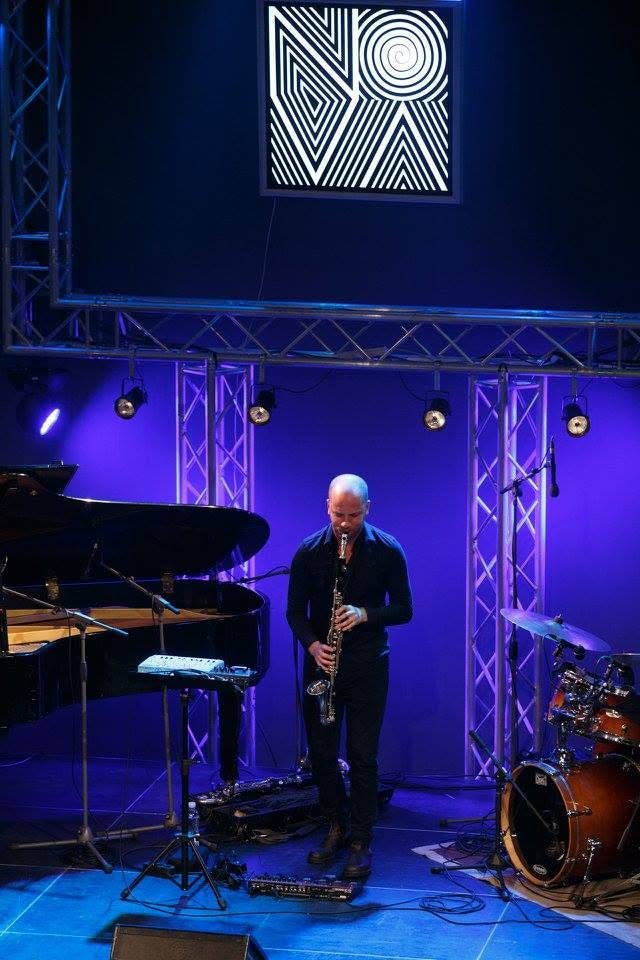
He returned to Serbia several times later, most recently this year, when we had a nice conversation and reminisced about the old days. He performed solo on electronics and clarinet at the underground club Dim, in his new guise and with a new audience compared to the one that used to follow him.
That was when I thought that one day I would look back at my favorite Zimpel albums, and that moment has finally arrived.
Wacław Zimpel Quartet: Stone Fog (For Tune Records, 2013)
This is an album on which we are still listening to Zimpel „the jazz musician“ – and where the playing potency of the entire band is equally in focus alongside its concept. This is a kind of „introspective free“ that does not burst with explosions but carefully doses its dynamic rises, while in a couple of longer pieces we can also hear hints of Zimpel – the minimalist. I particularly liked the interaction and the beautiful rapport with pianist Krzysztof Dys, who would later appear as his collaborator in the LAM Trio.
Hera with special guest Hamid Drake – Seven Lines (Improvised Music Series, 2013)
Of course, the name Hamid Drake caught my attention, in addition to the fact that I had heard this was another „Zimpel band“. Here I would also hear guitarist Raphael Rogiński for the first time, a musician who would return to Serbia and even collaborate with musicians from my part of the world in various incarnations.
The first two tracks, „Sounds of Balochistan“ and „Roofs of Kyoto“, last 17 and 15 minutes respectively and are already spectacles in themselves, bringing together the finest traditions of free jazz, repetition, and various global musical traditions (the Bandcamp page for the album says that “Seven Lines includes Polish folk songs and Jewish klezmer, but also music from the Far East, Sufi chants, blues sprinkles, African funk or free jazz elements“. Or – one could say that it builds on the tradition of free jazz which, in the late sixties and early seventies, began turning toward Asia and Africa, but in an original and contemporary guise. Beautiful.
Wacław Zimpel – Lines (Instant Classic, 2016)
This album is a kind of solo statement on which Zimpel plays Bb clarinet, alto clarinet, bass clarinet, khaen, Hammond organ, Fender Rhodes, drawing on the tradition of American minimalism in the spirit of Steve Reich. One could say that this album is a „corner stone“ for everything that would follow and a kind of paradigm of his expression, even of his later electronic phase.
LAM (Instant Classic, 2016)
This album is also conceptually minimalist, but based on a more classical instrumental structure featuring clarinet, piano, and drums. We could also experience it as Zimpel’s (successful) attempt to carry out his conceptual ideas and new interests within the framework of an apparent jazz format. In that sense, this album excellently combines the gradual dynamic gradations and climaxes characteristic of repetitive music with the potent improvisations of a very tight-knit jazz band.
Zimpel/Ziołek (Instant Classic, 2017)
On this album we hear a fun Zimpel detour into a combination of alternative rock and pop with avant-jazz-minimalism and electronics. You really have to be a master to sound layered and complex while at the same time remaining catchy and accessible. I have the impression that Zimpel succeeded in doing so on this album, and did it very fluidly and naturally, without creating any rough seams. Here we also have „indie“ vocal music and instrumental repetition, intersecting and intertwining in a perfect way.
Wacław Zimpel - Massive Oscillations (Ongehoord, 2020)
Another solo album (with a couple of guests) in which Zimpel turns more clearly toward electronics, while nevertheless retaining a „neo-retro“ analogue flavor alongside electronic and synth-like sounds that you might, for example, hear in Vangelis or some of the legends of that kind and caliber. Here it is clear that the clarinet retreats into the background, while the sound wall of synths, electronics, and beats takes center stage. And everything works flawlessly.
Wacław Zimpel - Ebbing in the tide (2020)
A 49-minute solo piece in album form. „The piece uses advanced processing techniques - developed specially for him by James Holden - to transform a single clarinet line into an other-worldly choir of woodwinds“, says the Bandcamp page. If we really had to slap some genre label on it, this would be a record of „ambient music“. Although I would dare say that here we are listening to the „classic Zimpel“, who could be a reference point unto himself. „Zimpel-like music“.
After the turn of the millennium, collaborations with James Holden, solo ventures, as well as performances with the Indian group Saagara followed, the latter being significantly responsible for defining Zimpel’s sound. Here, four musicians from the Carnatic musical tradition of southern India perform with him: percussionists Giridhar Udupa (ghatam), Aggu Baba (khanjira) and K Raja (thavil), and violinist Mysore N. Karthik. At the time when I fell in love with Zimpel, this was not an interesting band to me, but as over the years I have become increasingly open to Indian music, perhaps now is the right moment to reevaluate this group as well, which released its latest album in 2024.
Zimpel is only 43 years old and has many more years of a great career ahead of him. Since he is a musician in constant evolution, I am sure he will release many more interesting records that transcend genres. I see the period from 2010 to 2020 in his career as spectacular, and I gladly return to it, again and again.