


Do we take what we call “music” for granted? Even if we leave behind the world of rhythm, melody, and harmony and venture, for example, into the realm of textures and walls of sound—into free improvisation—we still tend to assume some kind of framework of rules and listening expectations.
In one of my earlier texts, I wondered how “free” free jazz really is, and how much it is simply a set of improvisational conventions that keep reproducing themselves over and over again.
Can we ask the same question about music itself? Is there a meaningful, exciting, and coherent set of sounds and sonic relationships that exists not only beyond conventional notation systems, but also beyond what we consider the basis of our usual emotional and intellectual experiences tied to music—or its social and psychological role? If such a thing exists, can it take the place that “music” holds in our lives?
Cičići
A few weeks ago, I interviewed trumpeter Nikola Vuković for Jazzin.rs, who is part of the trio Cičići. The band performed on May 20 at the opening of the Ring Ring Festival in Belgrade. Since Nikola is highly experimental in his approach to the trumpet—and his sonic practice involves extensions of the instrument, tubes, balloons, and so on—we also touched on the performative aspect of his playing. That is, the inseparability of our perception of what comes out of his instrument as “sound” or “music,” and what we, as viewers, see happening on stage and around it. If I were to hear that sound only through speakers, it certainly wouldn’t be as interesting as everything I see unfolding in the concert setting.
But is this a “concert,” or rather a “performance”? Or something else entirely? If we insist on definitions, I would arrive at a broader category—“art”—which encompasses sound, music, performance, theater, and, if you like, psychology or philosophy. And that’s great.
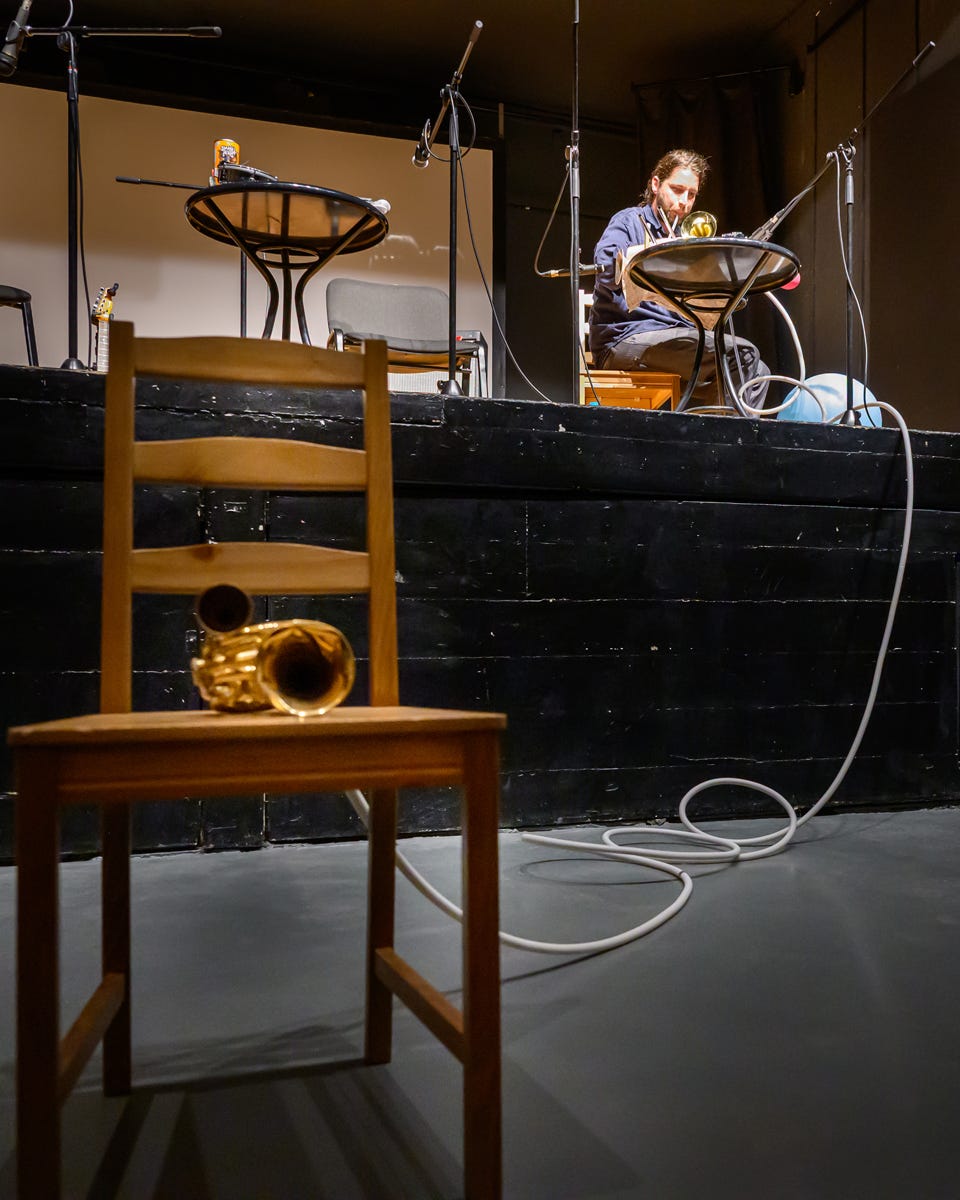
In the opening segment of the concert, Nikola Vuković has a prepared trumpet on a table on stage—though due to the height of the stage, I couldn’t quite see in what exact ways it was altered. His “main trumpet” is connected by a tube to a pocket trumpet placed on a chair in front of the audience, in the first rows. The sound heard at the beginning of the concert resembles a mobile phone ringing somewhere in the back rows.
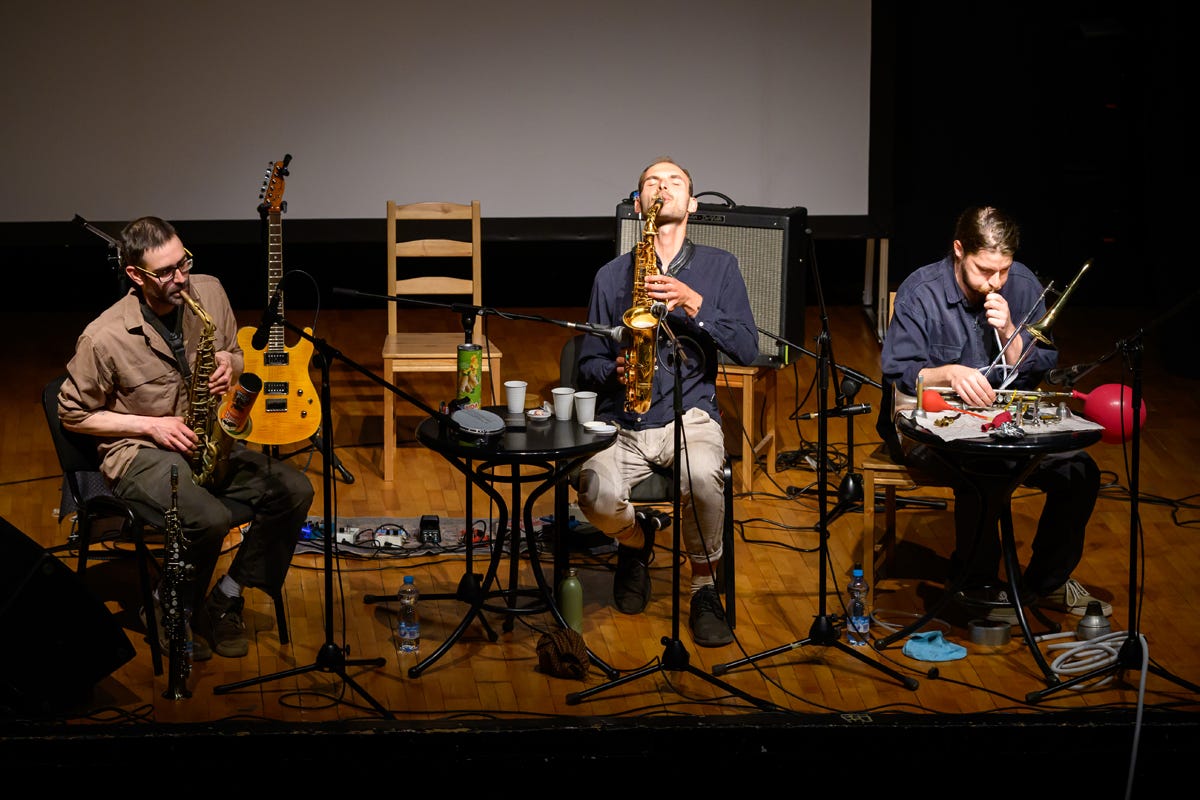
When saxophonists Luka Zabric and Jure Boršič join him, continuing to sculpt sonic vignettes at the edges of what we recognize as the sound of a saxophone (and wind instruments in general), the way we experience the rest of the concert can vary significantly. Of course, if you’ve been attending experimental music concerts for a long time, none of this may sound particularly new or surprising. Yet it still raises the same questions: can we imagine that “music” might be something entirely different from how we perceive it today? Can it be “reinvented” from scratch, based on entirely different postulates, relationships between sounds and frequencies?
In the first segment of the concert, Cičići establish precisely such “relations of frequencies,” which sound like a non-human language—a code perhaps used by birds, or by extraterrestrials from another galaxy. The gradual build-up toward louder sound brings us back to human settings, while the concert’s ending—where we hear more conventionally melodic segments—may be entirely unnecessary within this concept. Or perhaps it “saved the concert,” if you’re not particularly inclined toward philosophical reflections on sound when you’re expecting an emotional escape from everyday life?
Fred Frith
With Fred Frith, we encounter a kind of “total music.” As a musician who passed through the Rock in Opposition aesthetic rooted in prog rock, then through experimental band work in the 1980s and later numerous solo and duo combinations, his solo performances bring together both the estrangement of music in its conventional sense and the infusion of musicality into what might otherwise be considered sonic experiment.
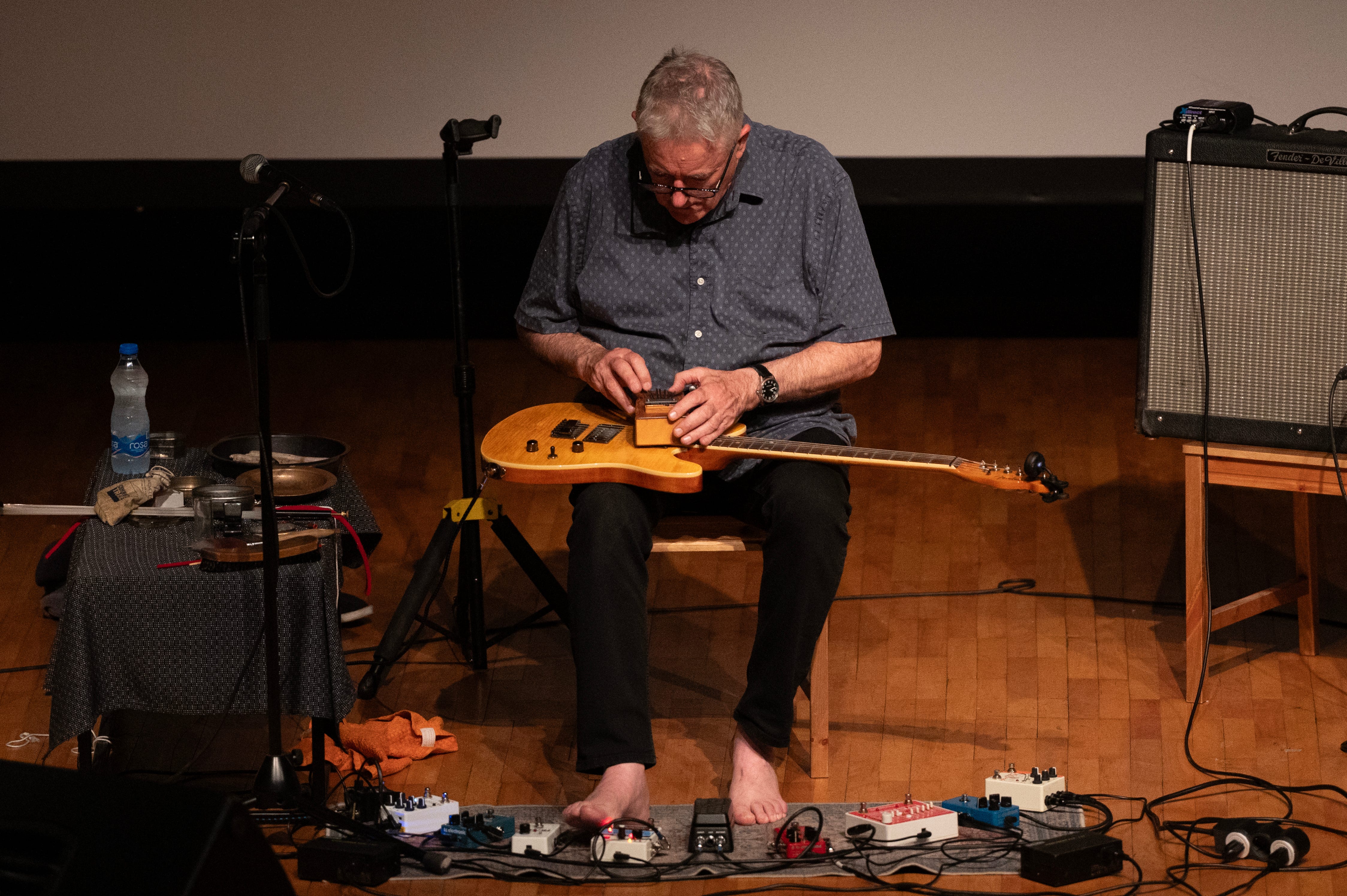
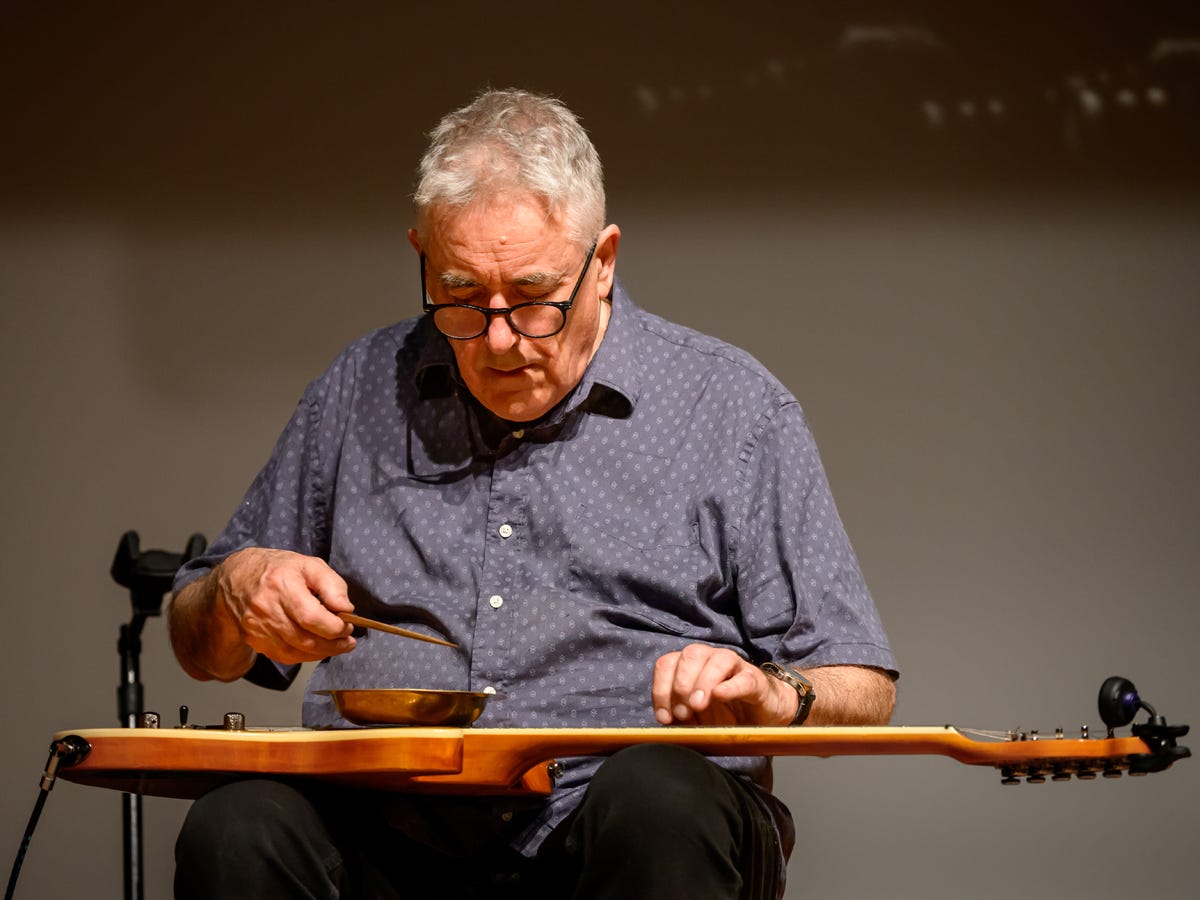
Fred Frith previously performed at Ring Ring in 2005, in what became a cult performance. Many remember that he had a bowl filled with some kind of grains, which he would place on a guitar laid across his lap. He would then pour the grains from one hand to the other, over the guitar, the bowl, and so on. What’s characteristic of Frith is that he never strays too far from “music”—he always manages to bring these sonic fragments back into something familiar, something close to the emotional register we enjoy experiencing at concerts. That was the case then as well, no matter how innovative everything I saw and experienced felt at the time.
Twenty-one years and several hundred concerts later, my ears have grown accustomed to all sorts of things. As much as I was looking forward to seeing Fred Frith again in Belgrade, I also suspected it might not feel as exciting as the first time. In conversations after the concert with people who had also attended the previous one, we came to the conclusion that Frith structured his performance almost identically. He opened furiously, with his recognizable guitar bursts and vignettes that made us all fall in love with him, continued with various objects adding rhythmic or noise elements, returned to melodic segments, and once again brought out his bowl of grains. Toward the end, there were also some playful vocal passages—almost like a male counterpart to Joëlle Léandre.
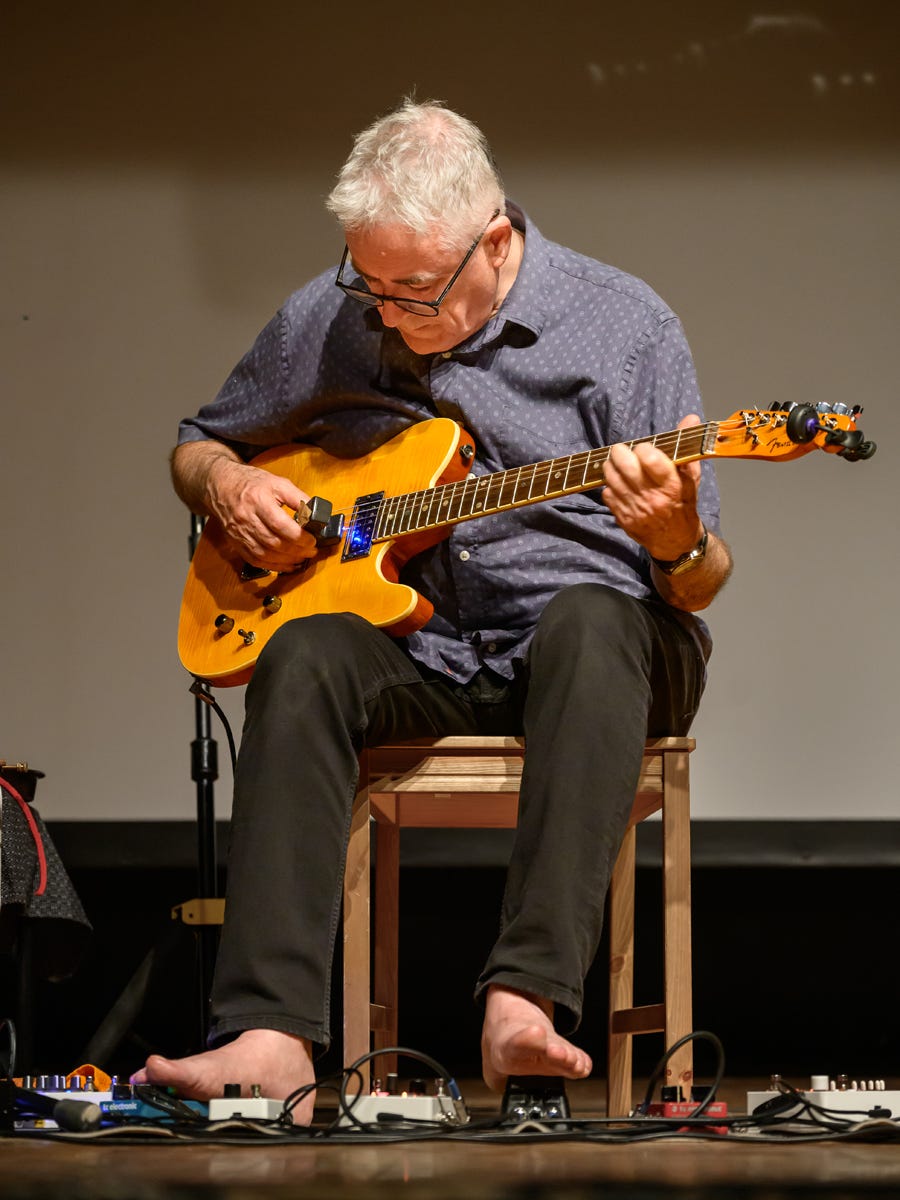
This time, it all sounded far more melodic, lively, and playful to me than it did 21 years ago. A fellow journalist I spoke with after the concert had a completely different impression. I believe we were both right—and it’s fascinating how the “same” concert can evoke entirely different emotional and intellectual responses, even among experienced listeners well attuned to avant-garde music. My own focus shifted from the intellectual to the emotional during the performance; still, I have to say that I take great joy in exchanging impressions afterward, in that diversity of reactions to what we’ve all seen and heard.
Jasna Jovićević & Predrag Okiljević
On the second evening of Ring Ring, I attended a concert that was not only clearly music-oriented, but undeniably “jazz.” Yet at a mainstream festival, it would most likely have been labeled as an “off” or “late-night” program. Once again, context shapes perception—you can watch the same concert after a set of oddballs squeaking and screeching on their instruments, or after a traditional big band playing swing.
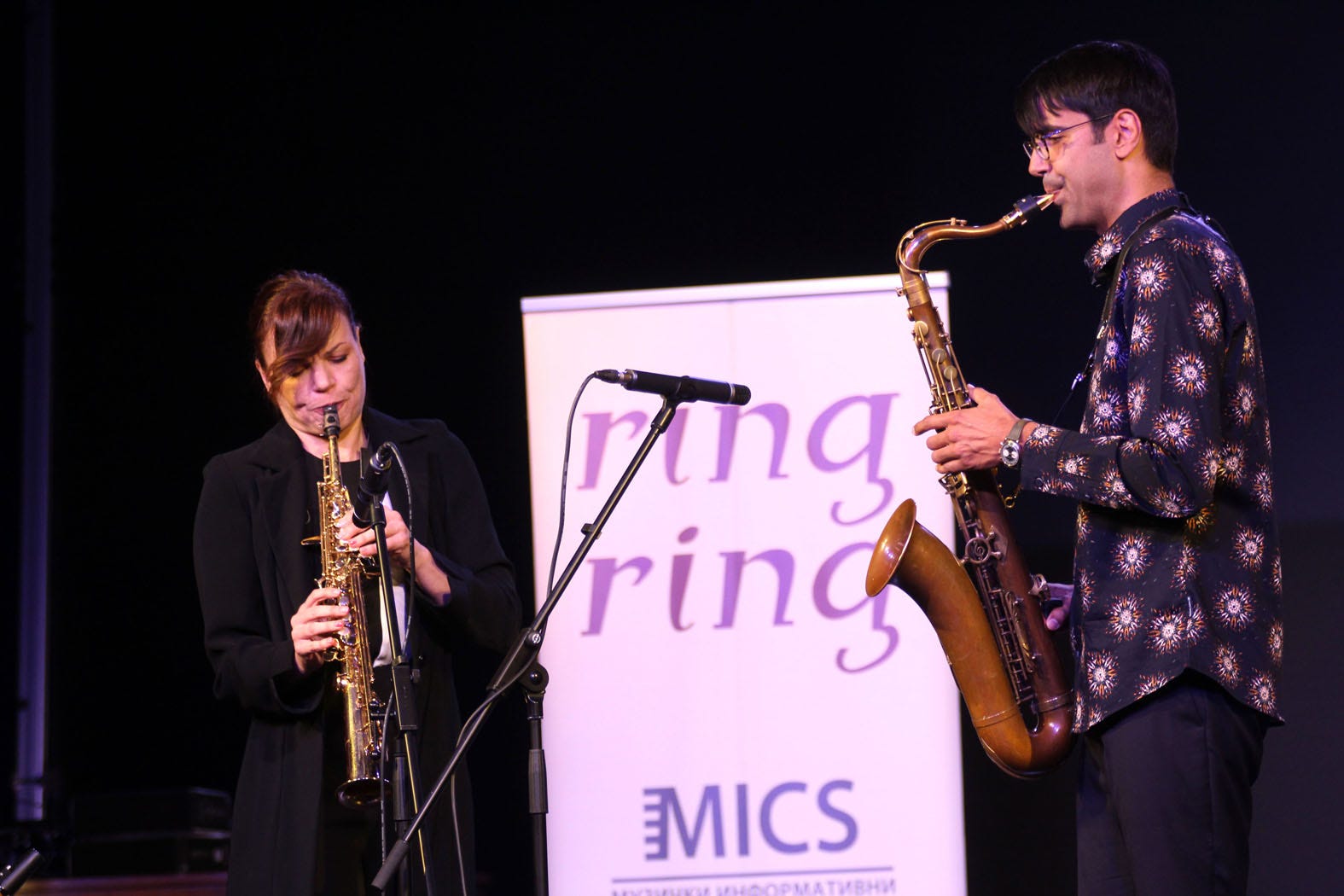
At Ring Ring, the context framed this as gentle music—two musicians who fully command the language of jazz composition, arrangement, and free improvisation. Over the past fifteen years, Jasna Jovićević has launched a number of compelling projects, from the chamber jazz-oriented quintet Quinary to classic free and improvised trios, so it didn’t surprise me to see her explore this atypical sax duo format. Predrag Okiljević has previously shone in bands like Dragon’s Fuel and Palm (in the spirit of the British neo post-jazz-rock school), as well as in various trio formations with a clearer free jazz orientation.
When I first heard they had formed a duo, I assumed it would be a brutal free improvisation project. As much as I enjoy both of them as highly engaging improvisers, I was equally glad to be proven wrong—this is music grounded in composition (and in written scores, placed on music stands).
At moments, I could hear echoes of The Tiptons or John Lurie—points of reference within my own listening framework. What I found particularly interesting was how certain conventions of well-known jazz quartets were translated into this micro-format, yet still sounded rich and full. At the same time, Jovićević and Okiljević have distinct improvisational styles—Jasna often shines in the higher registers on soprano and alto, while Predrag on tenor acts as a kind of counterweight and balance.
In that sense, their collaboration is a perfect match—both share that refined sense that even the wildest free improvisation should retain something melodic; that in the subtle flow between composition and improvisation, a certain kind of magic is born.