


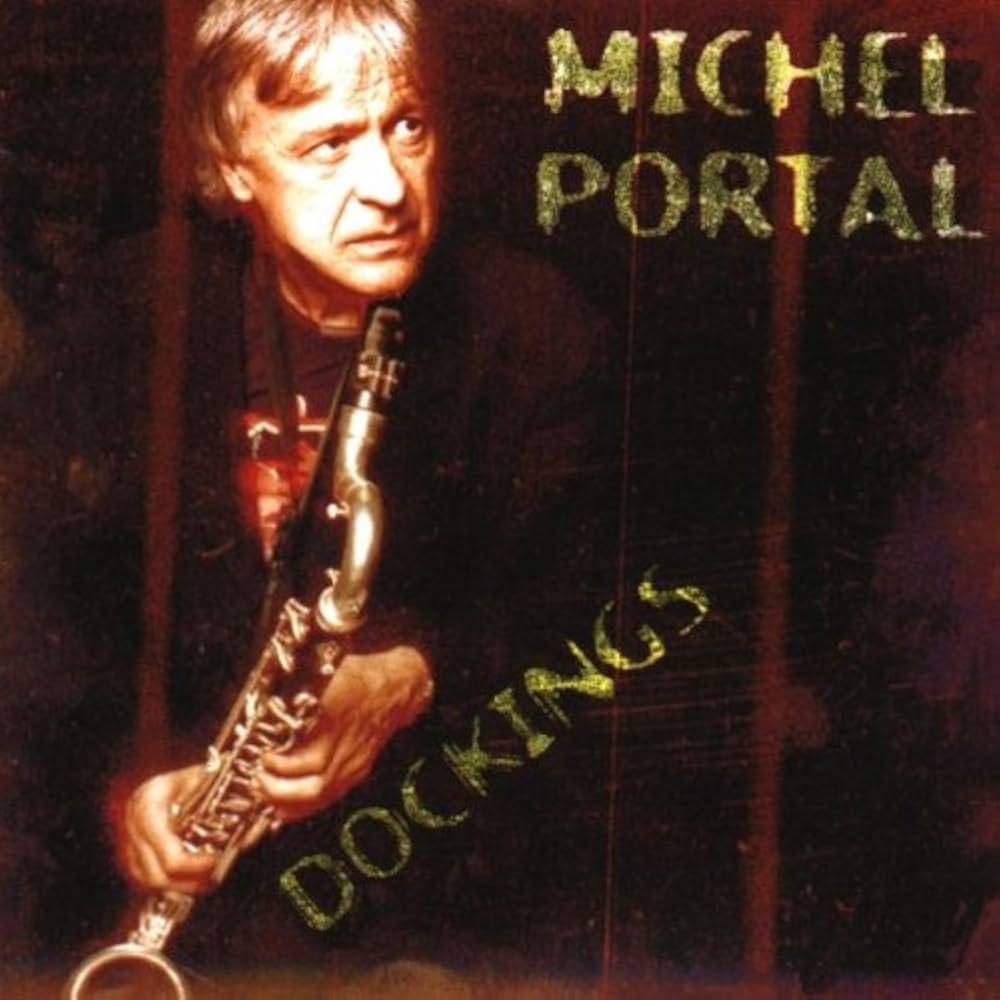
Last week, the legendary French jazz musician Michel Portal passed away. Reflecting on what kind of in memoriam I could write about him—without it being just a biographical overview of his life and work—I turned to my own personal experience.
In the early 2000s, music in Serbia was often obtained through peer-to-peer networks—like Soulseek, or Pirate Bay—partly due to financial reasons, and partly because the country was only just connecting to global distribution. Access to relevant jazz releases was still limited. In Belgrade, internet providers were starting to roll out fast cable connections, and those who were among the first to get online began using these networks to discover and share music. Luckily, some of these early users were serious jazz listeners who created fantastic catalogs and sold handmade burnt CDs with copied covers.
I first came across Portal’s name through his collaboration with Richard Galliano on the album Blow Up. Soon after, I noticed his album Dockings in a seller’s catalog—a record I knew nothing about. On my painfully slow internet, I checked the basics: it featured pianist Bojan Zulfikarpašić (arguably the most prominent jazz musician from the Balkans today), alongside Steve Swallow, Joey Baron, Markus Stockhausen and Bruno Chevillon. The release year was 1998, and the label was Label Bleu.
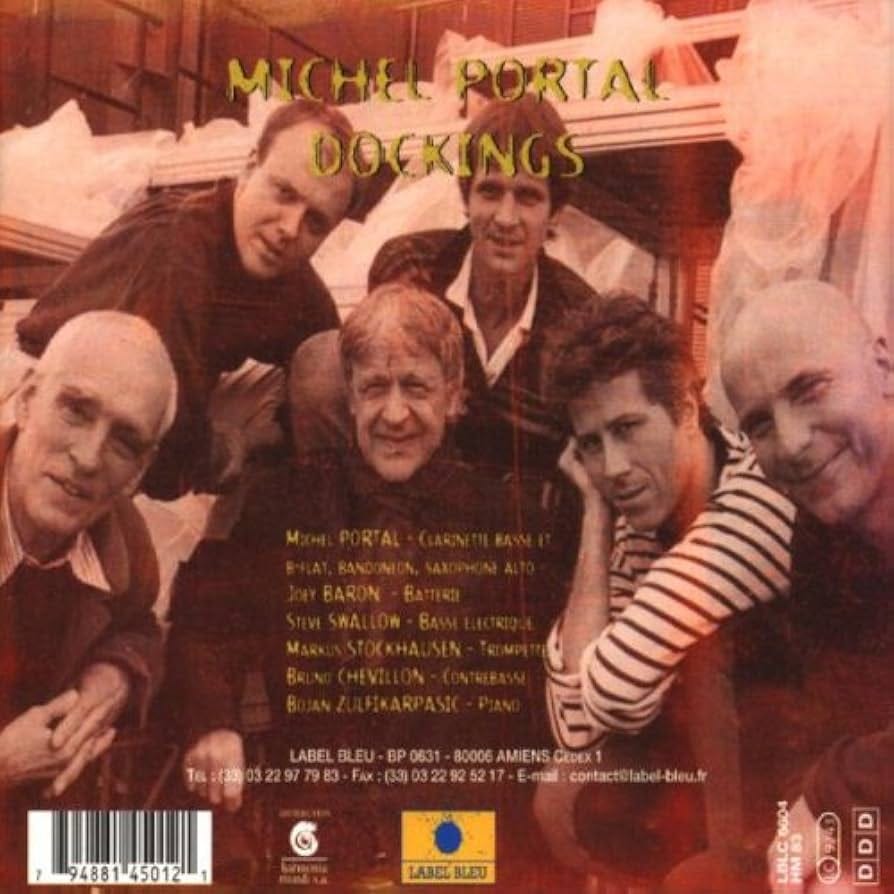
At that time, my jazz experience had mostly revolved around classics like Coltrane, Miles, and many Blue Note artists, while I was just beginning to explore contemporary musicians like Dave Douglas, John Zorn, The Bad Plus, and others. Every week, from my modest allowance, I would buy two or three burnt CDs. One week, I decided to spend the money on Michel Portal’s Dockings (a few years later, with my first stable jobs, I bought the original).
The excitement I felt listening to it for the first time is still palpable today when I return to the album. The opening track, Barouf, jumps in in medias res, furious yet unlike most jazz albums I had heard back then. Joey Baron brings his percussive-style sound and rhythm, structured yet circular and ritualistic. Portal enters with his cutting clarinet, Markus Stockhausen with his trumpet. The main theme hasn’t been revealed yet, but a dramatic atmosphere is already established. In cinematic terms, we meet the main characters and their personalities. Then comes a highly elaborated theme, signaling that we are dealing with a serious composition and arrangement, moving toward a clearer jazz structure while retaining that unique initial flow.
Portal’s instrumental palette on the album includes bass and B-flat clarinet, alto saxophone, and bandoneon. It wasn’t my first encounter with clarinet or bass clarinet in jazz, but the way he played sent shivers down my spine. Later, I learned that he recorded many albums interpreting classical music, and that his jazz experience spanned both contemporary mainstream and avant-garde traditions. When it comes to jazz clarinet, Portal’s influence on the modern scene is hard to overstate, as is the feeling of awe when encountering his artistry. When we think of jazz saxophone, John Coltrane often comes to mind as a paradigm. For clarinet in jazz, I don’t exaggerate in saying that Michel Portal is an essential figure.
The next track, Dolphy—a suggestive title—gradually draws the listener deeper into Portal’s musical universe through interplay with Baron. Only after a few minutes does bassist Bruno Chevillon enter, giving the composition direction with a simple line, followed by the rest of the band. Bojan Z joins on Fender Rhodes, and finally we hear the theme. The full band interplay is exuberant, reminiscent in parts of late-’60s Miles Davis albums (e.g., Filles de Kilimanjaro), yet unmistakably original.
Lion’s Dream maintains the previously introduced restrained setting, with Baron and Portal in the forefront, before the spectacle of Mutinerie begins. Up to this point, the album has achieved perfect dramaturgical balance: the music is exciting, each member’s contribution is hinted at, and the general atmosphere is restrained yet compelling.
Now, fully prepared, excited but still anticipating, Mutinerie bursts forth: a fully developed jazz composition, with an elaborated theme that is both accessible and complex. But if you expect it to settle into a predictable jazz pattern—you’ll be surprised.
Here again, the timing of the soloists is masterful. In the first three tracks, Bojan Z played subtly; now he opens the solo section on acoustic piano, playful and tense. Just when we crave his improvisational skill, we get him in full force. The rhythm section moves almost freely, then seamlessly transitions into a bop-inspired mode (though Baron’s playing remains unique), with Portal’s solo elevating the tension. After Stockhausen’s solo, rather than returning to the theme, the composition moves into a new segment, culminating in an ecstatic finale by the entire band. A true masterpiece.
After such exhilaration, the best thing is a gentle landing. Portal provides this in the next two tracks, Next and Solitudes, followed by a short but effective free-jazz interlude in Embrouille, which again raises tension. No track can outshine the spectacular album opening, but by then the intensity has already set a high standard. The album concludes with the slightly more conventional K.O. and Tourniole, and finally Carla Bley’s Ida Lupino, where Portal plays bandoneon—the only track that feels somewhat off in the context of the whole album.
Unfortunately, I never saw Michel Portal live. During the years when I knew his work and could afford concert tickets, he didn’t perform in Belgrade, nor did he appear at European festivals I attended. I did, however, have the chance to hear Mutinerie live performed by Vincent Peirani’s band at the Belgrade Jazz Festival. My heart leapt—I thoroughly enjoyed it.
Dockings has stood the test of time. Today, I consider it one of the most important European jazz albums ever — and one of the finest in jazz history. When I think of Michel Portal, this album comes to mind first, with due respect to his enormous and consistently high-quality body of work. I genuinely enjoyed revisiting Dockings while writing this piece, and I know I will return to it for the rest of my life.
Always a pleasure learning about interesting albums and artist from you. I somehow missed Portal's music and I am glad to discover it now.