


When we talk about the jazz scene in Serbia, a special place belongs to musicians from Vojvodina, the northern Serbian province that is culturally distinctive as a multicultural and multiconfessional environment. A large part of the population is made up of the Hungarian minority, but Slovaks, Croats, and members of other nations originating from the surrounding countries are also well represented. In that sense, we can also speak of a somewhat different cultural environment compared to central and southern Serbia, but also compared to Belgrade as the capital and largest city in the region.
In the context of jazz, this means that for decades Vojvodina has been more avant-garde than the Belgrade scene, and has also had a strong tradition of musicians and events operating outside the usual mainstream coordinates.
For example, the fantastic “Jazz, improvised music…” festival ran for decades in the small town of Kanjiža in the far north of the country, hosting, among others, Sam Rivers, Charles Gayle, Hamid Drake, Joëlle Léandre… and many other legendary names in avant-garde music and improvisation. Violist and composer Szilard Mezei, whom I have written about here on several occasions, lives and works in Senta, but since he leads several (often large) ensembles, more or less all Vojvodina musicians interested in free jazz improvisation and avant-garde composition gravitate towards him. There is also Jasna Jovićević from Subotica, whose current album I wrote about in the early days of Eurojazzist.
Novi Sad is the capital of Vojvodina and the centre of its cultural life, where a new generation of musicians has emerged over the past 15–20 years. Today, the best known in avant-garde circles is pianist Marina Džukljev, who, for example, performed with Michael Griener and Christian Weber on the main stage of Jazzfestival Saalfelden this year, and is very active in international collaborations, mostly in Austria and Slovenia.
But for our story, we will focus on two musicians – saxophonist Predrag Okiljević and drummer Lav Kovač.
Last decade, together with bassist Marko Čurčić and saxophonist Vojislav Savkov, they formed Dragon’s Fuel, a band whose first few years stylistically evoked British neo-jazz-rock (Polar Bear, Led Bib, Acoustic Ladyland, etc.), before they later began to evolve stylistically. But even more importantly, they founded the informal collective Horz, which also spawned the Horz Music label, through which they began releasing a host of different albums – with this band, as well as in various duo, solo, trio, or band combinations.
Horz became the first jazz collective in Serbia not to rely on the usual model of chasing an “official” and “reputable” label, but instead decided to take matters into their own hands. This gave them greater freedom and spontaneity in presenting their music and trying out new musical ideas, which also significantly contributed to their musical maturity.
Lav Kovač began releasing albums on piano or keyboards as well, while Predrag Okiljević also recorded albums in quite diverse formations. In this way, he developed an interesting playing style that sits somewhere on the fine line between free jazz and the breezy, melodic style of Charles Lloyd: he never overdoes the overtones or fast solos, but carefully measures out his phrases and creates micro-units from them, trying to function within the appropriate musical context. On the other hand, he also possesses that primal skill of tenor saxophone playing, with a rich, deep tone whose associations historically reach back to Coltrane or even Coleman Hawkins.
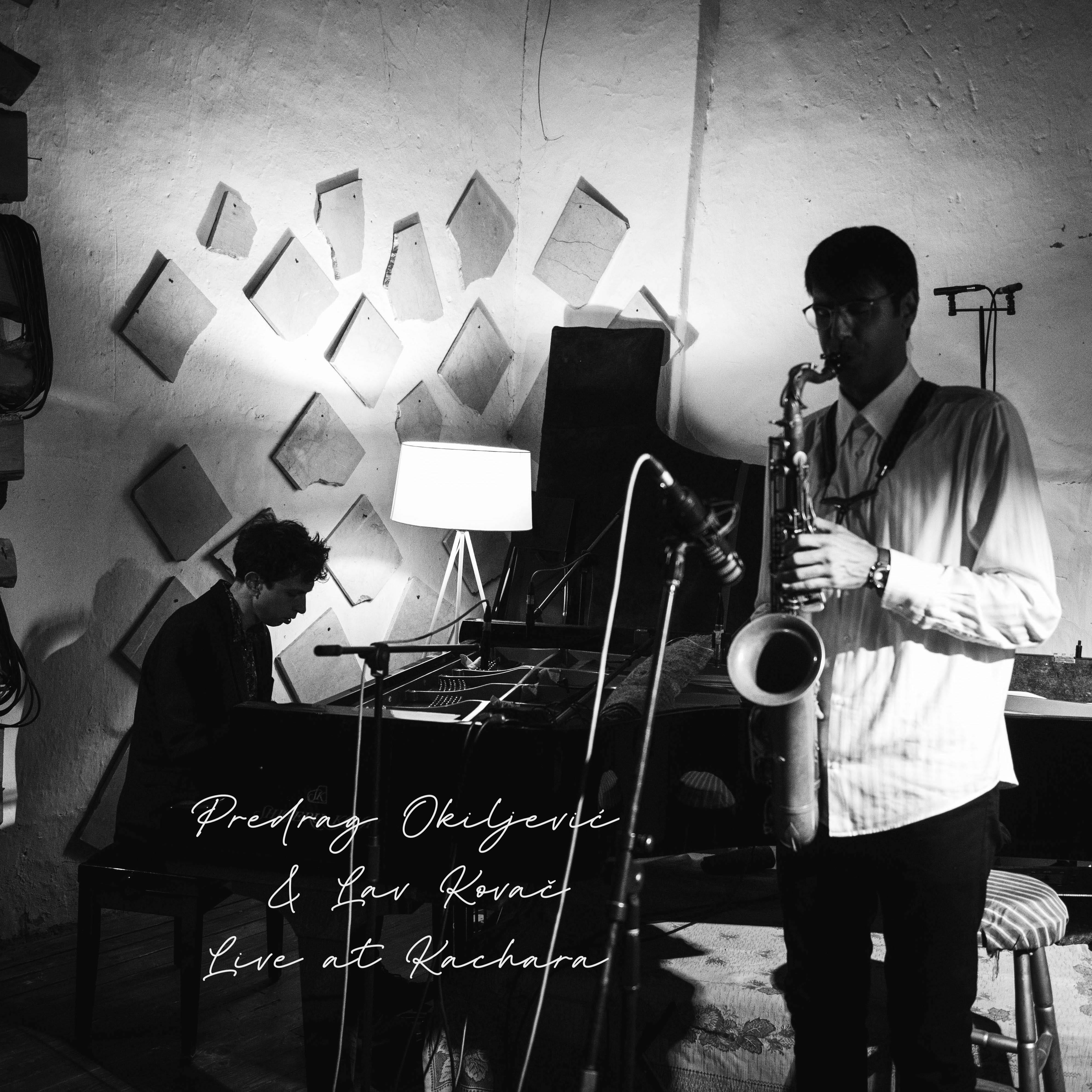
Finally, we come to their current album “Live at Kachara”, recorded at the studio of the same name in the village of Bukovac near Novi Sad. Without too much hype or advance promotion, the album was simply released on their Bandcamp page with minimal information and accompanying text, and is structured around two long pieces simply titled “Part One” and “Part Two”.
At this point, we might note that Lav and Predrag are not particularly interested in self-promotion beyond the usual posts on their private social media channels, which we could romantically view as the approach of “true artists”. On the other hand, I feel that their music can stand alongside what I see on stages across Europe, and I regret that they do little or nothing in that direction.
The moment I first played the album, two associations came to mind. The first was a concert by saxophonist Lee Konitz and pianist Dan Tepfer at the Belgrade Jazz Festival in 2013. It was an intimate and unpretentious encounter between a legendary musician and his considerably younger companion, one that perfectly combined the historical dimension of jazz with a contemporary spirit, although Tepfer was very much attuned to the context and Konitz’s stature. My second association was with Charles Lloyd and Jason Moran’s album “Hagar’s Song”, released the same year, again in the context of bringing together a saxophone legend and a young pianist in his prime.
On “Live at Kachara”, we hear two musicians in their mid-to-late thirties, so clearly this is not a meeting of “youth and experience”, but in terms of style and the way they approach their instruments, I felt that vibe. It is as if both of them have “taken their foot off the gas” a little compared to their regular projects, sounding like the most refined American ballad jazz, occasionally stepping outside this framework into somewhat looser improvisations (though by no means free in the usual sense).
Over the course of these long pieces, they actually play several shorter thematic units, occasionally punctuated by applause from the friendly studio audience. They move from classic structures in which one musician solos while the other accompanies, to occasional moments when we hear Kovač or Okiljević unaccompanied. These isolated solo moments flow gently, effortlessly, and without hurry.
In this way, the album creates the effect of an intimate encounter between two musicians and friends, rather than a carefully conceived and studio-polished release that had been prepared and thought through for a long time. And I have to say that this psychological effect is just as pleasant as the music itself, which is very rarely “edgy” or contemporary, and more often embodies the universal values of jazz in a duo format. This album can be a good starting point for further exploration of the work of these two (still) young musicians from Novi Sad, but it is also one of the most successful albums released on the Horz label so far.