


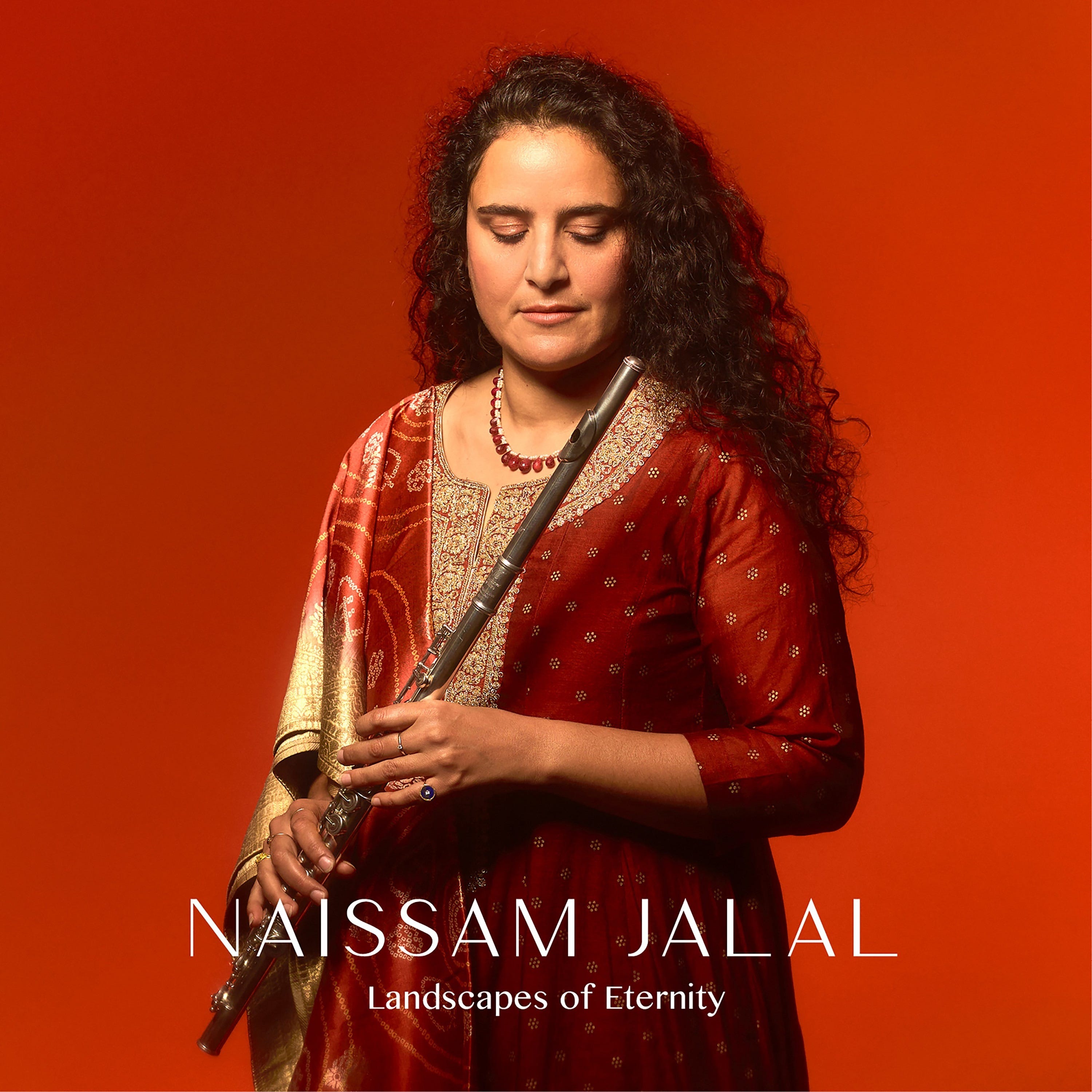
There aren’t too many grandiose albums in contemporary jazz. By that I don’t necessarily mean music built around a large ensemble, lavish arrangements and loud crescendos, but rather releases that manage to combine an ambitious concept with meticulous attention to every musical detail, as well as that certain “something” that makes us feel an album is “larger than life”, even if we can’t necessarily put it into words.
When I think of such examples, the first album that comes to mind is “Promises”, released in 2021 by Floating Points, London Symphony Orchestra, and Pharoah Sanders, where the winning combination is a legendary musician placed in a new and unexpected context that would prove to be a perfect meeting of three seemingly different musical cultures. Of course, Pharoah Sanders wasn’t just any legend, but a musician who played with Coltrane in the later stages of his career and then became one of the pillars of so-called “spiritual jazz”.
This subgenre would experience a commercial rise with the emergence of Kamasi Washington and especially his album “Epic”, after which “jazz spiritualists” would start springing up like mushrooms after rain, often relying only superficially on the genre’s common tropes – flute, harp, choir, basic modal jazz, the occasional Sanders-like overtone on saxophone, and so on.
There is probably no word in contemporary jazz more worn out than “spiritual”, which today is used as a (marketable) identity badge, ignoring the possibility that what is spiritual in music is not a set of formal and stylistic rules, but a deep and personal experience of a musician’s relationship “with a higher power”, or simply with themselves. In this kind of market landscape, a creatively conceived album featuring Pharoah Sanders is a major event because it reminds us of the essence of this music, which comes through even when you’re playing with a DJ and a symphony orchestra.
From here, we quite naturally arrive at flutist, vocalist and composer Naïssam Jalal, who once fell in love with jazz after hearing Coltrane’s “Olé” on the roof of a textile factory in Mali. “It hit me like a ton of bricks. It was a healing process in a musical trance”, Jalal says, describing the experience in a fantastic interview for this year’s spring issue of We Jazz magazine.
“In jazz, I’m moved by Pharoah Sanders, Alice and John Coltrane, by the way they express their inner selves. (…) But I’m not sure that’s down to modal music; it’s a question of mindset”, she explains further.
After growing up in France, then living for several years in Syria and Egypt, travelling through West Africa and thoroughly studying and absorbing numerous non-Western musical traditions, she spent years successfully incorporating them into her jazz expression. When she got the opportunity to visit India and study Hindustani music, she immersed herself in it more deeply than ever before. As she herself explains, while preparing to record the album “Landscapes of Eternity”, she spent five years listening exclusively to Hindustani music. “It took me a long time to immerse myself deeply in the music and not treat it as an exotic accesory”.
As you listen to the album, you will unmistakably feel that this is a truly personal, deeply lived and sincere approach to this music in the context of modal jazz, following in the footsteps of the aforementioned influences. You won’t need Jalal’s explanations to feel that. But there is no harm in mentioning them within this broader context as we think about what spirituality in music actually is, or what the “exoticisation” of non-Western musical traditions means. We won’t be thinking about this merely to feel like sophisticated, learned intellectuals and jazz connoisseurs; rather, we’ll do so to genuinely open our minds to what comes from outside the Western jazz market, and to seek spirituality beyond what constitutes today’s “spiritual branding”.
Naïssam Jalal has made a grandiose album. It is grandiose in its concept, in its meticulous attention to every musical detail, every note and every arrangement.
“It is an album of landscapes I passed through in North India and within myself” explains the album’s creator. The song titles (Tears in Delhi’s fog / Bath of forgiveness in the moonlight / Soft rain on a silent river / In the rice fields at dawn / Inner landscape in raag Kafi) evoke her journey.
The ambient introductions to the tracks create a sensory synesthesia. During the first few minutes of each composition, Jalal does not flood us with barrages of notes, but invites us to “immerse ourselves” in her musical world, while our minds naturally begin creating their own images and sensations. You can almost smell the fog, feel the breath of fresh air by the river, experience the awe of an imagined landscape. Through the titles, Jalal suggests her own experiences, but in our minds they become entirely personal.
The drone sound of the tanpura creates a sonic landscape over which delicate musical nuances unfold. Naïssam Jalal sets the scene with her lucid approach to vocals. In the opening “Tears in Delhi’s fog”, we hear her switch from flute to vocals and back again within the same musical phrase or passage. Sometimes it is a growl that occupies a “no man’s land” between flute and voice. They become one and create a highly exciting musical sensation. But they also function as separate instruments, with Jalal knowing exactly when to let one or the other take precedence, patiently building the dynamics of the compositions.
We hear another fantastic voice on the album. In the second composition, “Bath of forgiveness in the moonlight”, Samrat Pandit is responsible for the ambient opening sequence in the spirit of Hindustani music, while in the following “Soft rain on a silent river” he only enters somewhere around the halfway point: his singing almost imperceptibly and gradually begins to slide into a solo passage surrounded by an increasingly busy and animated band. It is precisely in these two sequences that we see all the brilliance of Jalal’s approach to arranging – both within the album as a whole and within an individual track.
As we listen to the album as a whole, we won’t be able to say whether this is a “jazz album with Hindustani influences” or “an album of Hindustani music with jazz elements”. We will certainly be able to attribute certain musical fragments to a particular musical tradition, but Jalal manages to create music that functions as a whole, in which both the album and the compositions have their own clearly defined dramaturgy.
For me, the key element is precisely this “slowness”, or rather the gradual way in which Jalal builds her compositions, from which the sense of the work’s “monumentality” then emerges. Not because it is loud or because there are many instruments, but because of its completeness, the multitude of details within a fluid musical whole, the clear intention to delve deeply and unreservedly into both the music and one’s own self, to entrust the listener with one’s own vulnerability, delicacy, but also spiritual strength.
Musicians:
Naïssam Jalal: flute, vocals
Samrat Pandit : vocals
Sougata Roy Chowdhury : sarod
Leonardo Montana: piano
Zaza Desiderio: drums
Nabankur Bhattacharya: tabla
Flo Comment: tanpura
Thank you for this very insightful review! I never heard of Naïssam Jalal before, but your story with samples convinced me to put this album on my buy list for the coming Bandcamp Friday.
Naïssam is no doubt more than an exceptional music moving convincingly on a broad range of music for years now. She
has the rara gift of creating unity of spheres on a moment’s base