


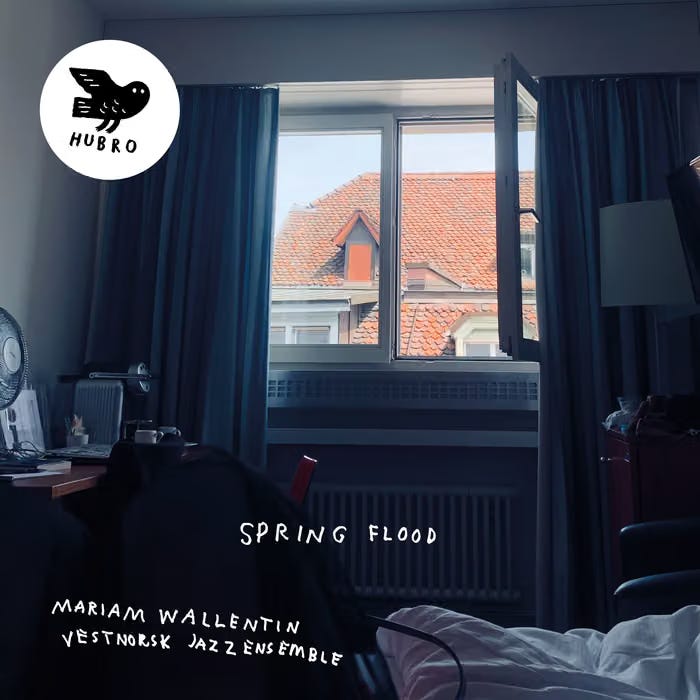
Ever since the first single announcing the album appeared, I had been eagerly and curiously awaiting Spring Flood. For many years, I have followed (and still follow) the work of Mats Gustafsson’s Fire! Orchestra, in which Mariam Wallentin formed an impressive vocal duo with Sofia Jernberg. The way this large ensemble redefined our ideas of vocal jazz on the one hand, and “alternative jazz” on the other, was exceptionally creative even when, at first glance, it seemed simple. There is much that could be written about them, and there will surely be other opportunities, so we can return to the star of this piece.
Here I also have to add my great fondness for the Hubro Music label, which sometimes makes me think that it is giving us music from the future – an exciting and creative vision of everything that characterises the Scandinavian jazz scene, from authentic folk music to ambient music, jazz and electronics, in combinations that transcend these genre boundaries and definitions. So, in my book, Mariam Wallentin + Hubro was a winning combination from the outset, along with an opportunity to become better acquainted with Vestnorsk Jazzensemble and their work.
Spring Flood is an album of “alternative vocal jazz” that fans of Fire! Orchestra will enjoy, but it is important to point out that Wallentin is an authentic creative figure in her own right who has been leading her own projects Wildbirds & Peacedrums and Mariam the Believer for years. Although Kjetil Møster is the artistic director of Vestnorsk Jazzensemble, giving us a reference figure from the realm of “wild” Scandinavian jazz, the music is subordinate to the sophisticated creative vision of the bandleader and makes no attempt to “hijack” the listener’s attention.
I believe this is one of those albums that wins over any even remotely interested listener from the very first spin. At least that was the case with me. The album entered my “heavy rotation” and has been on one of my playlists for long car journeys for months now. It is short, but packed with “hits” and seductive in a way that hits you first in the gut, appealing directly to the emotional spectrum through which we experience music.
I also believe that the skill of crafting an effective alternative/indie/whatever song is no lesser than the skill of creating complex, intricate and avant-garde jazz, because in both cases the ultimate destination is the listener’s emotional experience.
Mariam Wallentin draws the rich orchestration into her universe; horns and strings move in and out of the soundscape, sometimes bustling and thunderous, at other times discreetly painting the sonic landscape behind the vocals. The nine-piece Vestnorsk Jazzensemble are masters of nuance and are not as sonically imposing as a traditional jazz big band, but instead function like a palette from which exactly what the song needs at any given moment is selected. There is no need for everyone to play at full force every second; it is enough for each musician to “jump in” when the time is right.
What is exciting is the way Mariam Wallentin manages to maintain the firm structure of the songs and the emotional charge of indie/pop/rock music while simultaneously showcasing the full richness of her voice. Wallentin does not force vocal flourishes in the upper registers, but instead sounds balanced; in gentler tracks such as “Red”, even lazy, while in explosive pieces like “Love Is Fire” or the title track “Spring Flood”, she shines through a combination of a playful vocal delivery that teases and intrigues us and a clear, powerful one that hits us straight in the head.
Her poetic universe is deeply personal and does not reach for slogans, but instead delves into the inner self and the realm of feeling.
“The Rhine flowed and murmured day and night outside the hotel, and the riverbank was covered with small flowers and trees already in bloom. And I encountered spring in a new place. I saw the green breaking through and the water rushing along, accompanied by entirely different scents and temperaments than at home. The familiar and the unknown hand in hand. And I alternated between documenting and imagining; about all the memories and lost treasures of the water, about the body’s longing and desire as the spring light reveals it — while the river remained in constant motion and the blue and red buds along its banks slowly awakened,” Wallentin says of her stay in Basel, where she made the initial sketches for the album, which would take on a new and exciting form over the course of just a few days of recording.
It is precisely this dedication to the personal in her poetic expression that is one of Mariam Wallentin’s great strengths. The fundamental musical idea, the lyrics, vocals and orchestration each possess their own highly distinctive and individual qualities, enriching what we experience as a complete musical work. And it is as fluid as a river and as powerful as fire. Layered in its apparent simplicity, but above all immensely exciting and seductive.