


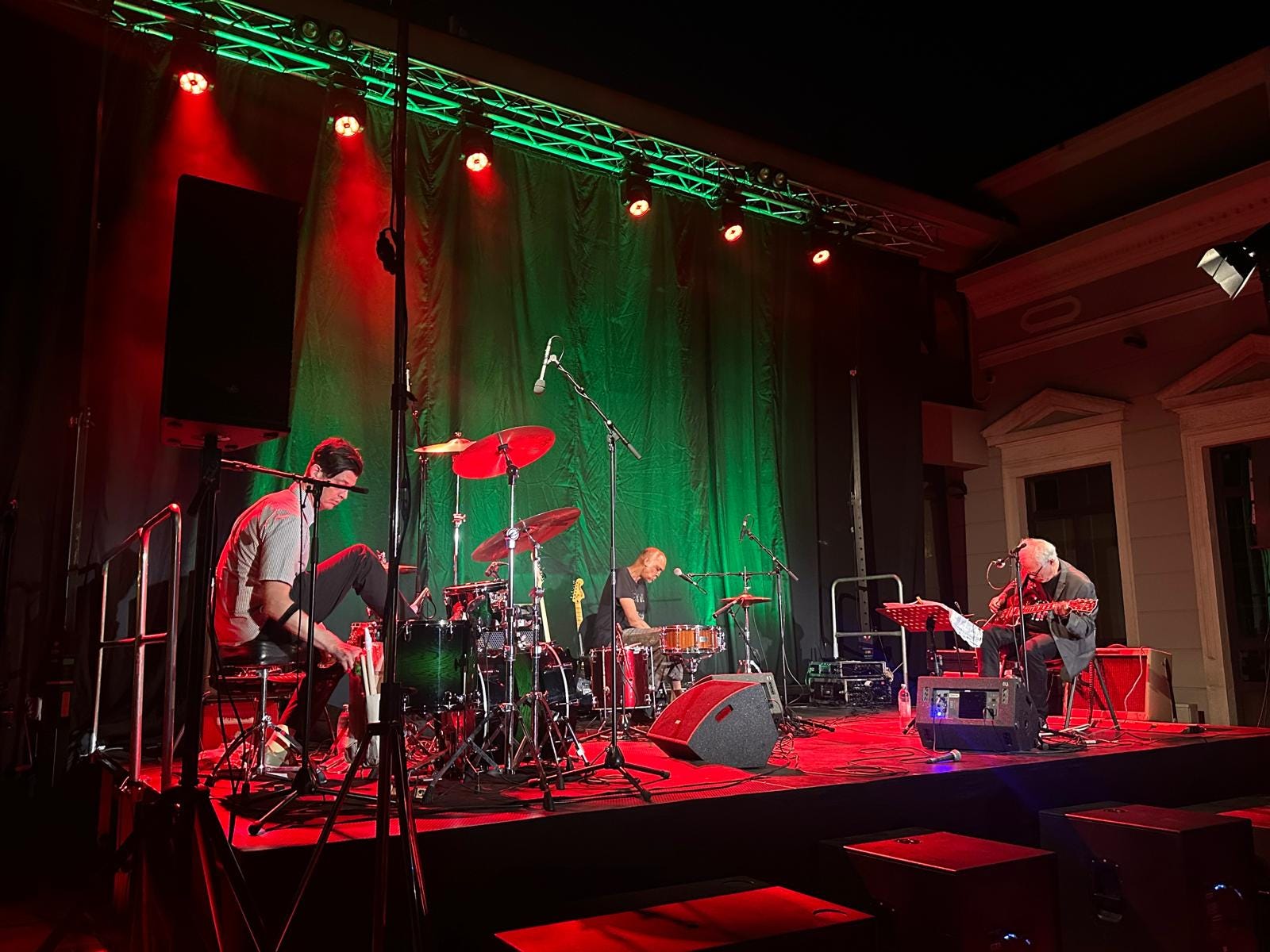
Before getting into the concert itself—Ceramic Dog led by the legendary Marc Ribot—it’s worth briefly considering the context and location. Pula is a city in Istria, a Croatian region that has long been perceived as more “left-leaning,” or at least less nationalistic than other parts of the country. The city of Pula itself is also strongly associated with an antifascist tradition.
The Ceramic Dog concert took place on July 4, which also coincides with the former Yugoslav holiday Dan Borca (Day of the Fighter). The date commemorates a 1941 meeting of the Politburo of the Central Committee of the Communist Party of Yugoslavia, when the decision to launch an uprising was made. Although the holiday was officially abolished after the breakup of Yugoslavia, antifascist organizations continue to mark it. In his opening remarks, Željko Marković—an indefatigable organizer behind the Jazzbina concert series—did not miss the opportunity to highlight the importance of music and art as spaces of resistance and nonconformism, especially in times like these, when right-wing pressures on culture, fundamental freedoms, and ultimately human lives are growing stronger.
The US Declaration of Independence was signed on July 4, 1776, so the concert date carried significance both locally and for the country Marc Ribot comes from—a country where decent people are ashamed of Donald Trump and his rule, and rightly fear the ways in which its democratic spirit is being dismantled and eroded. For someone coming from Serbia, what is happening in the United States feels like a long-familiar déjà vu. Much of what the world now experiences as a shock to common sense through the rise of right-wing and populist politics has, in Serbia, been unfolding since the 1990s—with only a brief pause in the early 2000s, before the democratic prime minister Zoran Đinđić was assassinated by a sniper. In the meantime, the world has, in a sense, “become Serbian.”
So there we are, on the terrace of a venue called Circolo, in the very heart of Pula. The organizer sets the tone with his speech; Marc Ribot walks on stage and greets the audience with the mention of “Dan Borca” in Serbo-Croatian. He begins with a highly distorted, improvised solo version of The Star-Spangled Banner, before being joined by Shahzad Ismaily and Ches Smith. Of course, Hendrix’s iconic Woodstock performance comes to mind—a great guitarist nodding to another. But Ribot is too singular for simple homage; his frayed, seemingly unpolished and deliberately unbalanced playing style becomes a commentary on the anthem itself—a commentary on the United States today.
Croatian journalist Zoran Stajčić from the website Ravno do dna put it perfectly, so there’s no need to reinvent the wheel: “One of the most important guitarists of resistance in today’s world left his mark by gradually suffocating and silencing the distorted echoes of his version of the anthem. As if that familiar melody were fading, melting, and disappearing in his hands. It was precisely the silence within its patterns that felt ominous, like something erasing the very paragraphs of the most famous Constitution Americans have been proud of for 250 years.”
The distorted solo improvisation flowed into “Soldiers in the Army of Love,” which Ribot introduced with verbal—and far more explicit—comments about “political violence dramatically increasing in the United States.” At this point, we were already deep into the concert, yet Ribot still refused to let us simply “enjoy the show.” He was deadly serious in his tirade, pulling us into what he had to say. Only once we had sobered up ourselves could the punk-rock onslaught begin, followed by a sequence of more “conventional” Ceramic Dog pieces familiar to fans of the trio—somewhere between high-energy alternative rock and the restless improvisational spirit of three legendary figures of the New York scene.
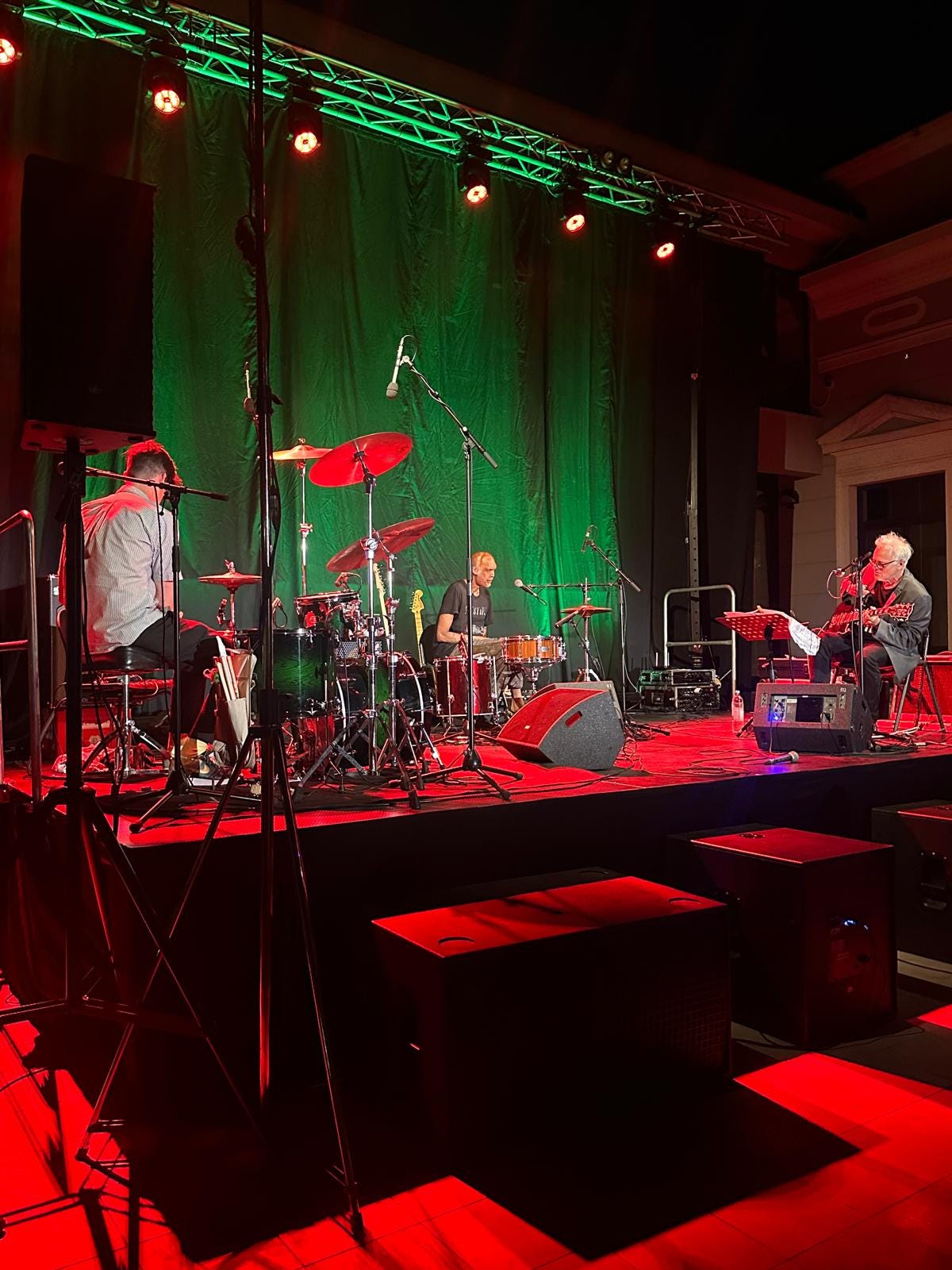
At the beginning, a (justified) anger reigned, amplified by noise; at one point, this gave way to a rather extended improvised set in which the band, without any sense of urgency, explored their instruments. It might have seemed—at least on the surface—out of sync with the previously furious, high-energy, punk- and rock-oriented set.
Marc Ribot, as a soloist, is known for his apparent “mistakes” and “slippages” during improvisation—but these are integral to his style and reflect a deeply perceptive way of revitalizing the basic ideas of jazz. Just as an unexperienced listener of jazz music might hear irregular drum accents or saxophone overtones as mistakes, Ribot challenges the seasoned listener—the one who thinks they “know” jazz but gets comfortable with the fixed phrases and stylistic patterns that many jazz musicians fall into. Ribot’s “mistakes” somehow always arrive at exactly the right moment, carrying both musical and conceptual meaning.
On a broader level, the entire performance can be understood in similar terms. Ribot translates his artistic principles into the very structure of the concert. In Pula, he did not follow the logic of a “typical band” building toward expected climaxes. In this „three-act form“, after anger and improvisation came resolution—through the lyrical and deeply moving “Palestine” (Ismaily was wearing a shirt with the same inscription), followed by the tender and emotional “When the World’s on Fire.”
Before the encore, I believe that many expected “Activist,” but that didn’t happen either—instead, the band played “Lies My Body Told Me.”
Back in 1983, the legendary Yugoslav alternative rock band Disciplina Kičme released an album brilliantly titled “Sviđa mi se da ti ne bude prijatno” (“I like it when you’re not comfortable”). Marc Ribot seems to have adopted this general idea as part of his artistic credo, reshaping it through his own complex artistic persona. In a performance where strong political engagement meets catchy, singable rock; where the most delicate, tender vocals can move you to tears, alongside distorted, restless improvisation; where the essence of pop and rock music as entertainment collides with lyrics that evoke humanity’s darkest crimes and the slide of “democratic” Western societies toward fascism.
In these stylistic oscillations and contrasts—hallmarks of Ribot’s entire career—I see a (conceptual) reflection of the broader unease experienced by contemporary “anti-capitalists” and “activists”: the tension of someone who ultimately cannot live outside this world and must make necessary (and sometimes questionable) compromises. Ribot’s slightly bitter but playful body of work both shakes us awake and gently lulls us, pointing to the gap between the dream of a fairer society that always seems out of reach and the small, personal wins and everyday pleasures we actually live with.
Excellent commentary.