


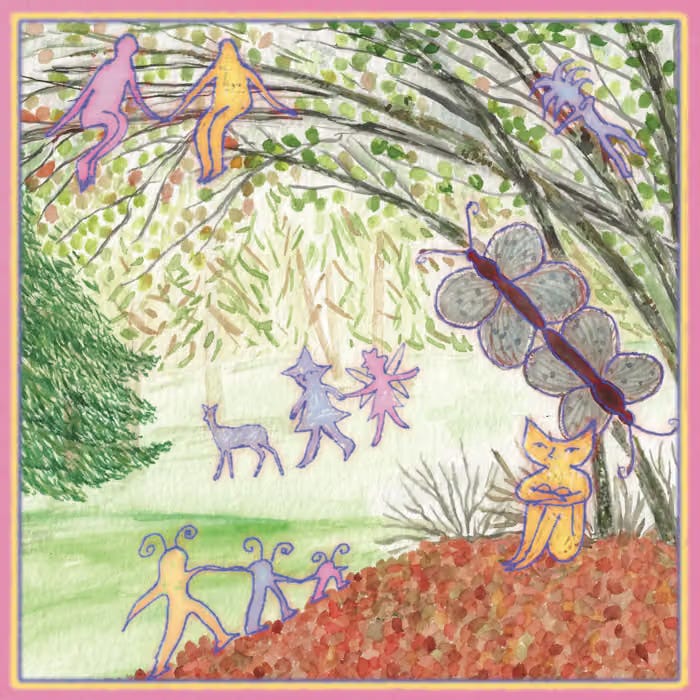
I’ve always been drawn to an eclectic approach to jazz—the kind where seemingly incompatible genres meet and collide. Ever since we’ve reached “the end of history” within jazz, postmodern concepts over the past 20–25 years have often relied on a certain degree of irony toward genres that are more commercially successful than jazz. If there’s a beautiful pop melody, a 21st-century jazz musician will often “deconstruct” it. If there’s a rock rhythm, there has to be some crazy break thrown in, or the rhythm section and the front line will be placed in stark contrast—and so on in that vein.
But there is also a number of musicians who have managed to organically transcend this “gap” between genres. If we scratch beneath the surface—which often depends more on perception and the narratives created by the public—it becomes clear that every genre, no matter how commercial, carries within it, at its peak, anthology-worthy, artistically challenging melodies and compositions. There’s also a growing discourse suggesting that generations who came of age in the 21st century are less burdened by genre distinctions than those of us who grew up in the ’80s and ’90s—and that is certainly a good thing.
The octet I’m Not Done Cooking, led by French pianist Lara Humbert, who lives and works in Brussels, is a wonderful example of eclectic music that approaches each of its (possible) genre labels with love, respect, and genuine authorial enthusiasm. The promotional materials mention “elements of pop, classical music, and experimental jazz” as key references, which certainly makes sense—but only as a starting point for exploring the layered and imaginative musical journey offered by this cleverly named octet.
Lara Humbert can first and foremost be regarded as an accomplished composer and arranger. This doesn’t mean that the band’s solo contributions are of lesser value, but rather points to a particular mindset—one that ultimately shapes what we perceive as the album’s overall mood.
In practice, this means that the compositions themselves are built patiently and in layers. They have their own dramaturgy—an exposition of the theme or core musical idea, moments of culmination, and resolution—that doesn’t necessarily follow conventional jazz logic.
At the same time, a similar sensibility emerges when listening to the album as a whole, where I also had the impression that the tracks are sequenced in this order for a clear reason. I’m not referring to the logic of conceptual albums that follow a written narrative, but rather to what I experienced here as an internal musical logic.
An eight-piece band is, of course, defined by its musicians; personally, I found the dynamic between Lara Humbert and guitarist Raphaël Desmarets particularly compelling. As evident as their jazz credentials are, the sonic universe they create often reminded me of the finest moments of ’70s and ’80s pop and rock—somewhere in an abstract space where Pink Floyd, Queen, and Elton John might meet, only to be joined by an ’80s-era Fred Frith with his adventurous albums. Also, I would single out violinist Amèle Metlini as the octet’s standout instrumental voice. But to reiterate—this is not an album of instrumental feats, but of purely musical achievements, shaped by the precise and delicately elaborated artistic vision of Lara Humbert.
In that sense, the nearly 10-minute composition “Dreamland” is quite paradigmatic, carrying a touch of the playful spirit of Flat Earth Society. There’s also the orchestrally lush “Da Zone,” the dynamic “La Fusée” (which the composer cites as inspired by Knower, Meshell Ndegeocello, Saya Gray, and Bill Frisell), and the warm, lyrical “Jouvenet,” which closes the album. Speaking of the album’s distinctive “warmth,” I especially appreciated the way the bass and drums were recorded—soft, without any artificial punch, almost as if they were tailored for vinyl listening. So far, I’ve listened to the album in digital and CD formats, but I have a feeling the vinyl experience would be an even better fit.
The album title, beginning with “Tome 1,” suggests that there may well be a second, a third, and so on. Whatever future installments may be called, I’ll be looking forward to them.
Musicians:
Lara Humbert – piano, compositions, arrangements
Alejandra Borzyk – tenor saxophone
Lúcia Pires – flute
Amèle Metlini – violin
Adrien Lambinet – trombone
Matteo Mazzù – e. bass
Raphaël Desmarets – e. guitar
Gaspard Sicx – drums, vibraphone
You are so prolific, Nikola. I can barely keep up with you.