


Ever since the first video announcing Bjerge, Strand by Jakob Bro, Larry Grenadier, and Jorge Rossy featuring Charles Lloyd appeared, I’ve been eagerly and happily anticipating the full album. The video featured “Peace Song”, a composition co-written by Bro and Lloyd, and I could immediately tell it would be one of my top five jazz compositions of the year. On top of that, Lloyd’s solo here is fascinating, exciting, wild. I found myself thinking how lucky we are that Charles Lloyd, now well into his eighties, is still playing with such enthusiasm and releasing so much music, giving us the chance to hear him again and again on new recordings, some of which rank among the finest work of his career.
And what about Jakob Bro, who isn’t even 50 yet? Having recorded a string of fantastic albums for ECM over the previous decade, he has embarked on a new chapter in his career over the past few years, both as a musician and as a curator, through his Loveland Music.
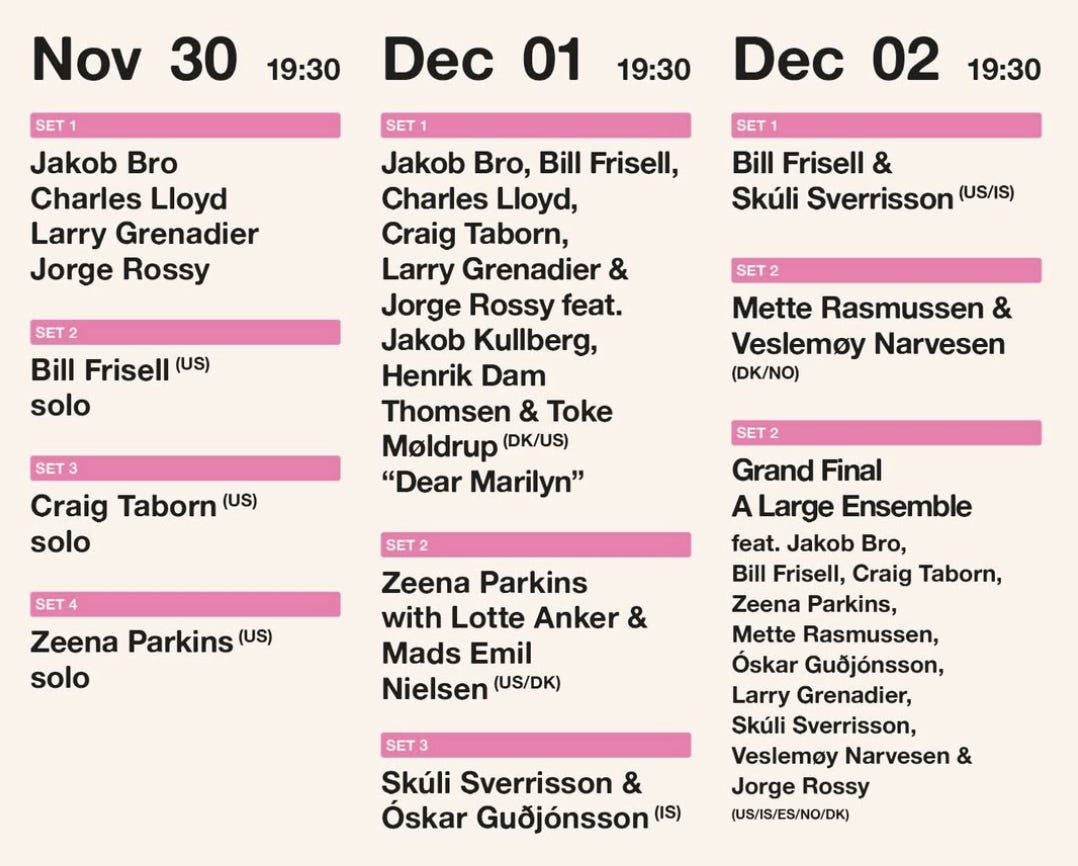
The album arrived a few days ago and has absolutely lived up to my expectations. I’m also delighted to say that I’ve booked my flight to Copenhagen at the end of the month, where I’ll be attending the second edition of the Loveland Festival. The quartet mentioned above will be performing on the opening night. So I won’t say too much more about this band just yet, as I’m saving myself for the festival, whose entire lineup is fascinating (see the poster below).
I first heard of Nefertiti Quartet just a few days ago, quite by chance, while scrolling through social media. I noticed that their album Maze in Köln had come out a couple of months earlier on Berthold Records. Since I was already familiar with the label (thanks to Kuhn Fu and vocalist Mirna Bogdanović), I added the album to my Tidal playlist and enthusiastically listened all the way through. And now I’m listening to it again as I write this.
It turns out that this is a still relatively young but also very experienced group, with 13 years of playing together and five albums already behind them. The quartet consists of pianist and band founder Delphine Deau, saxophonist Camille Maussion, bassist Pedro Ivo Ferreira, and drummer Pierre Demange. The group’s name is a clear homage to the composition and album Nefertiti, as well as to Wayne Shorter himself.
In a broader sense, the quartet also pays tribute to the great saxophonist and composer through its own music and its meticulous approach to composition, particularly the relationship between composition and improvisation and the way they intertwine within individual pieces. This is a band that boldly and skilfully explores the essence of acoustic jazz, without tricks or concessions to anything “fashionable” or “contextual” in the sense of placing the music within a particular conceptual, sociological, or political framework. At the same time, they successfully avoid conventional head-solo-head structures. In other words, very much in the spirit of Shorter, without actually sounding like his compositions. I’m glad I stumbled upon this band and look forward to listening to more of their music.
The third new album in this week’s selection is Amalthea by Sylvie Courvoisier and her quartet, featuring vibraphonist Patricia Brennan, bassist Thomas Morgan, and drummer Dan Weiss, released by Pyroclastic Records. I wrote about Courvoisier recently, following her performance in Serbia at the Pančevo Jazz Festival, which left a strong impression on me. Over the couple of decades I’ve spent encountering her music on recordings and in concert, I’ve always felt that her playing represents a kind of “gold standard” for avant-garde jazz piano. It’s something similar to what I feel when listening to Craig Taborn, for example. What she plays is a standard that many younger pianists aspire to, with varying degrees of success. What she achieves so convincingly often becomes merely a “style” in the hands of others, whereas with her I feel we’re right at the source.
Of course, behind every great jazz musician, whatever their instrument, stands the entire history of this music. Everything someone plays today has been gradually absorbed over decades into a “collective jazz consciousness” that is probably more important than any individual. Although it’s in our nature to celebrate numerous “geniuses”, none of them emerged out of nowhere, without roots in earlier human and artistic experience. In that sense, Sylvie Courvoisier’s work is one of the (brilliant) points along this wonderful jazz continuum, and one that has undoubtedly left its mark on the first quarter of the 21st century.
Waiting on this album since the first Peace Song video, and now a flight to Copenhagen to hear the quartet open Loveland. Lloyd in his late eighties, still taking a solo that wild on a brand new tune, would get me on a plane too. Hope you write up the opening night.
Loveland line up looks great, very exciting to see Oskar and Skuli featured on there, the Box Tree album remains a touchstone of restrained but burning improvisation for me!