



Eurojazzist is my new channel of communication with the jazz audience—and my first one in English. I had been thinking about it for a long time, but finally made the leap after seeing how successfully my dear Macedonian colleague Nenad Georgievski has been building his substack page Vintage Cafe over the past few years, following the international reputation he had already established as a contributor to All About Jazz.
I embraced this new venture with great enthusiasm, while at the same time continuing to write for other outlets and working on my jazz radio show at Radio Belgrade 3.
Hi-Files Magazine: Engaging with the Regional Scene
I’ve been writing for Hi-Files magazine for nearly seven years. The publication primarily focuses on audio equipment, targeting an audience of dedicated audiophiles. I’ve known editor Ljuba Miodragović since my time at One-HiFi, where I worked as a distributor for European jazz and classical labels such as ECM Records, ACT Music, Enja Records, Harmonia Mundi, and others. Another sector of the company imported hi-fi equipment from manufacturers such as Sonus Faber, Devialet, Naim, Harbeth, Rega Research, ProAc… I’ll probably revisit that period in a future Eurojazzist column, as it intersects—directly or indirectly—with many jazz-related topics.
In Hi-Files, I’m given three printed pages, along with the occasional thematic or concert special. Two pages are devoted to an interview with a musician from the former Yugoslav region working in jazz, instrumental, or world music. The remaining page features four short reviews—one “main recommendation” and three additional albums rated from one to five stars. I don’t aim for controversy, so most of the albums I cover are genuine recommendations, typically receiving ratings of four or five stars.
Last weekend was my deadline for the issue coming out in early March. I chose Croatian keyboardist and composer Toni Starešinić, whose band Chui was highly active at the end of last year and the beginning of this one. The local music press describes them as space-rock or space-jazz—both labels are accurate. Historically rooted in prog-rock traditions, the band is also highly eclectic, featuring in its horn section the excellent Croatian jazz saxophonist Vojkan Jocić, whose work I greatly appreciate. Their music is engaging and accessible to diverse audiences, from the “alternative” crowd to listeners more inclined toward instrumental music and jazz proper.
Last year I reviewed their latest live album with an extended horn section for Glazba.hr. The current piece will take a broader look at Starešinić’s overall work, including several of his other recent projects. He was extremely generous and expansive in his responses, and I regret that I’ll only be able to use a portion of them within the constraints of limited print space.
As for the mini-reviews, there’s often overlap—if an album or artist is strong, I might feature them on Radio Belgrade, in Hi-Files, and now on Eurojazzist as well. For the upcoming issue, the four selected artists are Björn Meyer, Jure Pukl, Jasna Jovićević, and WOS Trio (Predrag Okiljević – saxophone, Ksawery Wójciński – bass, Aleksandar Škorić – drums). The latter also appeared on my list of the best domestic jazz albums of 2025, which we compiled for Jazzin.rs. It’s a full-blooded free jazz trio in a live setting. While their music operates within well-established genre idioms, the performance on Live at UK Miloš Crnjanski reaches a remarkably high level. The recording itself is also of excellent audiophile quality.
Radio Belgrade 3 – Where Culture Is Treated with Rigor and Care
Radio Belgrade operates several channels. As is often the case with European public radio, the higher the number, the more avant-garde the programming. In Serbia, most media outlets have been privatized and significantly diminished, leaving very little room for serious, non-commercial culture. Radio Belgrade remains one of the last old-school institutions that treats culture with genuine rigor, and its third channel is particularly distinctive. Here you’ll hear contemporary composed music, avant-garde jazz, and readings of philosophical or sociological texts and essays.
My first engagement with Radio Belgrade dates back to 2004, when my review of a philosophical book was read on air following a classical music concert. I’ve been working on a part-time basis there since 2013, when I was invited to create a show simply titled “Jazz.” Editors Ksenija Stevanović and Ivana Neimarević granted me full editorial freedom to select content that doesn’t follow market logic or cater to an imagined “average” listener. I’m deeply grateful for that trust.
In an average month, three slots are reserved for concerts sourced from the European Broadcasting Union—a platform through which radio stations across Europe exchange concert recordings from all genres. This month, I aired several performances from last year’s jazzahead! festival in Bremen: the Israeli piano-oriented trio Shalosh, Germany’s Carl Wittig’s Aurora Oktett (contemporary and chamber jazz), and Sweden’s Smag På Dig Selv (techno-punk-jazz).
This week’s program featured Max Kochetov, a Ukrainian saxophonist who has lived in Serbia for decades, and his album Foolin’ Myself, released by the Italian label A.MA Records. Max has played a vital role in the local jazz scene, serving as a pillar of the club circuit and a mentor to younger generations. As a composer, he feels most at home in the Blue Note sound of the 1960s, and in recent years has been exploring ways to expand his voice within those foundations. His latest album features prominent European guests such as trumpeter Fabrizio Bosso, trombonist Samuel Blaser, and flugelhorn player Alex Sipiagin.
The final slot of each month is usually dedicated to a “historical album.” Last year’s focus was on free jazz and avant-garde classics. This year, we’ve shifted toward unusual releases outside mainstream currents—records that may not have been fully understood or celebrated in their time but sound compelling from today’s perspective. In January, that album was On the Corner by Miles Davis. For February, however, we made a slight conceptual adjustment in order to pay tribute to the late legend Michel Portal, selecting one of his concerts from the EBU catalogue.
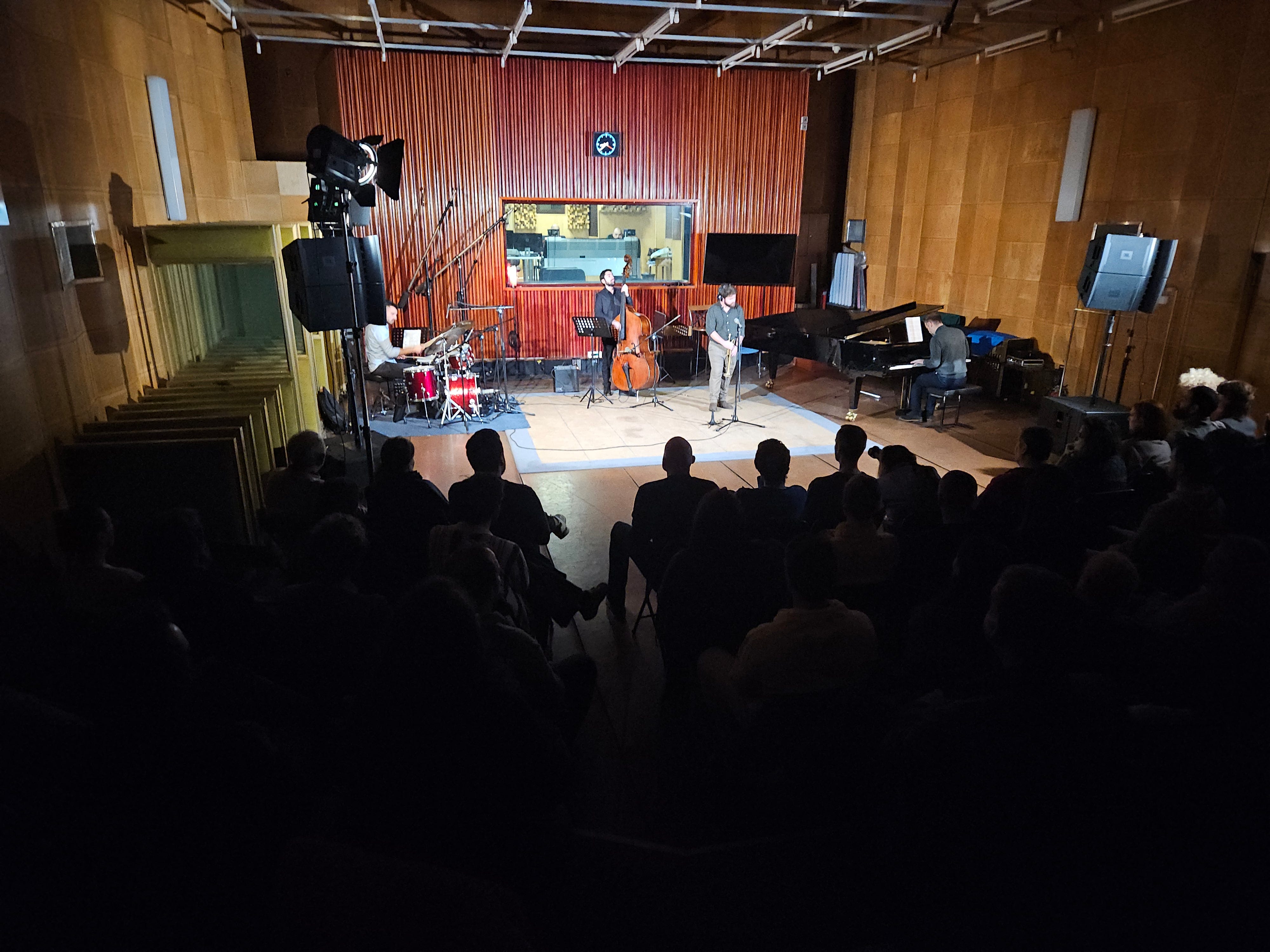
At the same time, we’re actively planning the concert series “Jazz u šestici”—live performances in the legendary Studio 6 at Radio Belgrade. The studio accommodates 50–60 people, creating an intimate atmosphere, and the concerts are broadcast live on the third channel. Admission is free with prior email registration, and attendance is always strong—so strong, in fact, that many end up on the waiting list due to limited capacity. This year’s program has yet to be finalized, but I look forward to every concert that materializes, however many that may be, given the ongoing budgetary challenges.
New Listens – James Brandon Lewis, Shake Stew, Tomeka Reid, Rok Zalokar
James Brandon Lewis is one of my favorite contemporary musicians, and I eagerly anticipate every release. As soon as it appeared, I added Deface The Currency by The Messthetics and James Brandon Lewis to my playlist. At a trio concert of his that I attended in the Netherlands a few years ago, a promotional text described his music as a meeting point between the street and the church. Add an alternative punk-rock edge, and the result is truly distinctive.
The Austrian band Shake Stew is always high on my list, so I welcomed their new album Ten One Two—a dynamic blend of contemporary jazz and a powerful rhythm section flirting with funk and African influences. The new album dance! skip! hop! by Tomeka Reid also felt like a safe bet. I had the pleasure of seeing this quartet in Belgrade at the Ring Ring festival several years ago, shortly after they formed. Given the constant influx of jazz releases, I haven’t always followed everything they’ve put out, but I’m now very much in the mood to dive back in.
All of these were reliable choices, but among the pleasant surprises I would highlight Slovenian pianist Rok Zalokar and his project Zhlehtet, particularly the album Pieces for Collective Change, which I may return to in a separate review. This is the first Zalokar album I’ve heard, and I was impressed by his sense of orchestration within the idiom of contemporary spiritual jazz—historically rooted in figures like Pharoah Sanders and Alice Coltrane, and today perhaps most closely associated with several bands from the catalogue of the British label Gondwana Records.
The album was released by Jazz Cerkno Records, the label arm of the outstanding Jazz Cerkno festival held annually in Slovenia in the second half of May. This is also my blind festival recommendation of the week, even though I haven’t yet seen this year’s full lineup. (On the website of the concert agency Saudades, I noticed that Mary Halvorson will be performing in Cerkno with her new band Canis Mayor, featuring Dave Adewumi on trumpet, Henry Fraser on bass, and drummer Tomas Fujiwara.)
Last year’s lineup included Otomo Yoshihide, Ingrid Laubrock, Peter Evans, William Parker, and many others. It is truly an exceptionally curated program of contemporary and avant-garde jazz, set against the magical backdrop of the Slovenian mountains.