


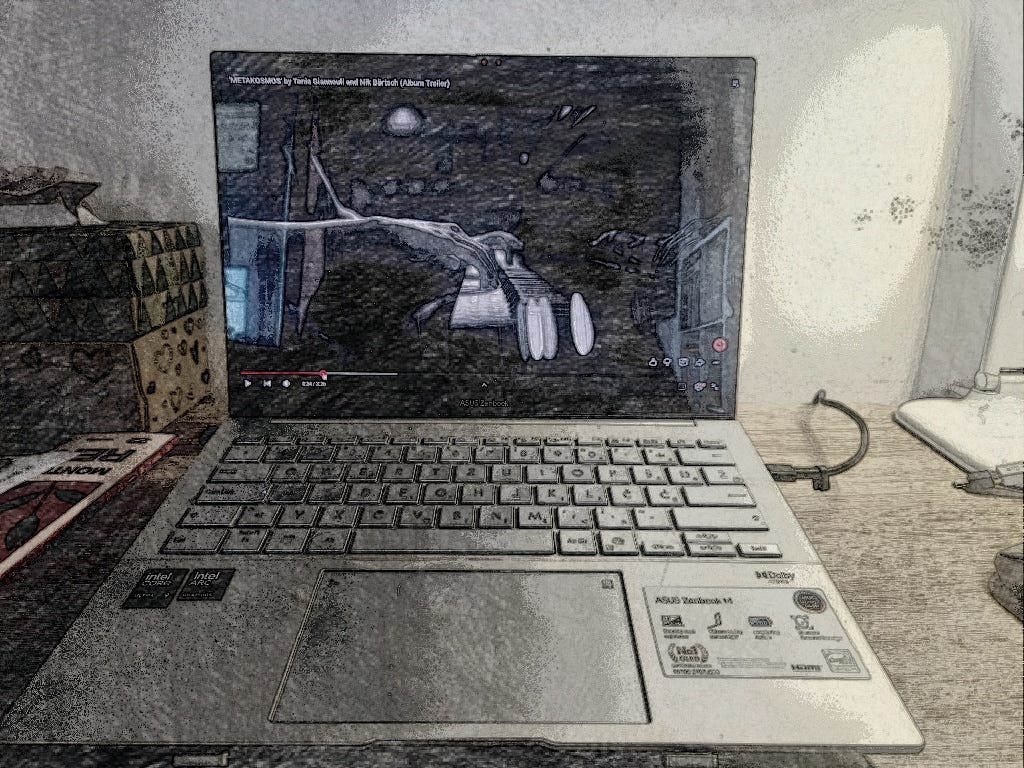
Thanks to my role as a jazz journalist and critic, I often find myself in a position to receive new albums as much as two or three months before their official release date. Naturally, I enjoy that. One such happy occasion happened in August, when pianist Tania Giannouli got in touch to tell me that she had (finally) recorded a duo album with pianist Nik Bärtsch. They had already played a number of shows together over the past few years, so this wasn’t much of a surprise and was really just a matter of time. But still – totally cool.
I’ve been a huge fan of Nik Bärtsch’s music for about 20 years now, going back to the days before he joined ECM. His zen-funk-minimalism may seem very simple on the surface, but it is full of finesse and dynamic nuance, details that keep the music moving even when it feels like we’re listening to endless repetition.
Looking at the broader discographic framework of his work, there have been various formations – from his key band Ronin to extensions featuring horns or strings, all the way to his 2021 solo work “Entendre”. As much as I had been convinced that his strength lay in the way he functions within a band, this solo album showed me that Bärtsch knows how to make his point in any context.
On the other hand, I discovered Tania Giannouli’s work through an email. One day, I received a message from a Greek pianist I didn’t know (at the time), clicked to listen to the music, and liked what I heard. It was the 2020 album “In Fading Light”, recorded with her trio at the time, featuring Andreas Polyzogopoulos (trumpet) and Kyriakos Tapakis (oud). I wrote a mini-review for Hi-Files magazine and continued following her work, but I became a full-fledged “fan” when her symbolically titled solo album “Solo” appeared, revealing the full richness of her style – a combination of classical elegance, folkloric playfulness, a subtle approach to prepared piano, but also a jazz sensibility that departs from the conventions associated with her instrument.
Although they are different, I very quickly noticed how natural the combination of Giannouli and Bärtsch felt in this context. Both are highly aware of the ways in which they use the piano as both a percussive and melodic instrument, combining bass lines with melodies in the higher registers, and so on. For now, I’m only sharing the trailer, and I’ll return to the album “Metakosmos” when it is officially released on October 23.
After Angles 4 became part of my everyday listening, I naturally became curious about what else the Relative Pitch label had released recently. Among several albums I added to my playlist, the Australian quartet Believe stood out with their album “Nature’s God”.
I don’t know much about the jazz scene in this country, and my natural first association is The Necks, especially when a band has an affinity for the avant-garde or minimalist repetition. That was only partly the case here, while my next, and stronger, association was the French group En Corps with Benjamin Duboc, Edward Perraud, and Eve Risser. Of course, all of this is extremely personal, and everyone will form their own association based on the most similar band in their own listening experience, so this doesn’t mean that the band is necessarily derivative.
In the Believe quartet, pianist Novak Manojlović made a particularly strong impression on me. He is obviously of Balkan origin – however, I knew nothing about him before, and my enthusiasm for his playing has absolutely nothing to do with patriotism, but comes purely from the joy of listening.
In the wilderness of the internet, Facebook has been suggesting videos posted by a certain Kenichi Nagatomo to me for weeks now. Once I stopped scrolling to watch an old video of The Lounge Lizards and watched it all the way through, and then the algorithm took it from there. Whenever I scroll, some video from the eighties or nineties featuring John Lurie or The Lounge Lizards pops up. Or one of the musicians associated with them, such as Arto Lindsay. Although I rarely return to Lurie’s albums these days, I’m a huge fan of everything he has done throughout his musical (and film) career. I also love his Basquiat-style paintings.
When I see these old clips, I’m often surprised by how popular The Lounge Lizards were, at least judging by the very large and far from indifferent audiences in big concert halls. To me, their music is melodic and accessible, certainly refreshing in the context of modern jazz of that time (or any time, for that matter), but I wouldn’t consider it something that would appeal to a mainstream audience. Perhaps his flourishing film career at the time, in Jim Jarmusch’s movies, also helped...
Whatever the case, the Facebook profile of the person named – or presenting himself on Facebook as – Kenichi Nagatomo is like some fantastic music channel carefully curating archival footage of Lurie and associated musicians. I’ve seen some of it before, some of it I’m seeing for the first time, and I always enjoy it. Highly recommended.
Very cool, thanks!
For more Australian jazz check out Earshift Records. https://earshiftmusic.bandcamp.com/.