


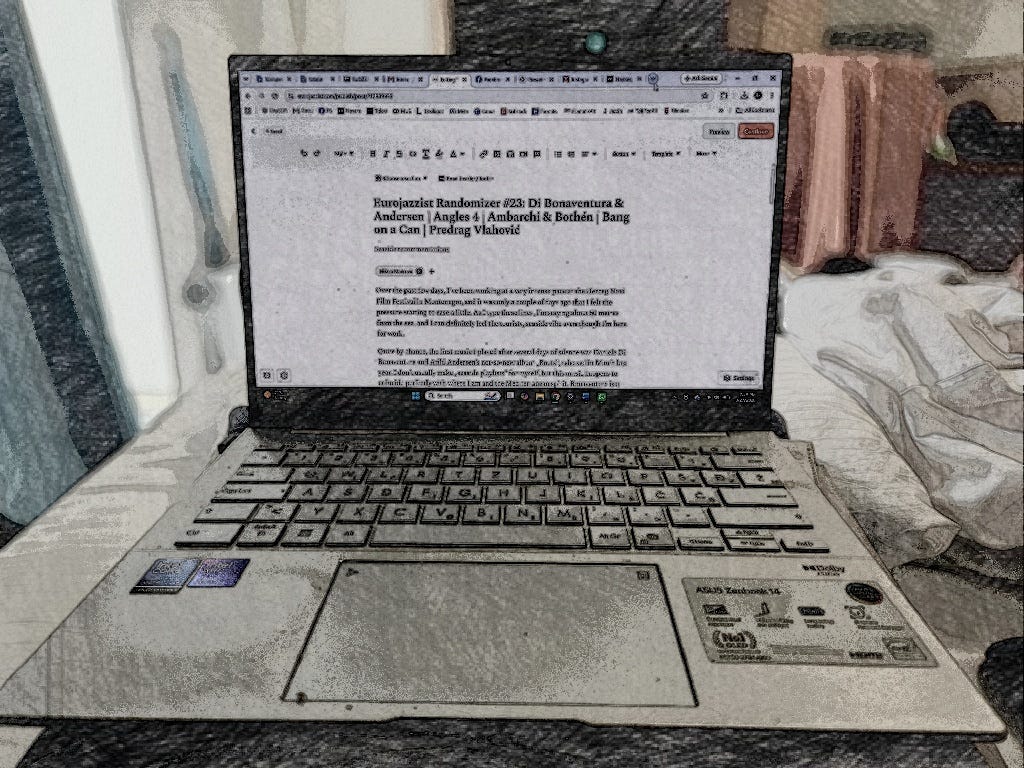
Over the past few days, I’ve been working at a very intense pace at the Herceg Novi Film Festival in Montenegro, and it was only a couple of days ago that I felt the pressure starting to ease a little. As I type these lines, I’m staying about 50 metres from the sea, and I can definitely feel the touristy, seaside vibe even though I’m here for work.
Quite by chance, the first music I played after several days of silence was Daniele Di Bonaventura and Arild Andersen’s not-so-new album „Roots“, released in March last year. I don’t usually make „seaside playlists“ for myself, but this music happens to coincide perfectly with where I am and the Mediterranean spirit. Bonaventura is a bandoneon player who sounds like some kind of „classic“ even when he’s recording new albums. He’s like a safe harbour you return to after listening to all sorts of adventurous music. Safe space. Retreat. Simply beautiful music, played with quality and communicating on a universal level.
Once I got back into the right state of mind for listening to music, everything else followed naturally. A few days ago, I’d already made a note that Angles 4 had released a new album, and saxophonist Martin Küchen is one of those musicians who meant a lot to me during my formative (jazz) years. At the Ring Ring Festival, mentioned here many times before, Küchen’s band Exploding Customer and post-punk legends Pere Ubu performed on the same night in 2007. I would later realise what a fantastic pairing that was, even though one came from „jazz“ culture and the other from the „rock scene“ in a broader sense.
Later, I followed various incarnations of Angles, as well as other excellent projects by Küchen, and occasionally enjoyed their live shows. In that sense, listening to the album „Angles 4“ feels like returning to old acquaintances and is yet another perfectly „safe choice“. „Coleman meets Mingus“ with a touch of contemporary avant-garde. Before listening to this album in full, I had a few „fails“ with new albums that I gave up on after the first couple of tracks because they just weren’t working for me; but with Kuchen, everything went perfectly smoothly.
Scrolling through Instagram then led me to my friend Predrag Vlahović, who really knows the scene and who, back in the day, wrote a blog dedicated to minimalist music (jazz, avant-garde, composed, ambient, etc.). For the past several years he has been sharing his music recommendations on his personal Instagram profile. I see him as an impeccable curator of new music within a specific genre and stylistic framework, and if you have even the slightest interest in instrumental music of this kind, I warmly recommend following him HERE.
The first thing that caught my attention was his post about „Serpentine“, an album by Oren Ambarchi and his trio Ghosted (Johan Berthling – bass, Andreas Werliin - drums), joined by veteran multi-instrumentalist Christer Bothén. Unlike the regular Ghosted albums, based on buoyant repetition and the „drive“ of the rhythm section, the music here is more dynamically varied, and Bothén’s parts bring a special flavour to it. The band approach remains in the foreground, while the wind lines seem to come from the background, almost like a „layer“, rather than a classic jazz solo. A bull’s-eye.
Feeling grateful for this successful recommendation, I went to Predrag’s profile to see what else he had written about in recent days. What particularly caught my eye was that he had revisited the work of the legendary Bang On a Can collective. First, he recommended the Bandcamp article „How Bang On A Can Rejuvenated New York’s Improvisational Spirit“ and then the album „Bang on a Can Classics“, which I found and played during an evening break in my hotel room.
Over the years, I’ve been very much aware of this group’s existence, especially since clarinetist Ken Thomson joined them, as I had previously adored him in the punk-jazz group Gutbucket. However, I had never really devoted myself to listening to their body of work, so „Bang on a Can Classics“ was a welcome introduction.
This certainly isn’t jazz music, but it is music that „transcends genres“, starting from what we often colloquially call „classical music“, when in fact we’re talking about composed instrumental music of Western civilisation. Bang on a Can approach „classics“ in a contemporary guise, but without populist tricks, with depth and excitement. I recommend both the album and the aforementioned article about their vital, decades-long career.
["This certainly isn’t jazz music, but it is music that „transcends genres“, starting from what we often colloquially call „classical music“, when in fact we’re talking about composed instrumental music of Western civilisation".]. So true. Thank you Nikola.