


At the time of publishing this column, I’m at the European Film Festival Palić in northern Serbia, where I’m part of the festival’s PR team. Since the next five days will be quite busy, I prepared this piece—and the next one—a few days in advance. After several days at the festival and three days of camping on the Croatian coast, I’ve settled back into my usual routine: listening to a mix of new and old albums.
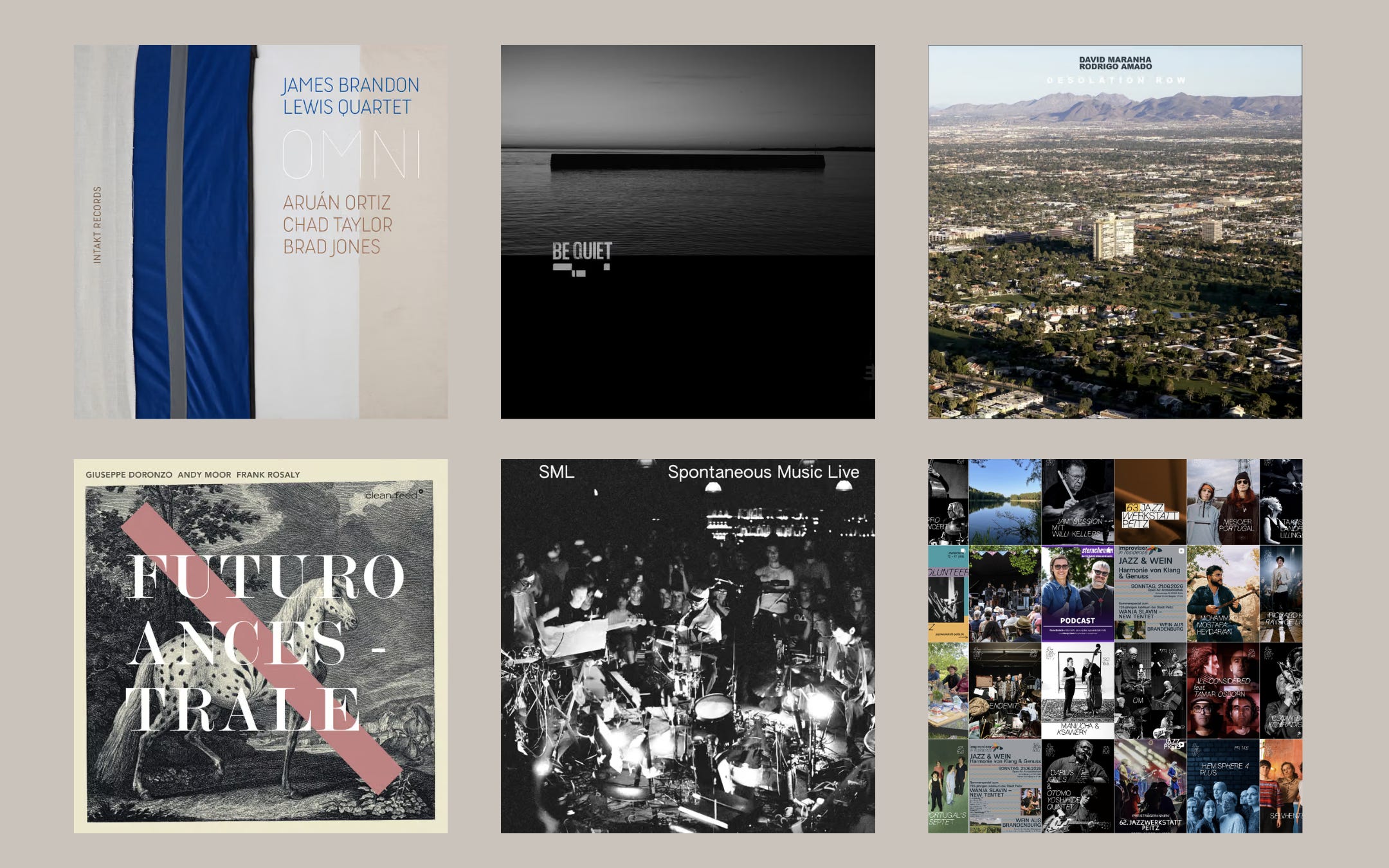
The first thing waiting for me was the album I’d been most excited about: Omni by the James Brandon Lewis Quartet. I first got into JBL when Divine Travels came out with William Parker and Gerald Cleaver—naturally, it was that rhythm section that “pushed” me to check out a musician I knew nothing about at the time. I was instantly hooked and started following everything he released. At the same time, I knew he wouldn’t always have such heavyweights behind him, and that over time he would shape a band—or bands—of his own, something more distinctly his. There have been several lineups along the way, but the one with Aruán Ortiz on piano, Brad Jones on bass, and Chad Taylor on drums feels, to me, like the definitive version.
I’ve written before that JBL might be the only contemporary saxophonist who has truly revived the spirit of Coltrane—not in terms of style or specific phrases, but in that deeper, spiritual dimension that comes from constant searching and pushing forward. It’s there in the long, intricate lines that seem to flow effortlessly from his instrument, rising toward something almost celestial.
He’s such a commanding player that he naturally dominates the sound wherever he appears. And yet, he’s also a remarkably humble musician—someone who clearly values and respects his collaborators, and who understands that the music always comes first. In this lineup, everything feels organic and fluid: at times complex, at times striking you directly, whether through free jazz, playful compositions, or blues-inflected passages.
I’ve loved every album by this quartet, and Omni, released on Intakt, is no exception. It sounds both familiar and new—fresh in the way only a truly cohesive band can be. You can hear what happens when a group fully locks in, when master musicians surrender to something greater than themselves. If you want to call that a higher force—even a divine one—I wouldn’t argue.
I’ve been following news of the new album by legendary Norwegian trumpeter and innovator Nils Petter Molvær for quite a while. He played a key role in shaping the aesthetics of creative electronic jazz from the 1990s to the present day. His new album, Be Quiet (Edition Records), was finally released a few days ago and has already found a steady place in my rotation. It’s a beautiful example of minimalism and intimacy: Molvær works in a duo format, collaborating with a different musician on each track, with recordings made in various locations around the world. On paper, that might sound like a scattered concept, almost like a compilation. In practice, it’s the opposite—the album feels strikingly cohesive, held together by Molvær’s unmistakable sound and a carefully curated set of collaborators, chosen with intention rather than for any superficial “all-star” appeal. For me, his music thrives in exactly this kind of stripped-down setting.
As I write this, I’ve put on headphones to listen to “Desolation Row,” a track by David Maranha (electric organ) and Rodrigo Amado (tenor saxophone), from their upcoming album due out on August 7. I’ve long been aware of Amado’s work and consider him one of Europe’s finest free jazz saxophonists, though I’ve followed his discography somewhat sporadically—there’s always too much in the queue. This album kept popping up on my social feeds, so I finally decided to give it a proper listen.
At first, the track’s 40-plus-minute duration suggested the logic of a live performance: a slow-building introduction, a single piece unfolding patiently over time, rich keyboard textures over which Amado plays in a melodic, almost exalted manner—gradually building intensity until it becomes fully frenetic. A quick look at the liner notes confirmed it is indeed a live recording. It’s so well produced that you might not even realize it at first, until the applause at the end. I don’t know how many tracks the full album will include, but even this single piece, available on Bandcamp, feels like a complete statement.
Giuseppe Doronzo (baritone sax, Iranian bagpipe) has already been mentioned here as a member of AVA Trio, but he’s active in other contexts as well. His album, Futuro Ancestrale, features Andy Moor (electric guitar) and Frank Rosaly (drums, percussion). They are “infiltrating diverse ancient cultures, charging traditional Ethiopian, Lesotho and Persian music with snarly punkish brio and granular post-rock textures, employing unorthodox approaches to modern instruments and contemporary takes to those from a bygone age,” as the Bandcamp description vividly puts it—and it captures the spirit so well that I’ll leave it at that. One listen in, and I’m intrigued.
Back to the United States: SML are already well established, and there’s little I can add about their latest record “Spontaneous Music Live”. What continues to impress me is their ability to dissolve individual egos. Just when you expect someone to step forward with a wild solo, another player cuts in—then another—yet it never feels disjointed. Instead, it unfolds as a seamless continuum. On the European scene, the closest comparison might be Nik Bärtsch’s Ronin, while at times SML also bring to mind early-2000s Medeski Martin & Wood. As with Jeff Parker’s work, Bryce Gonzales plays a crucial role here, engineering, recording, and mixing everything live in stereo. I love when a record captures the raw energy of a live performance, but I also value clarity and balance in production—and Gonzales delivers both with precision.
Jazz Across Europe
This week’s top recommendation is Jazzwerkstatt Peitz in Germany, this year’s winner of the Deutscher Jazzpreis for Festival of the Year. The lineup includes Aki Takase, Maria Portugal in different configurations, Darius Jones & Otomo Yoshihide, and many others. I haven’t experienced it firsthand, but from the footage I’ve seen and the settings it uses, the festival looks genuinely compelling—paired, of course, with a strong program. It takes place a week before Jazzfestival Saalfelden, which typically draws a lot of attention from fans of contemporary and avant-garde jazz, so timing-wise it has effectively “dodged a bullet” by avoiding overlap. This year’s dates are August 14–16, and the full program is available here.
Thanks for the reviews & especially for the festival recommendation. It’s almost impossible to get in advance - that is, with enough time to organise holidays, finance, booking & travel - adequate listings of jazz festivals in Europe & Asia.