


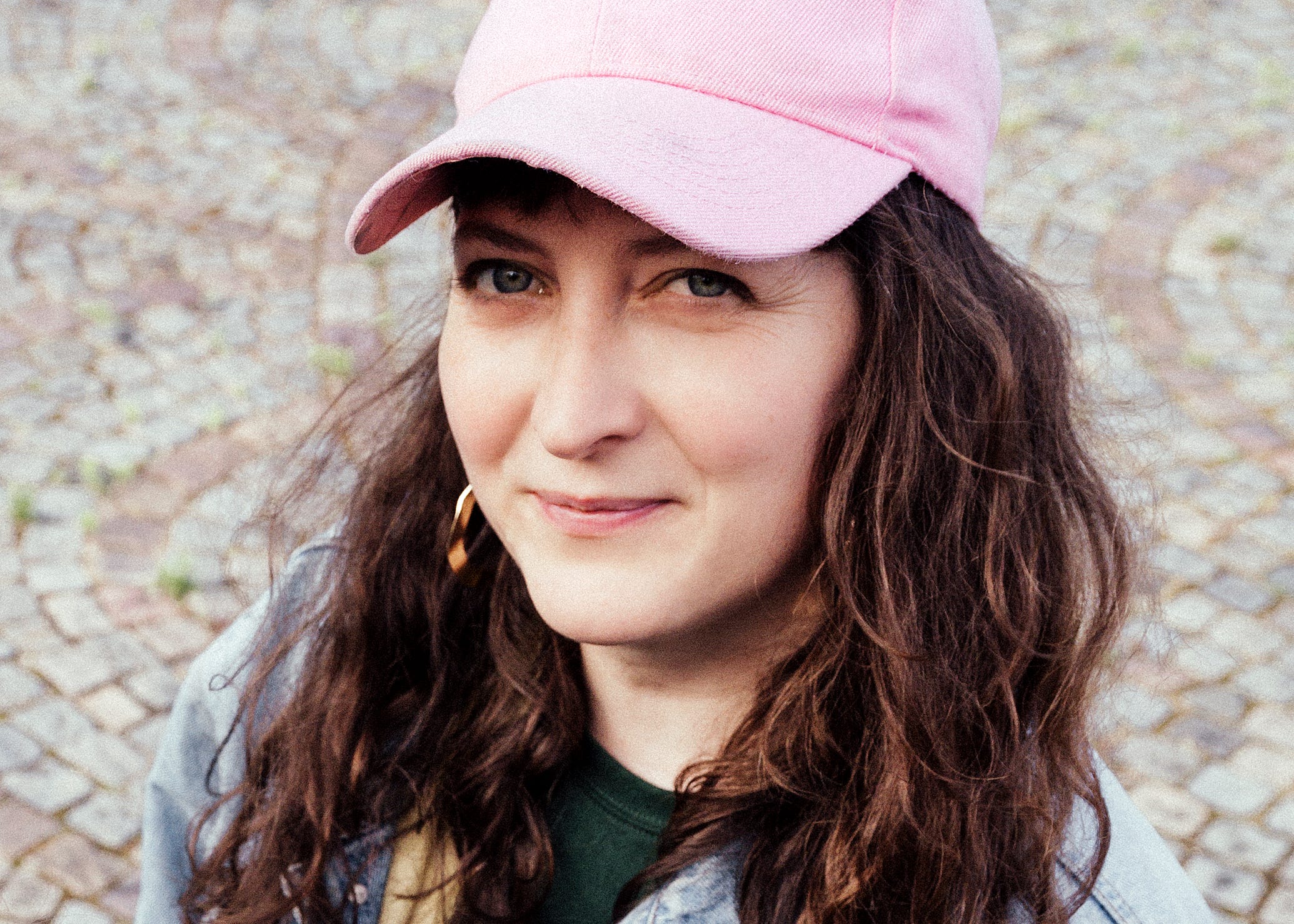
The conversation I had with the brilliant pianist (and flautist) Eve Risser took place on the final day of the Jazz Goes to Town festival in the Czech city of Hradec Králové, where she performed with the band BRIQUE. Having previously seen her only in rather “serious” improvisational and jazz settings, I found this concert particularly fun, playful, and different.
But Risser is no stranger to experimenting with different lineups and formats, as we’ll also see in our conversation. Some know her for her solo work, others for the trio En Corps, or for her large ensembles such as the Red Desert Orchestra and White Desert Orchestra. There are too many projects to list them all, but what they all share is Eve’s playfulness and inventiveness, both in composition and improvisation. I don’t think it would be an exaggeration to describe her as one of the most significant figures on the European jazz and improvised music scene.
We are at the festival Jazz Goes to Town, where you played last night with a band called Brique. Can you tell me a little bit about this band – how you started playing together, and what you like about it?
I met Luc Ex, because I loved his music. I listened a lot to his group with Tom Cora, with Phil Minton. One day I needed an interesting bass player in my big band, the large ensemble White Desert Orchestra.
He’s definitely an interesting bass player. Unique.
Yes. And he’s a funny guy. When I asked him, he said, “Oh, yes. I don’t do this kind of music.” But he listened to the band, and he liked it, so he said yes. I was very lucky. I took someone very different from my former bass player. So it’s nice because it changed a bit the way we played, or the rhythmic section. He played with Julien Desprez on guitar and Yuko Oshima on drums.
And it worked very well. Julien changed the music a bit, and with Yuko and Luc, it was very obvious that it worked. And then we had time to work sometimes on tour, and I said, “Ah, it would be so fun to do a group together.” And when COVID started, we had already planned to do it, but we had more time to rehearse at this time.
And actually, he knew Bianca (Iannuzzi) and Francesco (Pastacaldi) for a long time before. They met at Festival Jazz à Mulhouse, which is Metéo now. They also wanted to do a band with Luc a long time ago. Maybe they told me, and I forgot. So it’s so funny because at the end, everybody wanted to do this band. It was perfect.
Unfortunately, I didn’t understand many of the lyrics, so can you tell me a little bit about the lyrics for this band?
It’s in different languages. There are some in German. There are some in Italian, English and French. You should interview the Bianca for that because she made the choices, and I know that we have one tune in French that talks about the Swiss passport in the encore. That comes from Art Brut, people from a psychiatric hospital who wrote texts. She took some texts from those people, which are very interesting.
And I can see that music-wise, you’re having a lot of fun playing in this band.
Yeah. It’s about that. I think we need to find the energy, because we don’t have a lot to play. It’s quite simple, but we fail all the time, so it’s very funny. I don’t know if it’s good, but we make it tricky enough to cause accidents. Because the energy can go too far and the strict tunes cannot, which is great in a way. I like the magic balance of it.
But you have your improvisational parts, of course.
There is a bit of improvisation. But what we play is simple, so we have space for improv. Most of it is written, but it doesn’t sound like that, which is great, and I think it’s because we are challenged in a little place, each of us, because we are so different.
There are two Italians and one Dutch person. Luc is half French, and I’m French, and sometimes we are lost in translation. It’s so funny. You can be lost in translation in your own French group. But I think we are very different, and this makes a good group – when you take people who are different. I like that. I always try to do that when I make bands. And I know it takes more time, more energy sometimes, because there are misunderstandings.
But at the same time, it becomes special. It’s also a sociological belief that we shouldn’t play only with people like us.
That’s a good point.
Like in life, we shouldn’t hang out just with people like us. Otherwise, the world is poor. This band maybe doesn’t sound sure, but it sounds fun and generous.
It definitely sounds fun.
Generous. And for the audience, it makes a mirror of joy. Of course, it’s better if they stand up.
I watched that video from Saalfelden from earlier this year. It was quite a different setup, and you played the electric piano.
I don’t like playing electric, but sometimes you have no choice.
But when you have an electric piano, do you adjust your style of playing, your improvisation? How do you approach these different kinds of setups?
This concert was amazing because it was in a big hall, an industrial hall, which we like. But it was also... We were fast. I didn’t have a soundcheck because I played with another group before, so it was kind of stressful. I didn’t recognize my sound, and so I had to trust that the sound was good and play.
But another time, we played at Zappanale, a festival of Zappa fans in northern Germany. We played there with the same setup, but we had a soundcheck and it was a bit easier, but same style, very fun. And those people were standing up. But it was raining. There was a storm, so we played two hours later. We have funny gigs.
Before you came here, you worked on another project for the last couple of weeks, Le Mur?
It changed the name. Now it’s Le Mur ou la Peau, the wall or the skin, because there is this thing with “the skin is the wall of the body”.
You are most often associated with improvised music or jazz. How did you feel putting yourself in that kind of different theatrical setup?
I used to play a lot of contemporary music, and I also write music. What was new here is to make music for bodies, for dancers. But it was not a problem, because in contemporary dance, they also improvise a bit. They dance to some indications, and there is a little bit of something approximative. So when I played, I also had a little bit of approximation, and together it fits very well.
So I think we have that in common. and sometimes I’m like, “Okay, I’m late for two bars, four bars,” and I jump, and I make a change. Or if they hear the music going too fast, they come in a bit earlier. So I become one of them. The project was really about how we listen to each other. Music is listening.
And now I would like to go a little back in history. The first time I saw you playing live was in 2009 in Belgrade, when you played with Orchestre National de Jazz, songs by Robert Wyatt. How do you remember that time? My journalist colleagues and I, we were like, “Wow, there is a great new, amazing piano player here in the band. Who is that?”
In this music, you could barely hear an individual, no?
Yeah, we could at a concert.
Oh, yeah?
I remember quite well.
And I played a lot of flute, no? A little bit. I was young, and I already knew that I loved orchestras. So when I was there, I was like, “Ah, as soon as I’m done, I will do my own orchestra.” I love it. I love to be in an orchestra.
And I started to play amazing pianos. There was a great sound engineer. So I think I learned a lot. Amazing musicians, of course. To be 24 or 25 years old and working with the best sound engineer in France at the time was a very formative experience.
At the time, I played more and more with Donkey Monkey, a duo with Yuko Oshima, and we took the same sound engineer. So it was a very nice journey. It was about creative music, making new preparations, playing anywhere it was possible because I was very much into improv at this time. And when we played with Donkey Monkey, I had a Steinway piano. On a key, you can have eight dynamics on a grand piano. Good pianists, of course, have more, but I could experience so many different touches that I had never experienced before on a Yamaha. So I have good memories.
And also I travelled a lot. It was a bit too much for me to travel that much. I lost a bit. Sometimes I lose the thread a bit of my life when I travel too much. I have to go back home also, and this band played a lot.
So it gave me a good perspective on how to deal with the whole rest of my life. I have to take care of my things, go back home. There’s always very intense touring, but not like 40 dates in a row.
You mentioned playing a good piano, but also it’s usual that piano players don’t get to play on the exact same instrument on different venues. How do you feel when you’re on a tour and you have a different piano every night? Does it bother you? Is it a challenge?
Sometimes it’s hard when I play with Naïny Diabaté, the African singer. I need a really good piano because it’s just a duo and it’s like a recital. And when I have a bad piano, it’s really hard because I need a lot of different characters. Otherwise, I feel it’s a chance because I think I’m someone who can be very bored with routines.
It’s a fact that the piano is challenging. You have good surprises and bad surprises. Sometimes it’s better than what you could expect, and sometimes it’s worse. And also the sound engineer changes the sound. But there’s a personality of a piano. Every piano is like a person, and I have a lot of interaction with that.
I’m very sensitive to that. It happens that sometimes I arrive and I play another tonality because the piano sounds the same as mine on another note. And then I’m confused, I’m lost.
And when you play a prepared piano, for example, it strikes me as even a bigger challenge to adapt to some different pianos. Do you have some objects with yourself, or do you use different stuff?
This was challenging. But I had the chance sometimes to ask for the piano I want. You can ask the model of piano you want, or one you know is already okay for the preparation in improvisation. When the music is really written, like with the dance project, the ballet, I have a very specific preparation and I have to have the Yamaha C3, otherwise it’s really hard.
The other band I also remember a lot from your concerts all over Europe was the trio En Corps, which was quite a big deal for me, the critics, the audience.
It was at the same time as the orchestra project, and I always had a small band and a big band at the same time. I like to have every version. I have a solo, duo, trio, quartet, quintet, sextet, octet, tentet, 12 people, 19 people.
A very good friend, Robin Fincker, a saxophone player, proposed that we play at his festival in London. And I had just played a duo with Benjamin Duboc in Paris. And I really liked playing with Benjamin. I was very connected. And he said, “I really like to play with Edward Perraud.” And I said, “Oh, let’s play a trio for one gig.”
And it worked very well. So we wanted to do it again and again and again. And also the place of the piano is not soloistic. It’s more like we are three people. Edward can do melodies, Benjamin can be rhythmic and harmonic, and I can be very rhythmic.
I don’t want to ask you about each of your bands, as obviously there are many of them and it would take five hours to talk about every one. But I read an interview where you said it’s kind of lonely when you’re just by yourself on a tour and playing solo. Something along that line?
Yeah. I liked it at the beginning because I felt a lot of freedom, and the first experiences of touring solo were amazing. But then I discovered the pleasure of the orchestra thing, when you cannot control anything because it’s too big. And it’s the activity of a big family. I come from quite a large family. We are four kids.
Maybe I have this sensation of big parties. Very fun. And at the same time, I’m tired after, because I’m a very sensitive person, so I have to be alone at home to be able to do it. I have to be alone to be able to be with all these people I love. So it’s a paradox. Getting older, I like being with people a lot on tour. But now I know how to do it.
So when you’re with people on tour, how does it reflect on your musical ideas, writing? Do you find those conversations important, besides just playing music in rehearsals?
Yes, especially when I try to make this social mix of people. Like when we have a band with women from Mali.
We don’t talk the whole day because we would be tired, but we stay together and we learn a lot from each other just being next to each other. I don’t feel like meeting happens only with words, and for sure not because we play on stage. Staying together is important. Spend time and play, rehearse, and try to understand when there is a problem. Sometimes it works, sometimes it doesn’t.
It’s really like life. Normal life. When you try to mix with new people. And sometimes, of course, I play with rich white people. Norwegians. And we make very easy music for ourselves because we are educated the same way. So sometimes I need the challenge in that way, and I try to arrange a more complicated project. The music is not easy and the organization is a nightmare, but it’s really worth it. And I think for me, the role of rich people is to spend energy organizing complex things because they can do it.
I live in a rich country and I try to move my ass. I don’t say people have to do it like this because I also appreciate very calm people who don’t force anything, but I’m someone who is hyper-motivated, so I can be used for that. Trying to find my place in this world.
What is the project that you are most proud of in that context, connecting people from different parts of the world?
I think it’s the large ensemble. The large ensemble is called Kogoba Basigui. Things changed a bit, but we played for eight years with around 16 people. Almost only women. Amazing musicians. Amazing warm people. And there’s also the trust, the engagement of the whole band in the project. They don’t do it only for music.
Because of course, when the organization is very intense, you don’t earn so much money, so you need to know why you are there. To get something else than just money. And I think the people who are in this project are very special, as much in Mali as in France and Europe. I think it’s the strongest experience we had for some of us, and we continue because it’s not finished. We do a new project next year.
Is it important for you to be political in your art, not necessarily explicitly, but to some extent or level?
It’s not only that, but of course, yes, it is. And, I know that if I were more politically extreme, I would maybe do more underground stuff.
But I also need love. I need to be famous a little bit. I have to agree with myself that I need the stage, and I have to learn to deal with that. I think it’s super fine to have people who love being on stage.
It’s funny because music helps me to live when I play, but my social catharsis is cinema. I’m more into cinema than anything else because when I go to the cinema, I can really experience an answer from a director. And maybe I don’t find enough political music sometimes. I think I miss political music. I find more political stuff in cinema.
And cinema is also a good vacation for me because when I listen to music, I have so many ideas.
So you need to move away from music to some other art?
Yeah. To just stop working and rest my brain. And to be in the dark and be focused for two hours. Because at home on a mini screen, I stop the movie after 20 minutes. I like landscapes on the large screen.
Do you get the inspiration for the music from those landscapes?
Yes, very much because every material is a kind of sound for me. Like, what is this if it’s a sound? The glass. What is wood if it’s a sound? I found that the hurdy-gurdy sounds really like sandstone, so I made a band Pink Desert Orchestra, about the sandstone, which is pink.
My mother is a visual artist, and I grew up in a Steiner School. If you like it, you can develop the imagination a lot of things you have under your fingers because you draw, you make wood sculptures. In this school, you can spend a lot of time doing things with your fingers. So prepared piano is really the natural continuation of this whole process. It’s the same. I’m working with objects as a craft and when I put them there, it makes that sound. It’s like building a sound with your hands. You can do it with a computer, but you can do it with your hand as well.