


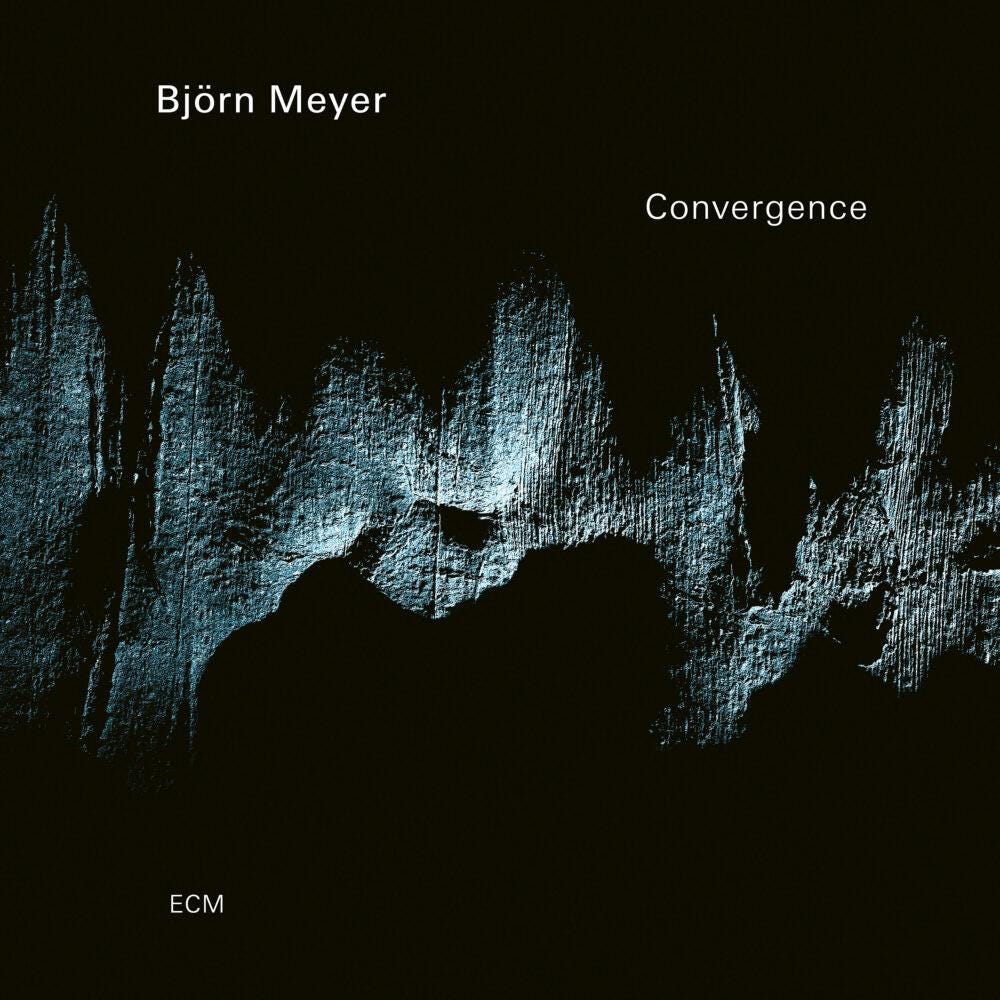
In a few previous articles on Eurojazzist, I’ve already mentioned bassist Björn Meyer and his current album Convergence. Since it has been a steady presence on my home playlist for some time now, I felt it deserved a more in-depth reflection.
When we talk about solo bass albums and the way we perceive them, we instinctively approach them differently from other jazz or instrumental recordings. There’s no grandeur of a large orchestra, no lucid interaction between musicians typical of a combo setting. There’s no conventional split between rhythm section and melodic instruments. Yet if a bassist tries to compensate for these supposed limitations through sheer virtuosity, we may quickly feel they are showing off at the expense of musical substance. On the other hand, if they remain confined to a rhythmic discourse, the music can seem detached from a broader musical context.
Bass guitarists have often addressed these challenges by relying on a wide range of effects—pedals, digital processing, loop sequencers—to create a sound that feels richer and more layered than what we traditionally associate with the instrument. It is almost as if both musicians and audiences have implicitly agreed that the bass guitar, in its original form, cannot provide a complete musical experience without technological enhancement (or a band).
Historically, the situation has been quite different with the guitar. The solo acoustic guitar holds a respected place in classical—that is, European composed—music and enjoys a much stronger “starting position” in the listener’s perception. Later, it assumed a central role in 20th- and 21st-century music through blues, country, and their countless derivatives. We all recognize the guitar as a kind of “hero” among instruments. Of course, the standard guitar has more strings than the bass and a broader dynamic range. Still, I can’t help but feel that the cumulative perception of the bass guitar’s role in popular music has contributed to the relatively small number of albums that rely primarily on musical ideas rather than technical extravagance.
These were the thoughts running through my mind as I listened to Björn Meyer and his album Convergence, released by ECM Records. The seasoned Swedish bassist uses effects, so in that sense he is no exception. Yet I consistently had the impression that I was listening to a musician deeply committed to what lies at the very core of music: a beautiful, memorable melody, genuine musicality, and an organic sense of rhythm in a solo setting. This feeling arose spontaneously, and at first I struggled to articulate it. Perhaps it wasn’t even clear to me why I was so drawn to this music, which is neither “edgy” nor seductively atmospheric in the way we might historically associate with one strand of the ECM aesthetic.
It is important to note that Meyer plays a six-string bass. Although the instrument still primarily operates in the lower register, it naturally allows for a playing approach closer to that of a guitar. Meyer does not emphasize the expanded range for its own sake; rather, he plays in what might be described as a universal guitar idiom. The bass tones lend warmth and a distinct sensibility to his music, but the essential values of the compositions are universal. In the album’s strongest moments, one could almost imagine listening to études from a classical guitar method book. Placed in context, this return to the essence of string instruments sounds anything but conservative. In fact, it feels almost inverted in relation to our expectations and experiences as listeners of contemporary jazz and instrumental music.
For me, the central section of the album—Gravity, Motion, On Hope, followed by the closing Nessoden—was particularly compelling. In Nessoden, Meyer adopts an especially classical touch, reminding me of his ECM colleague, acoustic guitarist Zsófia Boros. Perhaps that association is no coincidence, as the two have performed together.
Of course, there are also moments firmly rooted in the recognizable discourse of contemporary bass playing: the layered textures of the opening track Convergence, the atmospheric Drift, and Magnetique, likely chosen for the official video because of its visually striking tapping technique. Through a rich palette of playing techniques, Meyer achieves both variety and structural coherence, offering the listener enough material to sense which passages form the album’s core and which serve as connective tissue or breathing spaces between its (subjectively) most captivating moments.
At first glance—and judging by its nominal structure—Convergence may seem like one of those albums we add to a playlist for contrast, perhaps as a pause after an intense jazz recording dense with virtuosic playing and elaborate arrangements. After multiple listens, however, I began to experience it quite differently: as an essential musical statement and, so far, one of my favorite releases of 2026.