


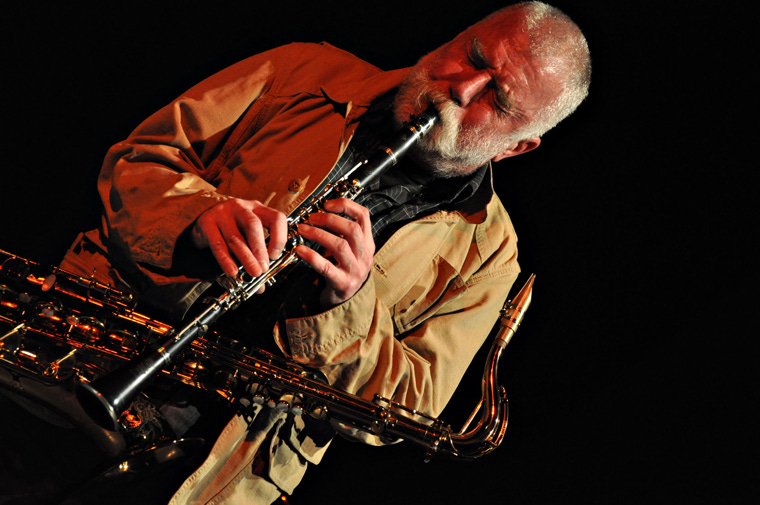
In March 2023, a dramatic statement regarding his health was posted on the official Facebook page of Peter Brötzmann. Alongside certain factual details about what had happened to him, and the announcement that he would be unable to perform until further notice, he added:
NO GOOD NEWS, MY FRIENDS, BUT IT IS HOW IT IS AND YES, I WILL DO MY BEST TO STAY WITH YOU IN WHAT FORM AND FUNCTION EVER. ALL GOOD AND NOTHING TO COMPLAIN, BEST TO YOU ALL b.
At that moment, I could already sense that the end was approaching, so the news of his final departure did not take me by surprise. We never properly met in person, although I had several suitable opportunities to strike up a conversation; perhaps I felt a certain fear, or awe in the face of his greatness. Or maybe he simply always seemed like a so-called private person, someone who didn’t particularly enjoy being approached by fans after concerts. It’s also possible that I was completely wrong. Yes, I could have introduced myself in the capacity of a “jazz journalist,” but even then I felt too intimidated, as I am much younger than he was. I hadn’t even been born yet when he had already left behind a fantastic body of work on par with the greatest musical legends.
After he passed away, I aired his music several times on Radio Belgrade. The last time was last year, when we launched a series dedicated to presenting the most important free jazz albums in history. Naturally, Machine Gun held an unavoidable place as one of the key releases of European free jazz. I prepared the show, wrote an accompanying text about the album and the context in which it was created, but at the same time I became aware that I had listened to that album very rarely in my life. One could even say—more informatively than out of genuine, repeated listening on a CD player or stream.
Does that make me a “false fan,” given that I never truly enjoyed his most significant work to this day? What was it that kept me at a distance from the album—or simply failed to draw me in more strongly?
Early Free Jazz experience
Reflecting on this, and on the fact that my memories of Brötzmann are primarily tied to projects from the 2000s onward, I returned to the very beginnings of my engagement with free jazz. Around 2001, I began listening to jazz, mostly classics from the 1960s. Parallel to that listening experience, I attended the Ring Ring Festival in Belgrade every year, where some of the most radical performers of the time appeared—whether from electronic experimental music, world music avant-garde circles, or free jazz. Some concerts remain vivid in my memory; others had a dramatic impact on shaping my musical taste, such as the jazzcore/metal Italians Zu.
After hearing those wild and unrestrained instrumentalists live, any subsequent listening at home felt somewhat tame. Or at least different—without the aura and energy I felt watching performers tear it up on stage, pouring out liters of sweat or seemingly expelling their souls through painful cries drawn from the saxophone. Even when I wanted to feel something similar, I would have had to turn the volume all the way up, which was not always appropriate when living alongside other people and neighbors. Nor did I always feel like listening to extremely loud and intensely performed music at home. In any case, during the years when I fell in love with jazz, a listening split occurred: I continued to experience free jazz mostly live, and only rarely at home.
In 2004, I checked the program announcement of the Ring Ring Festival and began searching online to see what I might attend; my student budget allowed for a maximum of two concert evenings. At that time, I still didn’t know who or what Peter Brötzmann represented. But the program listed a band: M. Pliakas / M. Wertmüller / C. Brötzmann, along with other performers less relevant to this particular story. The concert was OK—extremely loud and wild—but I must admit I didn’t feel much enjoyment beyond the mere curiosity of watching an unusual band. The concept was excellent, but I didn’t feel emotional engagement. The guitarist was, of course, Caspar Brötzmann, whom I didn’t yet know was Peter’s son. The other two members were bassist Marino Pliakas and drummer Michael Wertmüller, whom I would encounter again three years later in a somewhat different setting.
Full Blast in Zagreb
At this point, a more seasoned listener of Peter Brötzmann’s oeuvre will already have recognized two-thirds of the band Full Blast—the explosive trio with which the Patriarch of European free jazz himself worked. This very lineup performed at the N.O. Jazz Festival in Zagreb in 2007, which would become especially significant for me for several reasons. Among other things, because for the festival production and the Students’ Centre Zagreb I conducted my first three interviews ever—none other than with William Parker, Satoko Fujii, and Wayne Horvitz. The festival program was excellent, and it was the first time I had traveled outside Serbia for more than a couple of days to attend a festival and see a bunch of jazz bands important to me. By then I had learned a few things about Brötzmann and the historical context in which he created, but I had neither listened to him closely nor seen him live.
When I entered the small hall of Teatar ITD within the SC Zagreb and the music began, it was something I will remember for the rest of my life. Peter Brötzmann, as usual, very serious and focused, wearing a blazer. Pliakas and Wertmüller dressed head to toe in black, as if they had come from some industrial band or from Nick Cave and The Bad Seeds. On one side, an extremely serious free jazzer; on the other, a rhythm section that sounded as though it came from a noise-rock/alternative milieu—only without what we would normally recognize as a rhythmic pulse. Instead, their playing was explosive and packed to the maximum with tension; the sound of bass and drums filled the space and covered the low registers, buzzing and rumbling like a fast train or a bulldozer, while in the higher registers Brötzmann himself dominated.
Until then, at most jazz concerts I had sensed a certain conventional dramaturgy—from introduction and development to climax, perhaps followed by a lighter resolution in the encore. Here, I had the impression that the climax lasted endlessly. I had never experienced anything like it. And so it went until the end of the concert, when Pliakas and Wertmüller were drenched in sweat, while Brötzmann looked as though he had simply finished another day at the office. Perhaps slightly tired, but unscathed.
I saw them once more later at Ring Ring in Belgrade, but this time with a sense of familiarity and without that initial shock and excitement I will never forget.
Sonore
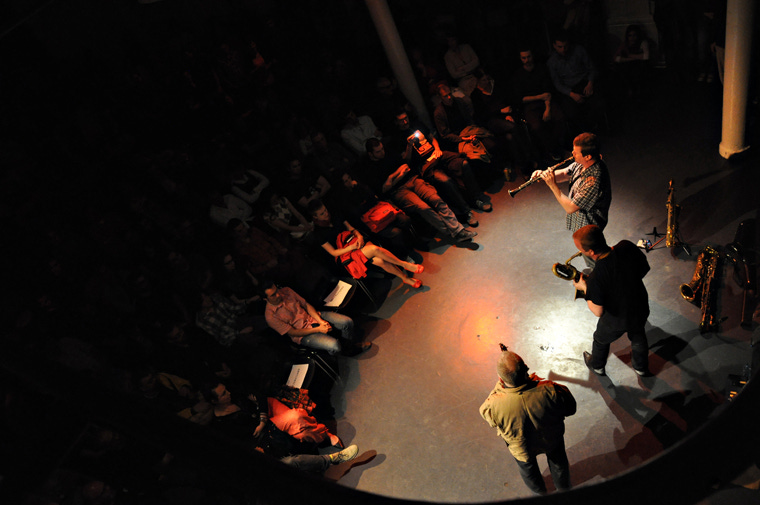
Ring Ring again, and this time an incredible trio lineup: Ken Vandermark, Mats Gustafsson, and Peter Brötzmann. A trio of grandmasters of saxophone (and clarinet), whom I knew would deliver a spectacle. It was 2012, and alongside their Ring Ring concert, they had a performance scheduled the day before at the Cultural Centre of Novi Sad (an hour’s drive from Belgrade). I decided to attend both concerts.
The first day in Novi Sad offered a somewhat unusual concert experience. The hall, with large windows along one entire side, had extremely unsuitable acoustics. This was particularly painful during passages when Vandermark played clarinet in the higher registers; at times I had to cover my ears to protect my eardrums. Very few people attended—perhaps around thirty in total. The atmosphere could hardly be described as “heated,” but the three geniuses were there, playing in top form. It was especially interesting how much consideration and respect they showed one another, rotating roles—whether providing melodic support to the current soloist or engaging in fierce interaction. And so it went for some fifty minutes without interruption.
After the concert, a friend and I approached Brötzmann, but I merely stood by while the two of them exchanged a few words. Vladimir said something about how great the concert had been, and Brötzmann briefly thanked him and replied I saw that you enjoyed it.
The following day, the performance itself was equally good, but we were given a more suitable environment. The musicians were moved from the stage into the central space in front of a mounted black curtain, the sound was excellent, and the players inspired. There were perhaps 100–150 devotees of their music in the hall. In an article for Jazzin.rs at the time, I wrote: “If in Novi Sad Brötzmann was primarily in the mood for rapid-fire bursts and deviant playing on the tárogató, here he brought far more saxophone blues into the performance, along with those anthological moments when he gradually moves from quite beautiful melodies into brutal free.”
Peter Brötzmann and Heather Leigh
Three years later, Brötzmann formed a highly unusual duo for him, with the much younger pedal steel guitarist Heather Leigh. I saw this formation at the Jazz em Agosto festival in Lisbon in 2017, in the beautiful natural surroundings of the Calouste Gulbenkian Foundation museum complex. Just as during the Belgrade performance of the Sonore trio, I had the impression that Brötzmann had delved even deeper into his “free blues.” At that point he was 76 years old, and one might assume it was no longer so easy to pour out one’s soul every night and play extensive solos in the high registers. Since we are speaking of a musician who is an institution unto himself, it feels awkward to use the language of references—but there was indeed something Ayler-esque in this constellation.
Peter Brötzmann for the Young (or: the Younger)
Returning to my initial dilemma about Machine Gun and his early works: perhaps there is also something of a generational gap involved. When I began listening to and watching Brötzmann, I was in my twenties, and it is easy for me to imagine that today’s kids might not immediately dive into the very heart of European jazz and its early days. I can imagine they might want to hear something closer to their own sensibility, something containing elements of contemporary alternative aesthetics—like the duo with Heather Leigh, for example. For me (generationally), Full Blast felt closest, though from time to time I also listened to other bands from that period, such as the Peter Brötzmann Chicago Tentet.
Be that as it may, I do not feel that I missed out on anything. I am immeasurably happy and grateful that our paths at least partially crossed; that as a young man and jazz journalist I had the opportunity to witness, live, some of the defining moments from the final chapters of the career of one of jazz’s true giants.